What is the Girrbach Reference SL articulator?
The Girrbach Reference SL articulator is a device on which casts of the upper and lower teeth are mounted and set to the values measured for that person in examinations, so that the position and movement of the jaw and the bite can be reproduced on the casts.
Among the 14 examination items, this is carried out as the "static jaw movement examination".
An articulator is an instrument that stands in for the jaw, allowing casts of the upper and lower teeth to be opened and closed and moved forwards, backwards and from side to side.
Among articulators, the Reference SL is a "fully adjustable" type: settings such as the inclination of the parts corresponding to the jaw joints can be changed to match each person's values.
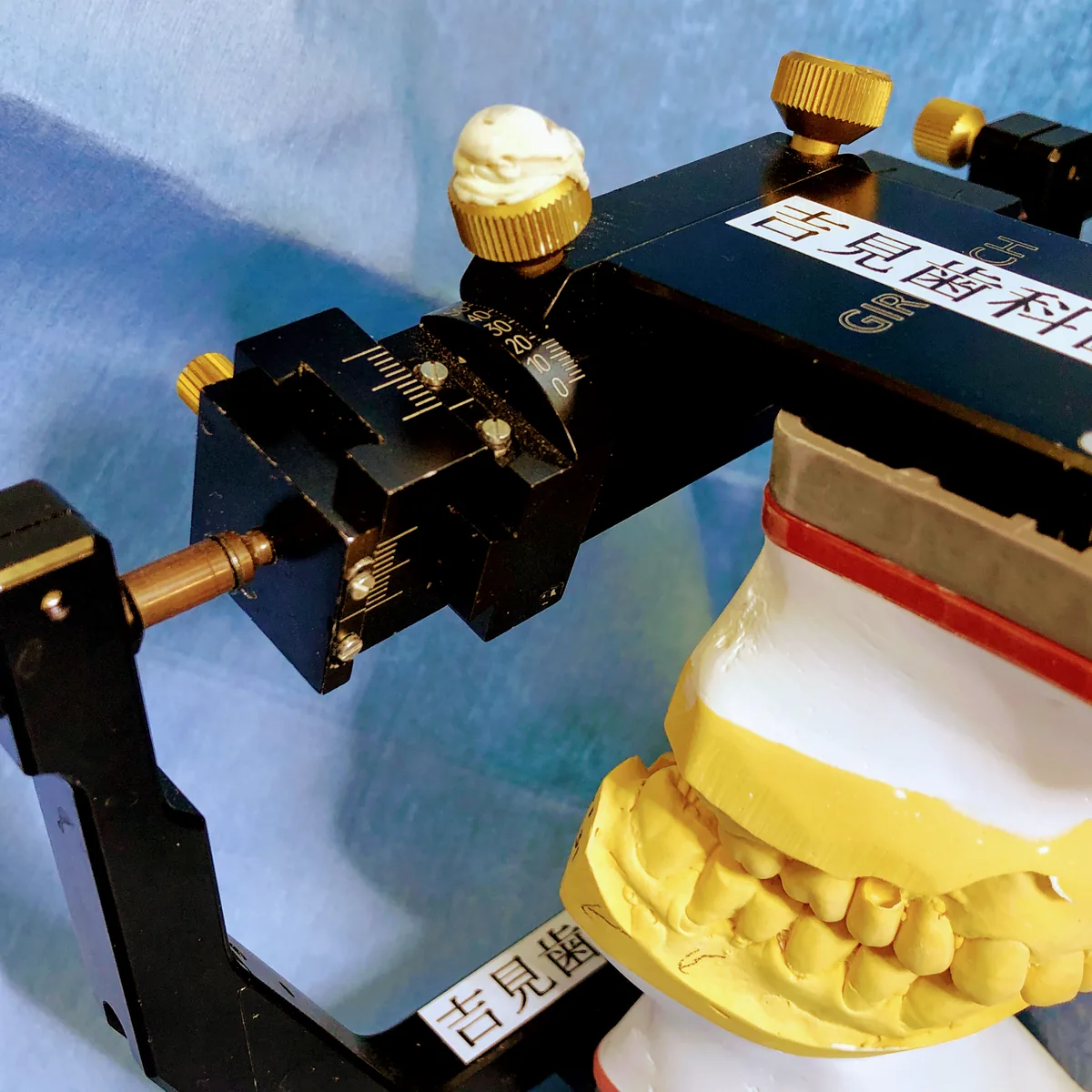
How the Reference SL articulator works
Below is a summary of the main features of the Reference SL articulator, based on the manufacturer's (GAMMA) descriptions.
| Part | How it works (manufacturer's description) |
|---|---|
| Parts corresponding to the jaw joints | Rather than a ball, these take the form of an axis based on the concept of the jaw joint's axis of rotation (the hinge axis). The inclination of the components along which the axis slides is matched, for both the forward path and the sideways path, using interchangeable parts |
| Mounting the upper cast | The upper cast is mounted to match its position relative to the axis of rotation of the jaw joints and the chosen reference plane |
| Device for setting the jaw joint position | The jaw joint position is set numerically in three directions: front to back, side to side and up and down. A position determined with Cadiax can also be set directly |
| Incisal guide table | When designing the shape of the teeth, this sets the angle at which the front teeth guide the movement of the lower jaw. There are also tables for guiding in sequence, based on Professor Slavicek's concepts |
The inclination values for the parts corresponding to the jaw joints are generally derived from the readings of a device that records jaw joint movement, and then set on the articulator.
At our clinic, we use Cadiax for that recording.
Values we set
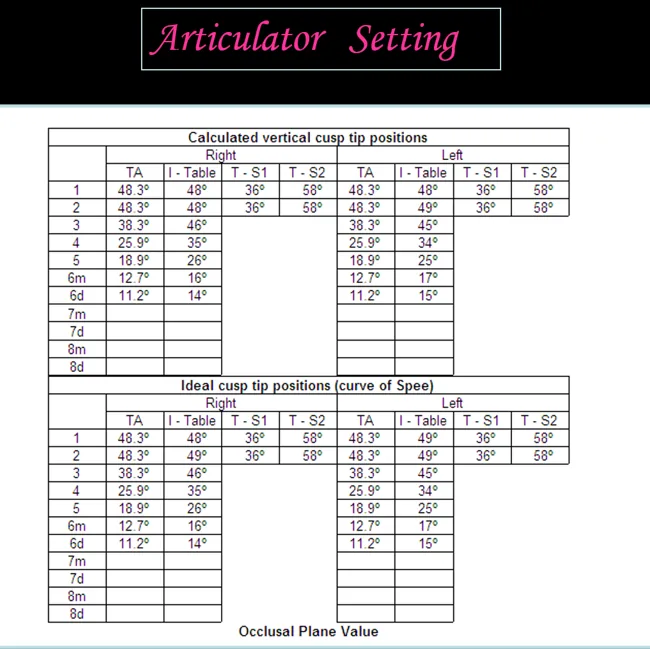
At our clinic, we set values such as the following on the articulator.
| Value set | Record it is based on |
|---|---|
| Angle of the path of the jaw joint as it moves forward (horizontal condylar inclination) | Cadiax |
| Target position of the lower jaw for treatment (therapeutic jaw position) | Calculated from three-dimensional jaw joint records and other data |
| Angle of the slopes of each tooth (cusp inclination), and their direction and distance | Calculated from the jaw joint records and the therapeutic jaw position |
| Angle at which the teeth guide the movement of the lower jaw (guidance angle) | Measured in advance, or calculated |
The table in the photo lists the angles for each tooth as numerical values.
Because skeletal structure and jaw movement differ from person to person, we set that person's values one by one.
How the angle of each tooth is determined is explained on the sequential occlusion page.
Using the same reference plane
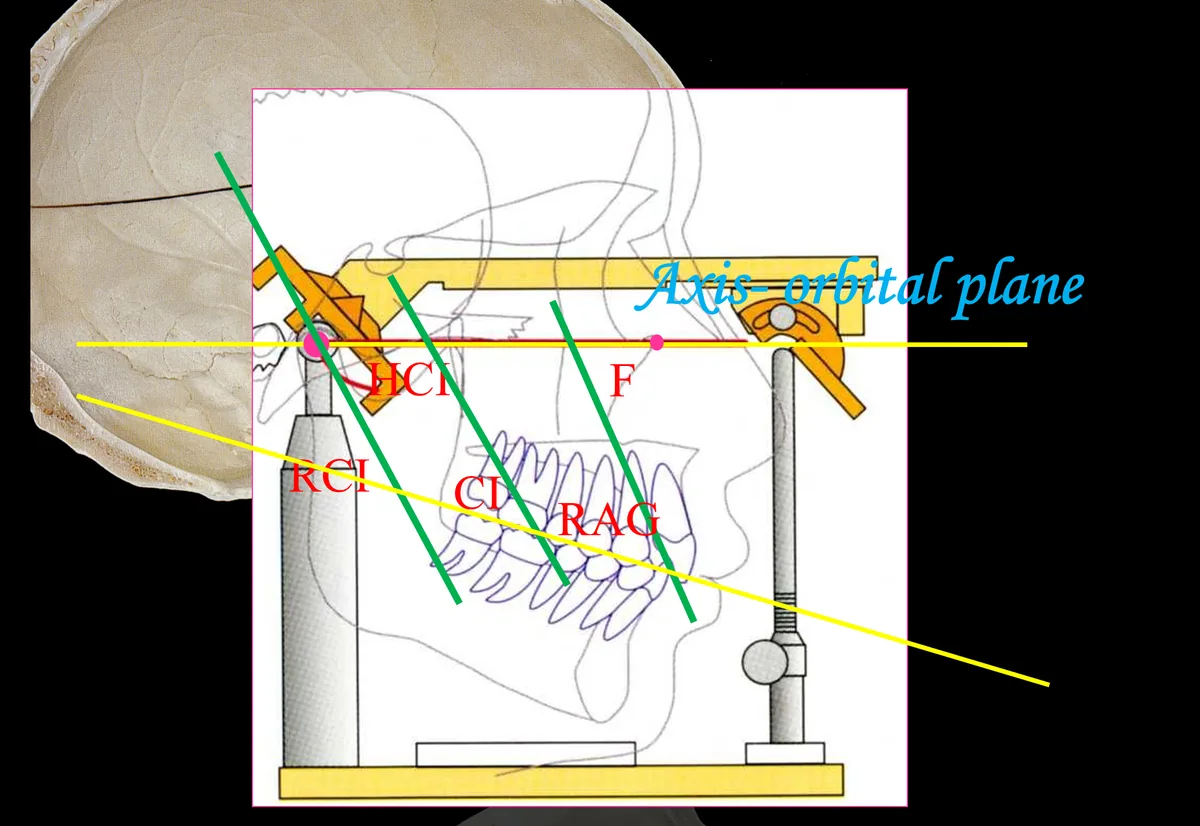
The values for the skeleton, the jaw joints and the teeth are all measured from the same reference plane (the axis-orbital plane).
This means the measured values can be represented on the articulator as they are.
The reference plane is explained on the lateral cephalometric analysis page.
Setting the jaw joint position in three dimensions
The jaw joints move in three dimensions.
For this reason, the target jaw joint position for treatment is also determined in three directions: front to back, side to side and up and down.
At our clinic, we attach a device called a condylar repositioning variator to the articulator.
It is a device for setting, on the casts, the target jaw joint position calculated from the examination values (see the photo at the top of this page).
Why we use the Reference SL articulator
To reproduce measured values on the casts
Looking into the mouth does not show how the left and right jaw joints move.
So at our clinic we record jaw joint movement, the skeleton, each individual tooth and tooth contact during sleep, set those values on the articulator, and reproduce jaw movement and the bite on the casts.
We value this idea: "Measure first. Then reproduce the measured values on the casts."
Because we want to set each person's own values as they are
Both the skeletal structure of the jaws and the way the jaw moves differ from person to person.
Using an articulator on which the values measured from that person can be set one by one, we work out a bite that matches that person's jaw movement.
Because we want to capture the jaw joint position as coordinates
The direction of the forces acting on the jaw joints and the surrounding tissues is affected by how the back teeth meet.
For this reason, at our clinic we capture the jaw joint position as front-to-back, side-to-side and up-and-down coordinates, and check its relationship with the bite of the back teeth on the casts.
To give each tooth its own angle
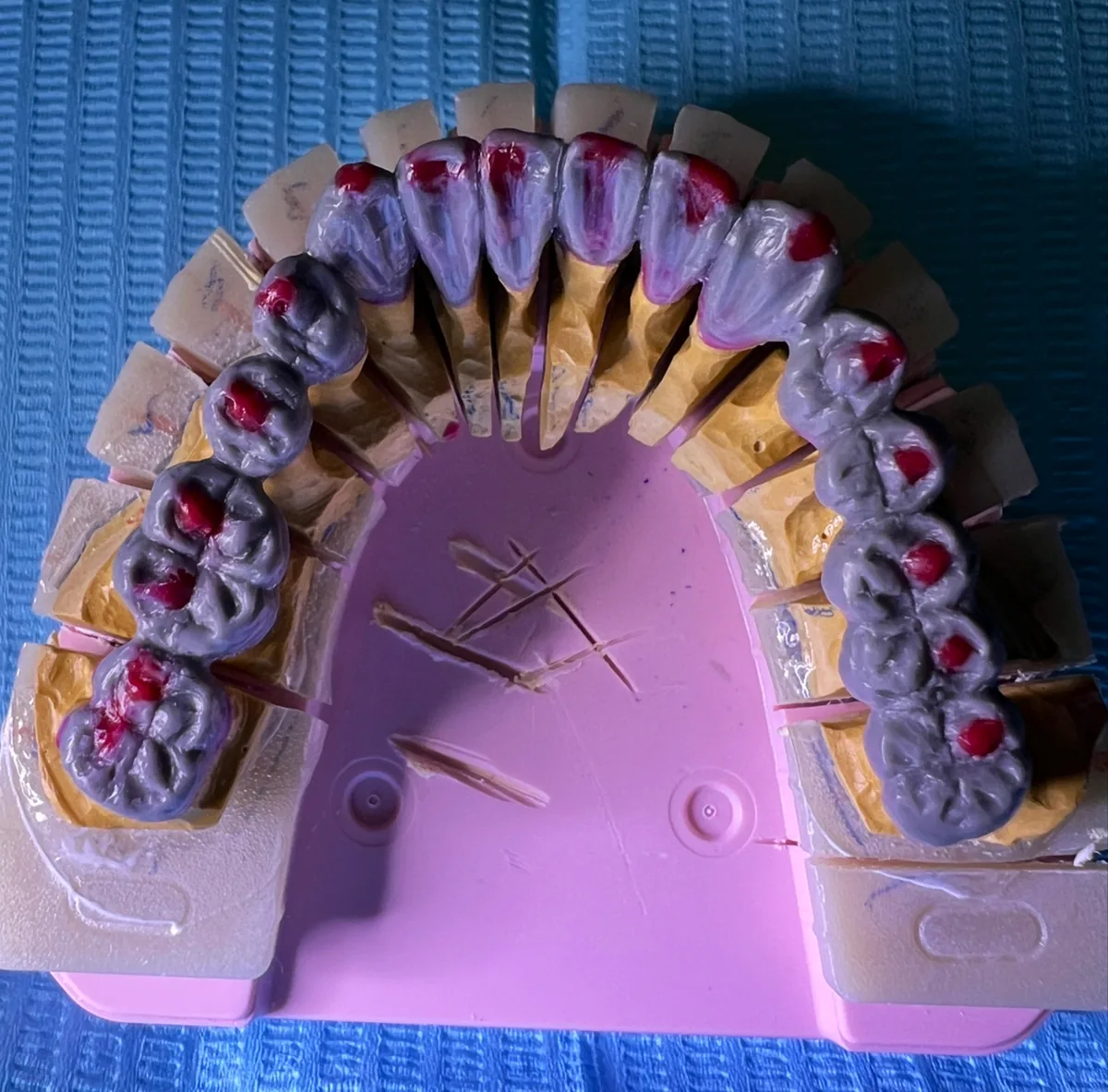
Each tooth requires a different angle.
So at our clinic we mount a sectioned cast, from which each tooth can be removed individually, on the articulator and give each tooth its angle.
In practice at our clinic
From measurement to the finished form
The articulator is used within the following sequence.
- Measuring jaw joint movement: with Cadiax, we record jaw joint movement in a relaxed state. When making dentures, we also record the traces of lower jaw movement while clenching, using intraoral gothic arch tracing.
- Measuring the skeleton and the teeth: we examine the skeleton with lateral cephalometric analysis, and each tooth and the inclination of the biting surfaces with a sectioned cast and occlusal plane measurement.
- Looking at tooth contact during sleep: where needed, we use BruxChecker.
- Reproducing on the casts: we set the measured values, and the values calculated from them, on the articulator, mount the upper and lower casts, and check the position and movement of the jaw and the bite.
- Giving it form, and measuring again: the positions and angles decided on the casts are given form as appliances, provisional restorations, dentures or crowns. After these are placed in the mouth, we record jaw movement and tooth contact again to check.
Transferring what was decided on the casts to the mouth
Positions and angles decided on the articulator can be used in treatment only once they have been transferred to the mouth.
When transferring them to provisional restorations, we decide on reference points and bring what was set on the articulator back into the mouth in line with those points.
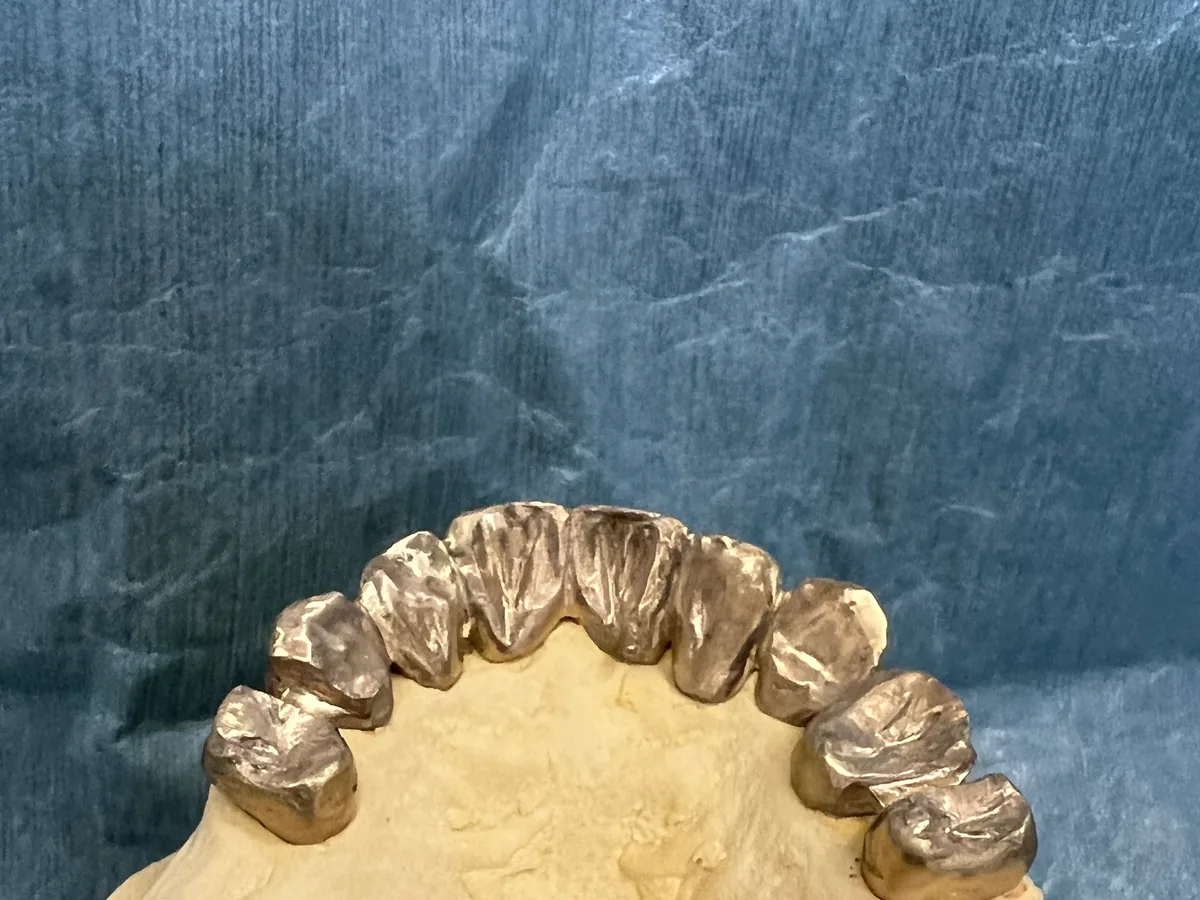
For appliances, the shape decided on the articulator is expressed in wax, transferred into metal by casting, and then fitted in the mouth.
The step of expressing the shape in wax is described on the wax-up page, and the step of transferring it into metal on the casting page.
Appliances for TMD
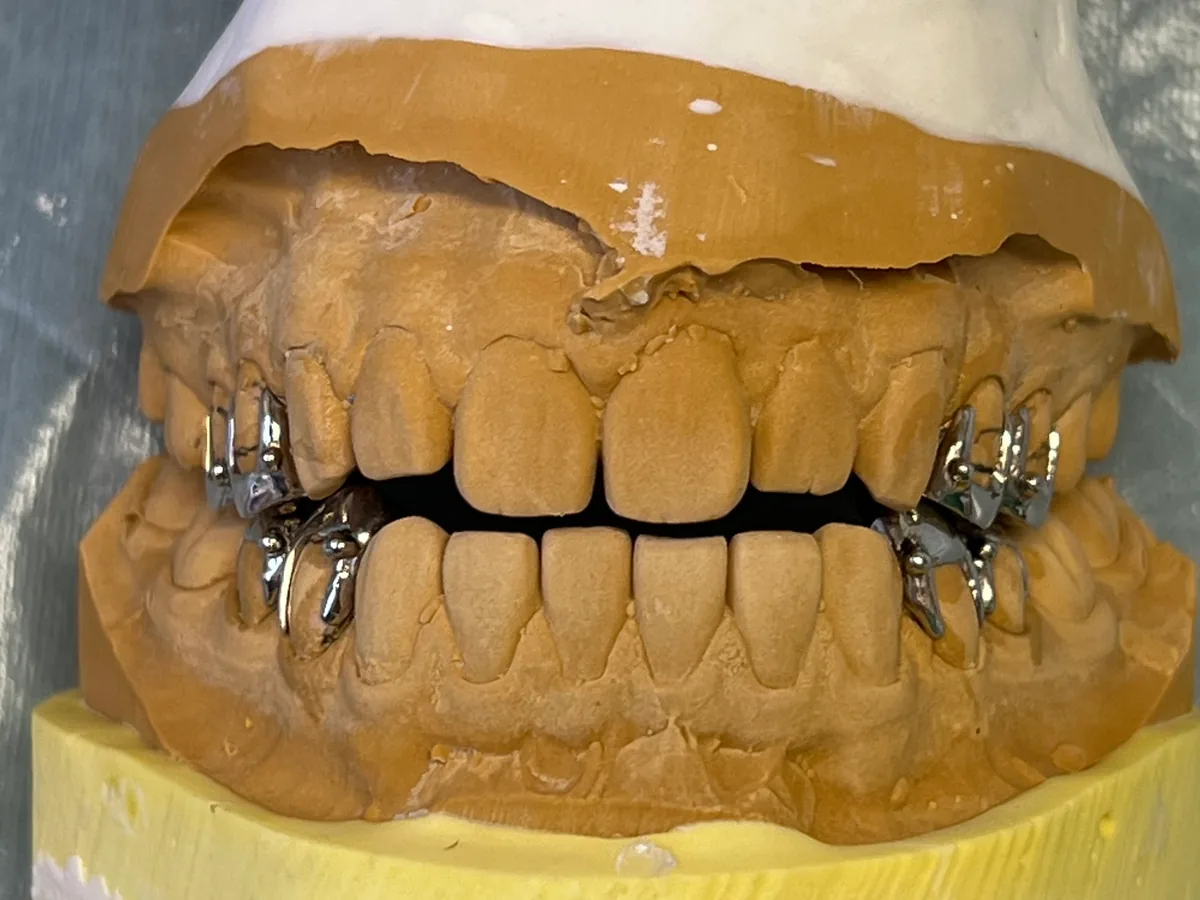
In TMD, the target jaw position for treatment is expressed in appliances such as metal overlays, metal splints and provisional restorations.
These are appliances for checking that position and bite in the actual mouth.
The shape of the appliance is decided on the articulator, combining the three-dimensional jaw joint records with information on the skeleton and the bite.
Orthodontics
In orthodontic treatment, too, we use the analysis of the bite on the articulator, together with the Cadiax records and the skeletal analysis, as a basis for moving treatment forward.
Crowns
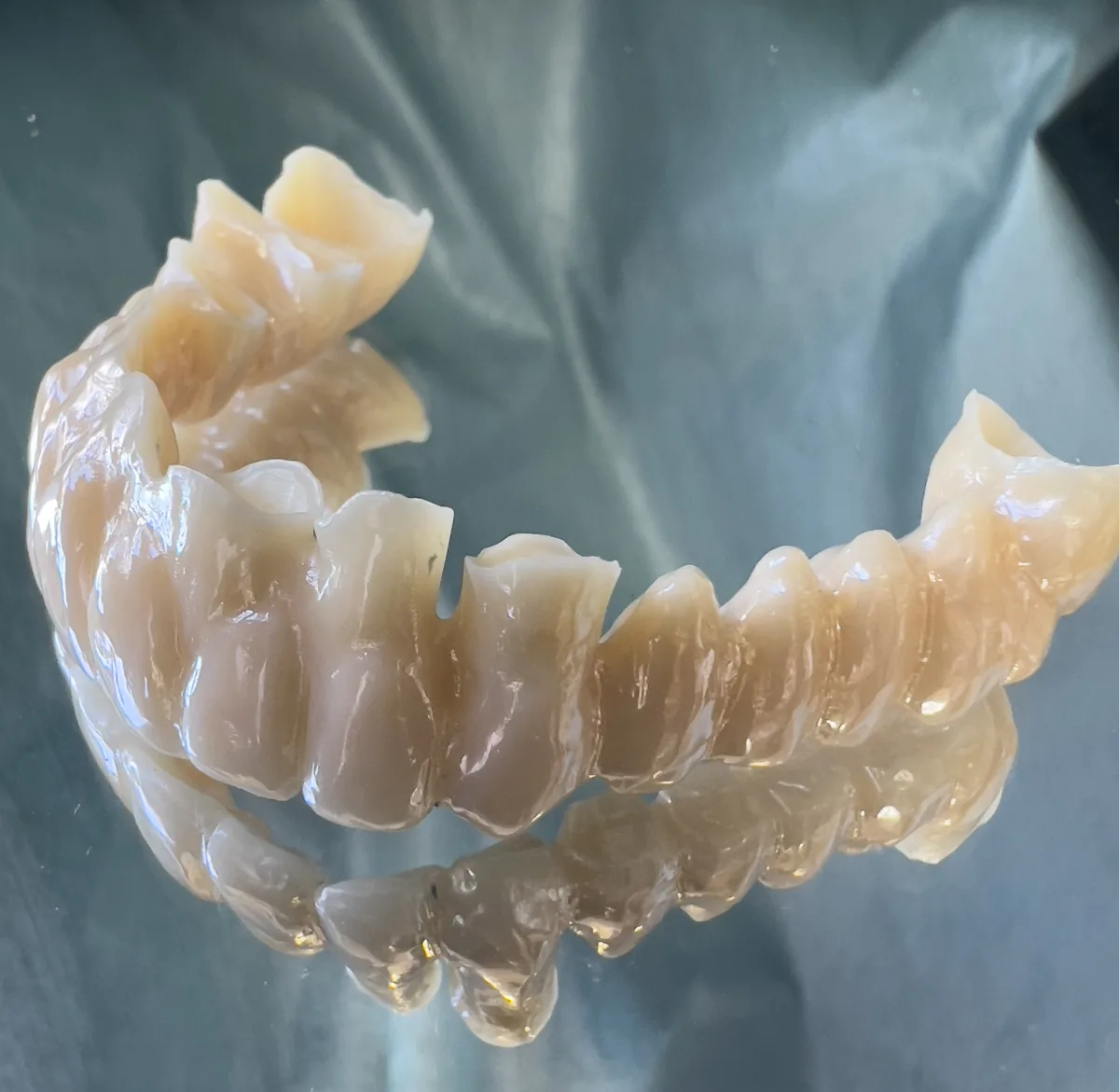
When many teeth are restored with crowns at the same time, we measure or calculate the angle of the jaw joint paths and the angle at which each tooth guides the lower jaw before fabrication, and decide the shape on this articulator.
Photos: crowns whose shape was decided on the articulator
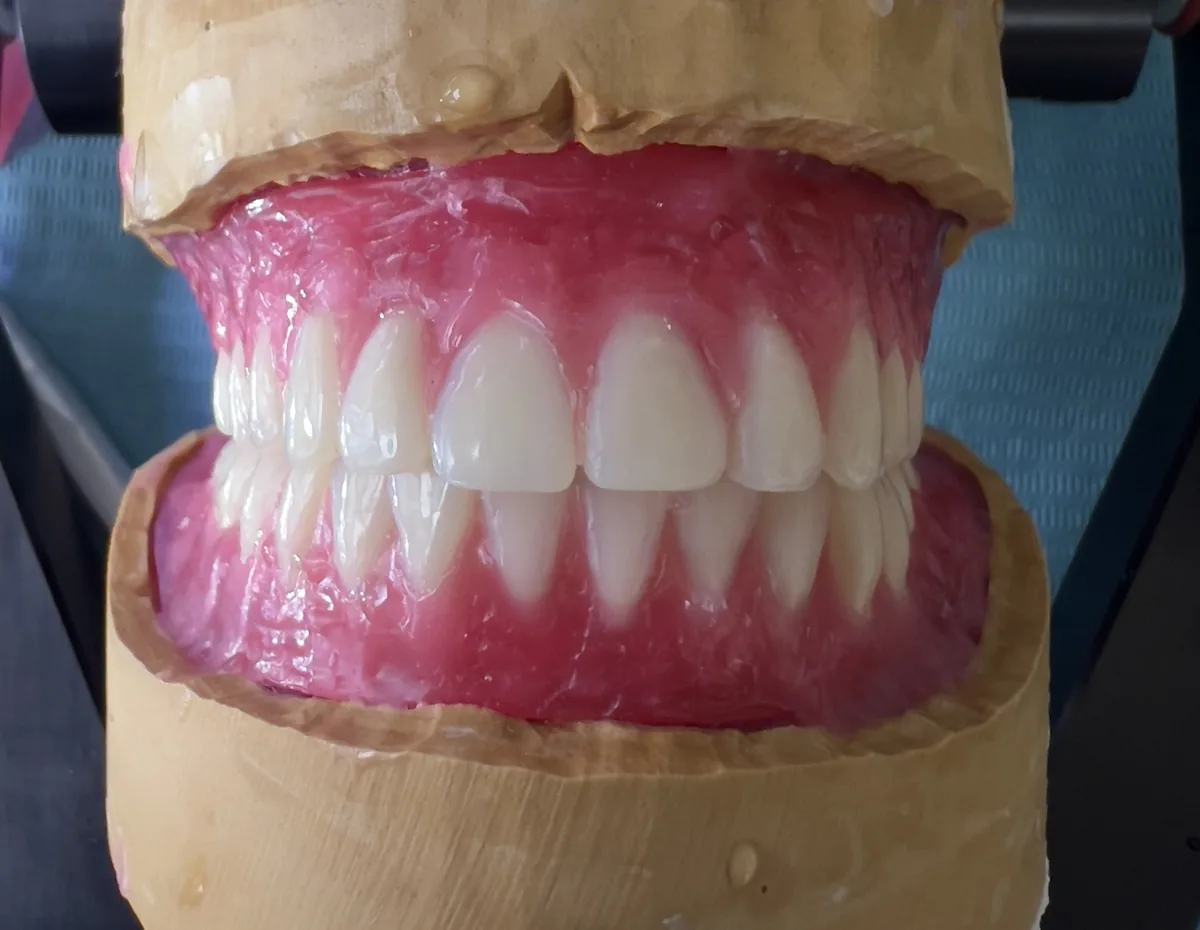
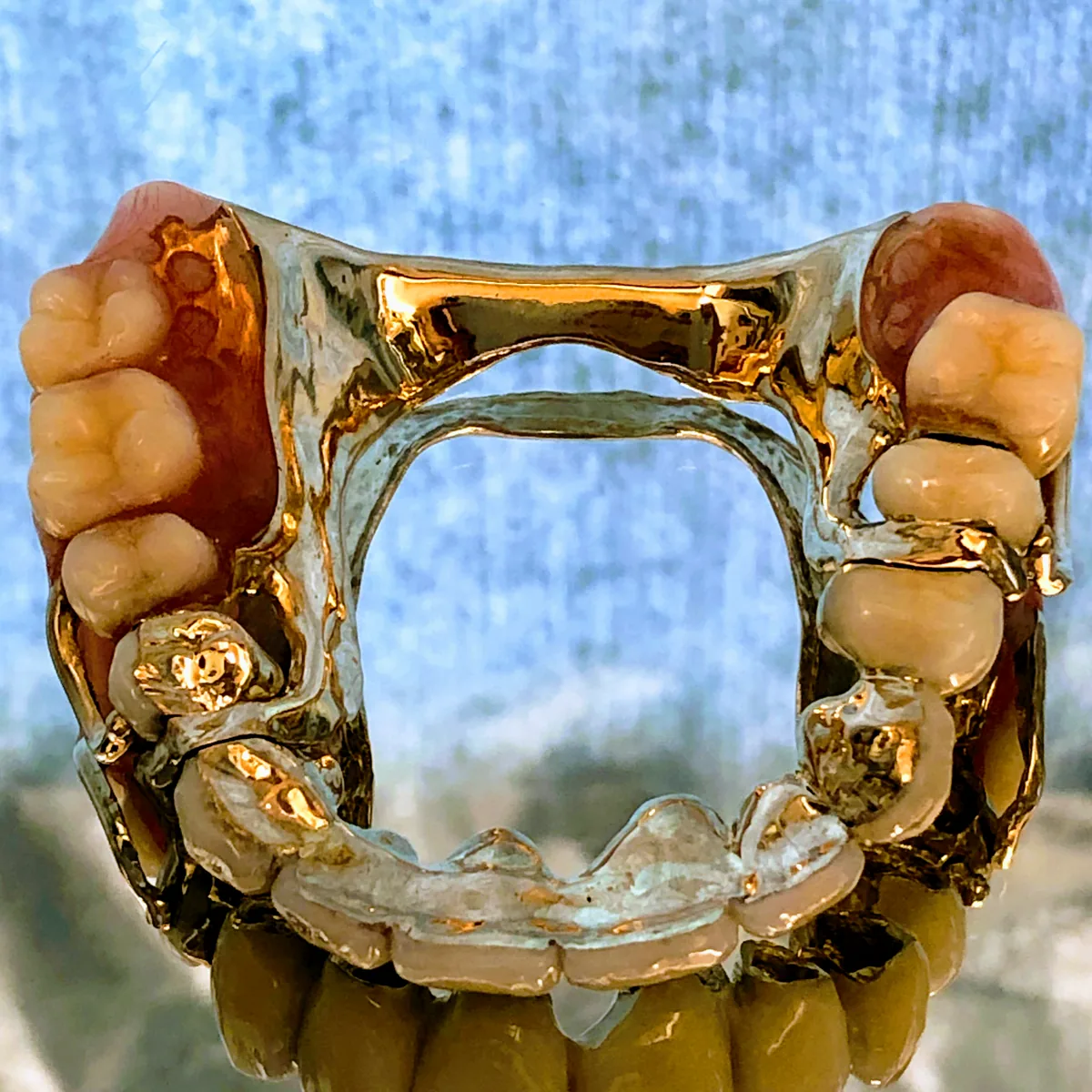
Dentures
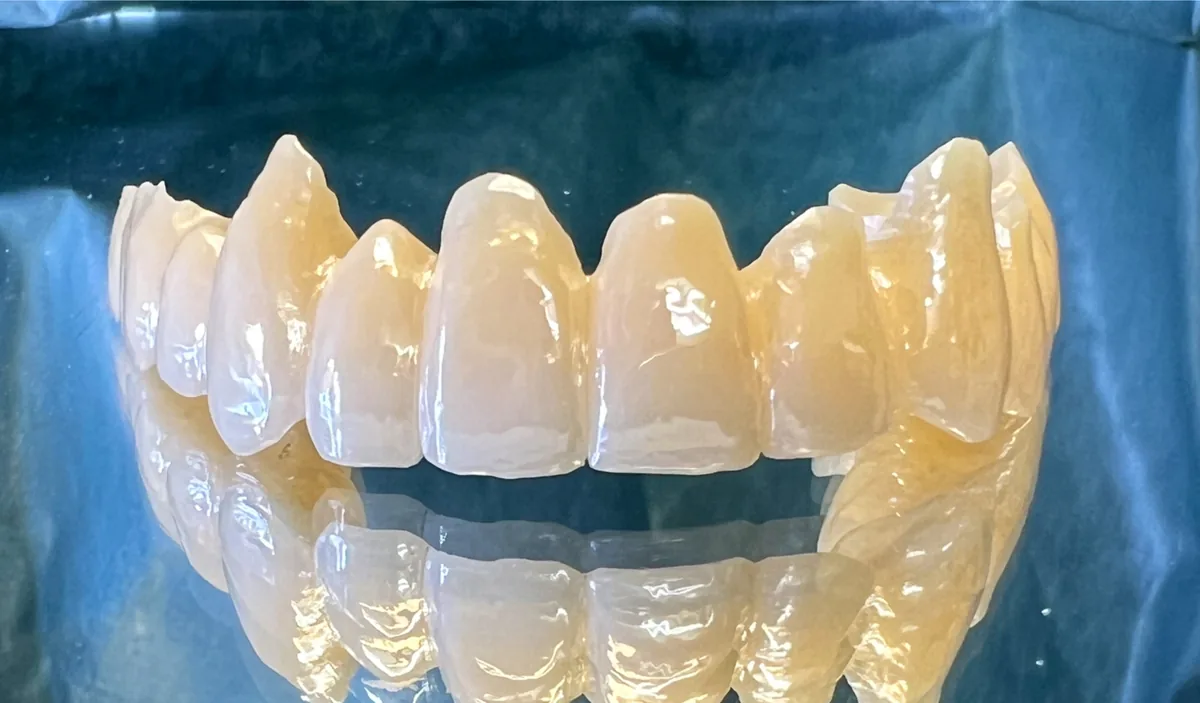
For dentures, where to place the artificial teeth and what inclination to give the biting surfaces are decided on the articulator.
Partial dentures, too, are designed with the aim that the bite built up on the articulator also fits in the mouth.
How the artificial teeth are arranged is explained on the artificial tooth arrangement page.
Photos: dentures
What the Reference SL articulator can and cannot do
What the articulator can do
- Set the values measured for that person in examinations on casts of the upper and lower teeth
- Check, on the casts, the relationship between the position and movement of the jaw and the way the teeth meet
- Set the target jaw joint position for treatment in three directions
- Determine the angle of each individual tooth
- Transfer positions and shapes decided on the casts to provisional restorations, appliances, dentures and crowns
What it cannot do, and how we compensate
| What it cannot do | How we compensate |
|---|---|
| Measuring jaw joint movement | Cadiax |
| Measuring the traces of lower jaw movement while clenching | Intraoral gothic arch tracing (when making dentures) |
| Measuring the skeleton | Lateral cephalometric analysis |
| Finding out how the teeth make contact during sleep | BruxChecker |
| Finding out how the gums (mucosa) supporting a denture change shape under force | Mucosal records |
| Checking whether the bite decided on the casts fits in that person's mouth | Checking while provisional restorations and appliances are in use (provisional restorations and provisional dentures) |
Frequently asked questions
- Is an articulator placed in the mouth?
No. It is an instrument on which casts of the upper and lower teeth are mounted.
Positions and shapes decided on the articulator are transferred to provisional restorations or appliances and checked in the mouth.
- What values are set on the articulator?
Values such as the angle of the path of the jaw joints as they move forward, the target position of the lower jaw for treatment, and the angle of each tooth.
We use values that are measured, or calculated, from records such as Cadiax and lateral cephalometric analysis.
- What does the condylar repositioning variator do?
It is a device that sets, on the casts, the target jaw joint position for treatment calculated from the examination values, in three directions: front to back, side to side and up and down.
It is used attached to the Girrbach Reference SL articulator.
- If something is made on the articulator, does it still need adjusting in the mouth?
After fitting, we still make adjustments as needed while checking the condition of your mouth.
Whether the bite decided on the casts is right is checked while provisional restorations or appliances are in use.
- Is it also used when making dentures and crowns?
Yes. The positions of the artificial teeth, the inclination of the biting surfaces and the angle of each tooth in crowns are decided on the articulator.
Related technologies and treatments
- Cadiax
- Lateral cephalometric analysis
- Sequential occlusion
- Wax-up
- All the technologies we use
- Temporomandibular disorders & orthodontic treatment that avoids extractions where possible: examinations
- Dentures (precision dentures): examinations
- Thorough diagnosis before treatment (14 examination items)
Sources we referred to
For the general explanations (how the articulator works and the device for setting the jaw joint position), we referred to the following published sources. What we describe about our own methods is based on the director's posts and explanations.
- GAMMA Dental, "Articulation" (manufacturer)
- GAMMA Dental, "Instrumental diagnostics" (manufacturer)
- GAMMA Dental, "Digital Diagnostic" (manufacturer)
- Ahangari AH, et al. Evaluation of the Cadiax Compact II accuracy in recording preadjusted condylar inclinations on fully adjustable articulator. J Contemp Dent Pract. 2012;13(4):504-508
- Lewandowska A, et al. Sagittal Condylar Inclination and Transversal Condylar Inclination in Different Skeletal Classes. J Clin Med. 2022;11(9):2664
Consultations and enquiries
Gibakai Medical Corporation
Yoshimi Dental Clinic
Square 2, Room 302 (third floor)
1-29-1 Tsukushino, Machida,
Tokyo 194-0001, Japan
TEL 042-795-1359 FAX 042-795-1398
Clinic days: Mon · Tue · Thu · Fri
10:00–13:00 / 14:30–18:00
A first visit begins with a first consultation (a private, non-insured service; 30 minutes to 1 hour) for examination and diagnosis. Questions about a diagnosis you received elsewhere are also covered within it.
In an emergency, such as being unable to chew or having severe symptoms, please call us on 042-795-1359 to discuss it.