What is BruxChecker?
BruxChecker is a very thin sheet that is worn on the teeth during sleep to record which teeth made contact, and how, during tooth grinding in sleep.
One side of the sheet is coloured red, and where the teeth rub, the colour comes off.
Among our examination items, this corresponds to the "nocturnal jaw movement examination".
"Brux" is a word that refers to tooth grinding (bruxism).
Bruxism means unconsciously grinding the teeth together or clenching them at times other than eating.
BruxChecker was devised by Professor Sadao Sato of Kanagawa Dental University and colleagues.
The sheet is 0.1 mm thick before it is formed.
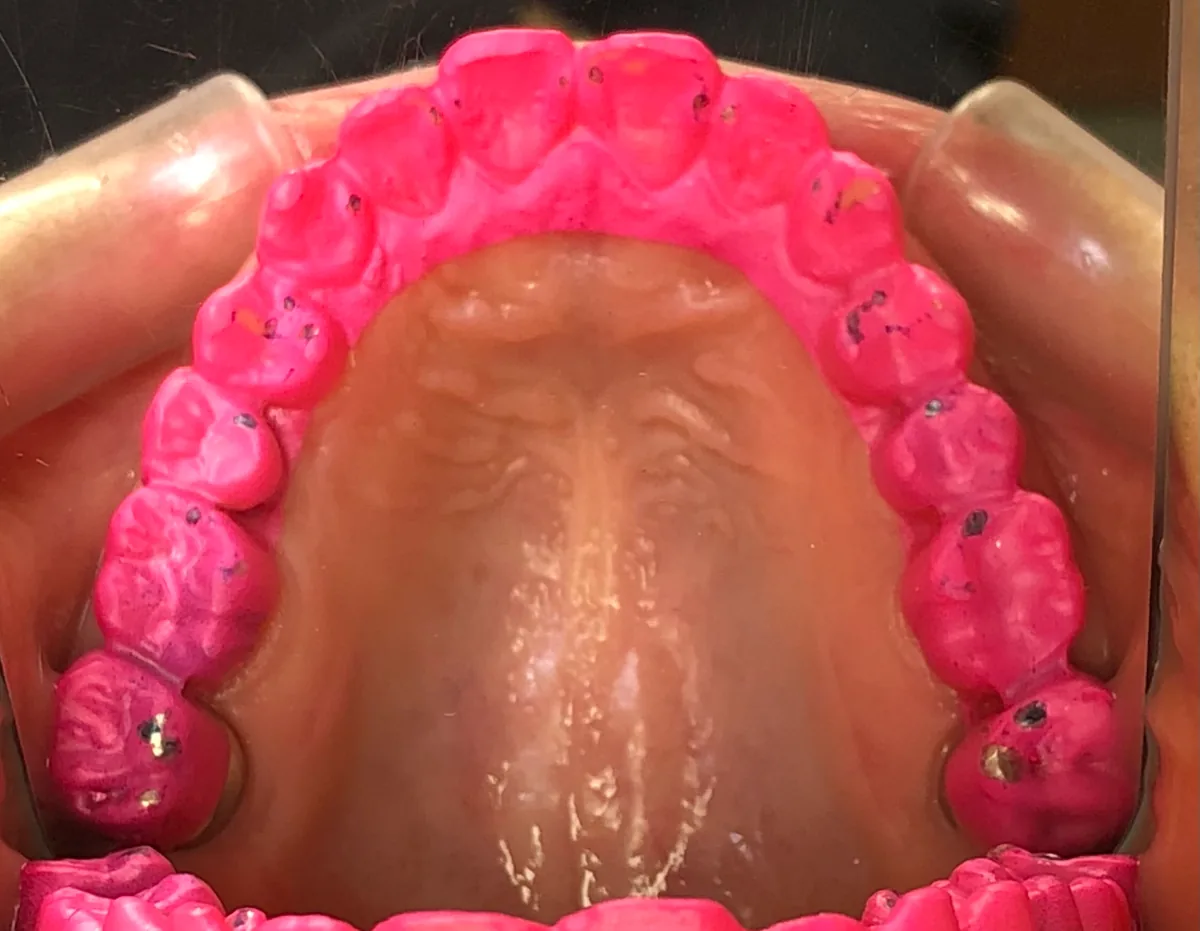
How BruxChecker works
Based on the distributor's description, we explain the general way it is used in four steps.
- Making a cast: impressions of the teeth are taken, and a cast of the dental arch is made in hard dental stone.
- Shaping the sheet to the teeth: the sheet is heated and pressed onto the cast so that it takes the shape of the teeth. The red side faces the opposing teeth.
- Wearing it to sleep: the finished sheet is worn on the teeth when going to sleep. It is generally said that it should be worn for at least one night. There is also a method of wearing it alternately, two nights on the upper teeth and two nights on the lower teeth.
- Looking at the rubbed marks: after the sheet is removed, the areas where the colour has come off are examined. They show which teeth rubbed, in which direction and over how large an area.
Rubbing patterns
In general, rubbing is classified into patterns according to which tooth the contact extends to on the side the lower jaw moves towards when it is moved sideways.
| Pattern name | Teeth in contact when the jaw moves sideways |
|---|---|
| IC | Incisors and canine |
| ICP | Incisors, canine and premolars |
| ICPM | Incisors, canine, premolars and molars |
The letters are the initials of Incisor (the front teeth), Canine (the third tooth from the front), Premolar (the two teeth behind the canine) and Molar (the large back teeth behind the premolars).
Along with this, it is checked whether the teeth on the side opposite to the one the jaw moves towards are rubbing.
At our clinic, too, we sometimes describe night-time rubbing with pattern names such as these.
How it differs from articulating paper (red and blue paper)
Tooth contact in the bite is generally checked by having the patient bite on articulating paper.
Articulating paper is a thin coloured paper that leaves colour where the teeth touch when biting.
What articulating paper shows is the contact when the patient bites while awake.
The director believes that, because the brain regulates biting while we are awake so that we do not bite too hard, strong contact during sleep is difficult to detect with articulating paper.
The distributor's material also states that the contacts found at a clinical examination differ from the contacts during tooth grinding.
| Point of comparison | Articulating paper | BruxChecker |
|---|---|---|
| When it is recorded | While awake (the patient bites in the treatment room) | During sleep |
| How it is recorded | Colour is left where the teeth touch | The colour comes off where the teeth rub |
| What it can tell us | Where the teeth touch when biting | Which teeth rubbed, and how, during tooth grinding |
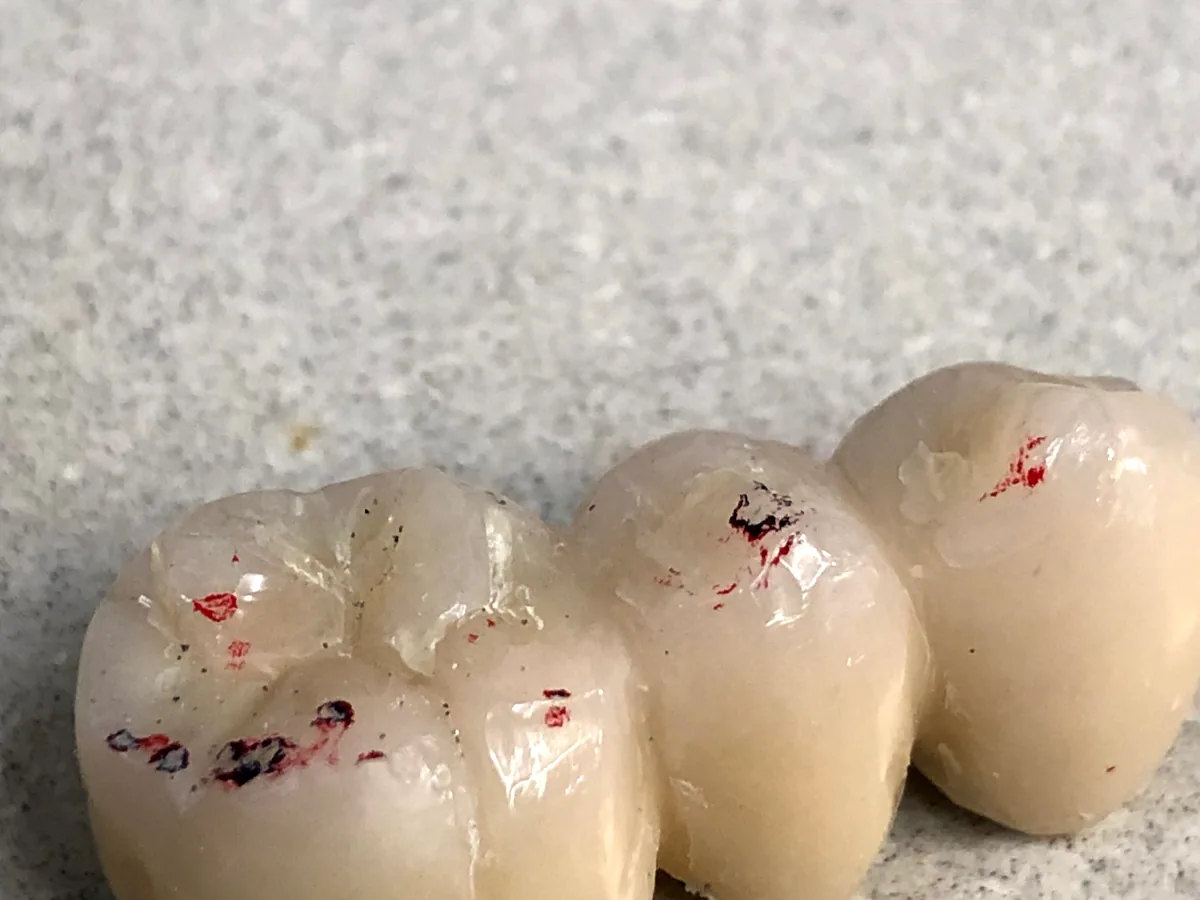
Why we use BruxChecker
Because the teeth tend to make strong contact during sleep
The director believes that the upper and lower teeth come into strong contact more during tooth grinding in sleep than while we are awake.
While we are awake, we can control the force of the jaw at will.
While we are asleep, we cannot.
For this reason, we check not only the daytime bite but also the night-time bite.
To consider the bite from both daytime and night-time records
When we consider the bite, we combine records such as skeletal records, records of the three-dimensional movement of the jaw joints and records of tooth grinding during sleep.
Of these, BruxChecker provides the "during sleep" record.
To see whether the adjusted bite is maintained at night too
We also use it during and after treatment, to check whether the bite adjusted through treatment is also maintained during sleep.
The director places importance on the number and strength of contacts during sleep being even on the left and right, and on the teeth separating one after another from the back when the jaw moves sideways.
For a bite in which the teeth separate one after another from the back, please see the sequential occlusion page.
Connection with the research of the professor who devised it
From 2002 to 2017, the director took part in research on occlusion, brain function and stress under Professor Sadao Sato and colleagues, who devised BruxChecker.
In practice at our clinic
When we use it
We use it as needed in examinations for temporomandibular disorders (TMD) and orthodontic treatment.
In the "orthodontic work-up (bite examination)" in the fee table, it corresponds to the examination item "nocturnal jaw movement examination".
In periodontal disease examinations, too, we may use it where needed to examine the bite.
Before, during and after treatment
We use BruxChecker several times over the course of treatment.
- Before treatment: in the detailed examinations, we record tooth contact during sleep.
- During treatment: we also record while the bite is being adjusted with appliances or orthodontic treatment, to follow changes in contact.
- After treatment: we check whether the adjusted bite is also maintained during sleep.
- Even after treatment has ended: where needed, we continue this check.
What we look at in the marks on the sheet
From the marks on the sheet, we check points such as the following.
- Whether contact is concentrated on particular teeth
- Where the surfaces that guide the teeth (guiding surfaces) are when the jaw moves sideways
- Where the surfaces that guide the teeth are when the jaw moves backwards
- How the points that give vertical support when biting (vertical stops) are distributed
- Whether there is a difference between left and right in the number or strength of contacts
- Rubbing patterns
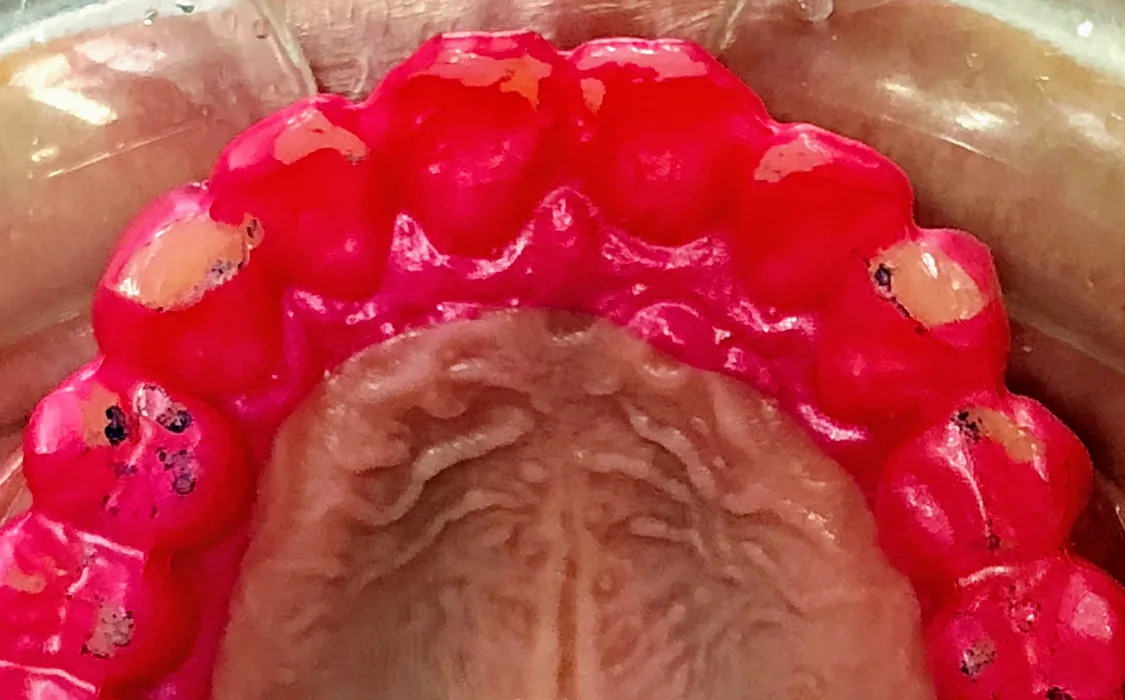
Together with other records
We do not decide the treatment plan from BruxChecker marks alone.
We consider them together with records of the skeleton, jaw joint movement and the bite while awake.
Treatment duration, number of visits, fees and risks → Fees
What BruxChecker can and cannot tell us
What BruxChecker can tell us
- Which teeth made contact during sleep, and how
- The surfaces that guided the teeth when the jaw moved sideways or backwards
- The distribution of the vertical support points
- The rubbing pattern, and differences between left and right
- Changes in contact before, during and after treatment
What it cannot tell us, and how we compensate
| What it cannot tell us | How we compensate |
|---|---|
| Jaw joint movement | Cadiax |
| Skeletal structure (relationship between the upper and lower jaws, facial height) | Lateral cephalometric analysis |
| Contact when biting while awake | Checked with articulating paper (red and blue paper) |
| The bite on casts, based on the values measured in examinations | Girrbach Reference SL articulator |
BruxChecker, on the other hand, is a sheet that keeps the marks left by rubbing.
The following cannot be determined from this sheet alone.
- The cause of tooth grinding
- How often tooth grinding occurs, or how much muscle force is involved (these cannot be measured directly)
- Clenching movements in which the teeth are pressed together and held still, without rubbing
The distributor's material also states that the cause cannot be determined with this sheet.
One study reported that the area where the colour had come off was related to the number of episodes of the grinding type, in which the teeth are rubbed together, but that no relationship was seen with the clenching type.
It has also been reported that the number of nights the sheet is worn changes the extent of the marks and how well it can distinguish whether tooth grinding is present.
Some studies also report that, as a test for distinguishing whether tooth grinding is present, its accuracy is limited compared with the standard method.
At our clinic, we use BruxChecker marks, together with other records, to see how the teeth make contact during sleep.
Frequently asked questions
- How is it different from checking with articulating paper?
Articulating paper shows the contact when you bite while awake.
BruxChecker is worn during sleep and records the contact during tooth grinding.
- When is it used?
We use it as needed in examinations for temporomandibular disorders (TMD) and orthodontic treatment.
We use it not only before treatment but also during and after it, to check changes in contact.
- Does wearing BruxChecker stop tooth grinding?
No. BruxChecker is a sheet for recording tooth contact during sleep.
It is not an appliance for stopping or reducing tooth grinding.
- Which examination is it part of?
It corresponds to the "nocturnal jaw movement examination" within the "orthodontic work-up (bite examination)" in the fee table.
The approximate number of visits (2–3) is for this examination as a whole.
- Is it also used after treatment has finished?
Yes. Where needed, we continue checking to see whether the bite adjusted through treatment is also maintained during sleep.
Related technologies and treatments
- Cadiax
- Sequential occlusion
- Girrbach Reference SL articulator
- Temporomandibular disorders & orthodontic treatment that avoids extractions where possible: examinations
- Periodontal disease
- The importance of biting force
- Thorough diagnosis before treatment (14 examination items)
- All the technologies we use
Sources we referred to
For the general explanations (how BruxChecker works, rubbing patterns and limitations), we referred to the following published sources. What we describe about our own methods is based on the director's posts and explanations.
- SCHEU-DENTAL, "BRUX CHECKER®" (distributor's brochure; PDF)
- GAMMA Dental, "Instrumental Diagnostics" (manufacturer)
- Onodera K, et al. The use of a bruxchecker in the evaluation of different grinding patterns during sleep bruxism. Cranio. 2006;24(4):292-299
- Park BK, et al. Relationship of tooth grinding pattern during sleep bruxism and temporomandibular joint status. Cranio. 2008;26(1):8-15
- Hokama H, et al. The effectiveness of an occlusal disclosure sheet to diagnose sleep bruxism: A pilot study. Cranio. 2019;37(1):5-11
- Besirevic-Bulic F, et al. Wear Management of Colored Foils for the Assessment of Sleep Bruxism Patterns. Diagnostics. 2023;13(2):172
- Yakkaphan P, et al. Accuracy of the BruxChecker oral device for the assessment of sleep bruxism. Br Dent J. 2026
- The Academy of Prosthodontics, "The Glossary of Prosthodontic Terms, Ninth Edition". J Prosthet Dent. 2017;117(5S) (PDF)
Consultations and enquiries
Gibakai Medical Corporation
Yoshimi Dental Clinic
Square 2, Room 302 (third floor)
1-29-1 Tsukushino, Machida,
Tokyo 194-0001, Japan
TEL 042-795-1359 FAX 042-795-1398
Clinic days: Mon · Tue · Thu · Fri
10:00–13:00 / 14:30–18:00
A first visit begins with a first consultation (a private, non-insured service; 30 minutes to 1 hour) for examination and diagnosis. Questions about a diagnosis you received elsewhere are also covered within it.
In an emergency, such as being unable to chew or having severe symptoms, please call us on 042-795-1359 to discuss it.