The respective roles of research and clinical care
This page presents our research activities, papers and conference presentations. Research exploring the link between occlusion and the autonomic nervous system does not indicate the cause of an individual patient’s symptoms or the effect of their treatment. Please read about the subjects, conditions and limitations of each study together with the linked original papers.
Research activities Research Activities

From 2003 to 2016, I was engaged in research on "occlusion, brain function and stress" under Professor Rudolf Slavicek of the University of Vienna and Professor Sadao Sato of Kanagawa Dental University. Since 2012 I have served as a lecturer at the University of Vienna summer school, where I teach dentists from various countries. This year, too, I am determined to report to everyone the results of research from my current laboratory (Professor Yumie Ono, Department of Electronics and Bioinformatics, School of Science and Technology, Meiji University). The photographs show a commemorative plaque from participating in Professor Slavicek's marathon course and my certificate of lecture at the University of Vienna.
Publications
Advanced Biomedical Engineering
I would like to report that my research paper has been published in the international academic journal Advanced Biomedical Engineering.

Paper title: "Autonomic Responses to Tooth Grinding under Different Dental Occlusal Conditions"
Read the paper (in English)
It has long been suggested that a poor bite may lead to general ill health and mental stress, but the detailed mechanism remained a mystery. In this study, 17 participants performed tooth grinding under two conditions, an "ideal occlusion" and an "inappropriate occlusion," and we investigated in detail how the body's responses changed.
This paper is a study of the autonomic responses when tooth grinding is performed under different occlusal conditions. Its findings were obtained under the study conditions and do not indicate the effect of treatment for an individual patient.
We are deepening our understanding of occlusion and jaw function while examining the findings from our research. For details of the study, please see the original paper.
Conference presentations and lectures
Since 2012, I have given presentations and lectures at conferences and universities in Japan and abroad (newest first). Research findings are obtained under defined conditions. They do not indicate the cause of an individual patient's symptoms or the effect of their treatment.
Paper (Advanced Biomedical Engineering)
“Autonomic Responses to Tooth Grinding under Different Dental Occlusal Conditions”
Original article (first author; co-authors: Tatsuya Suzuki, Yumie Ono)
For the content of the paper, please see the Publications section of this page.
Biomedical Engineering Symposium 2025 (Japanese Society for Medical and Biological Engineering)
“Autonomic Responses to Dental Malocclusion Assessed by Blue Light-Evoked Pupillary Light Reflex”
Poster presentation and short presentation (D-10, first author)

Japan Prosthodontic Society, 130th Commemorative Scientific Meeting, Symposium 8 “Update on Occlusion Theory”
“The Importance of Objective Examination and Diagnosis in Occlusal Reconstruction and the Potential of Occlusal Treatment”
Symposium speaker
On June 20, 2021, I took part as a speaker in the symposium “Update on Occlusion Theory” (co-hosted by The Academy of Clinical Dentistry, a specified nonprofit corporation). I spoke about a possible relationship between occlusal treatment and the responses of the limbic system, a higher center of the autonomic nervous system.
Chairs: Takahiro Ono (Niigata University), Takumi Ogawa (Tsurumi University) / Symposium speakers: Kentaro Nakamura (Tokai Branch), Hidehiro Yoshimi (Tokyo Branch), Hideki Tanaka (Kyushu Branch)
Although there is no clear definition of an “appropriate occlusion,” views on what constitutes a more desirable occlusion have changed greatly over time, making it difficult to properly understand which occlusions are desirable and which should be avoided. Moreover, as digitalization has advanced rapidly in dentistry since the start of the 21st century, the once-abandoned pantograph is being re-evaluated, and a new theory of occlusion for the digital age is taking shape. In this session, we ask leading clinicians at the forefront of occlusion theory for their insights on both long-established and new theories of occlusion.
Source: Japan Prosthodontic Society, 130th Commemorative Scientific Meeting

73rd Annual Meeting of the Japan Society of Autonomic Neuroscience
“Analysis of the Therapeutic Effect of Temporomandibular Disorder Treatment Using the Pupillary Light Reflex Response to Red Light”
General presentation (online, first author)
Due to COVID-19, the presentation was given online. I examined the relationship between the course of occlusal treatment and autonomic nervous responses, and discussed the possibility that responses of the limbic system influenced the results. I express my heartfelt gratitude to Professor Yumie Ono, who supervised the research, and to the late Ms. Yuki Komoriya, the analysis programmer.
72nd Annual Meeting of the Japan Society of Autonomic Neuroscience
“Analysis of the Therapeutic Effect of Temporomandibular Disorder Treatment Using the Pupillary Light Reflex Response”
Oral presentation (general session C-10, first author)
At the meeting, there were also several research reports from the medical field on the trigeminal nerve and the autonomic nervous system.
Society for Neuroscience, Neuroscience 2018
“Change in autonomic nervous responses in patients underwent dental occlusion treatment”
Poster presentation (first author; co-presenters: Yuki Komoriya, Tatsuya Suzuki, Yumie Ono)
I presented the results of our research up to that point, which examined how autonomic nervous responses change over the course of occlusal treatment.

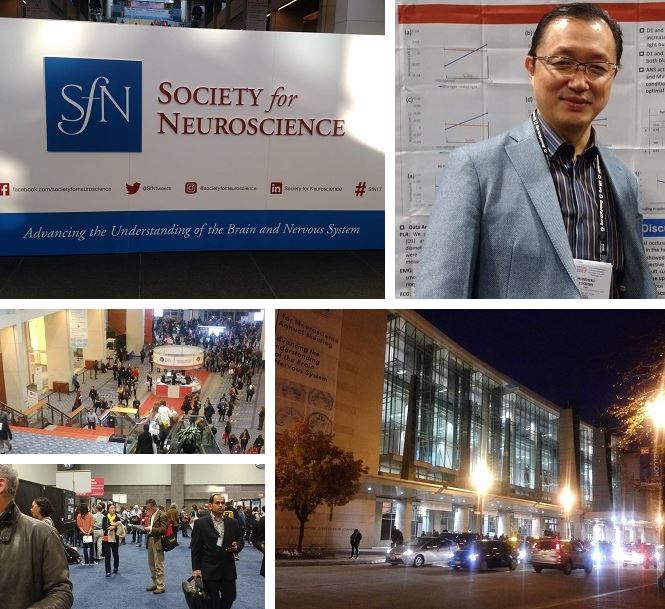
Society for Neuroscience, Neuroscience 2017
“Change in pupillary autonomic activity by mandible grinding with different types of simulated dental occlusions”
Poster presentation (first author; co-presenters: Mayako Shinomiya, Yuki Komoriya, Yumie Ono)
I presented on autonomic nervous responses when the occlusal scheme is changed.

International Academy of Advanced Interdisciplinary Dentistry, Asian Section (iaaid-Asia), 8th Scientific Meeting
“Autonomic Nervous Conditions Associated with Occlusal Pattern Divergence”
Poster presentation (P-5), session chair, closing address (as vice president)
In addition, two posters as co-presenter (P-1 and P-2).
VieSID (Vienna School of Interdisciplinary Dentistry) Summer School
- 2016
“The divergence of occlusal patterns play different roles in mediating the autonomic nervous reflex”
- 2015
“Prosthodontics and TMD” (slide title: “Prosthodontics and TMD – Especially in Complete Denture”)
- 2013
“Reconstruction of Occlusion by Unload the TMJ and Temporal Bone”
Lecture

50th anniversary ceremony of the Department of Prosthodontics, Faculty of Dental Sciences, King George's Medical University
“Occlusion and TMD: The Aim of Dentistry”
Invited lecture
International Congress of the Italian Gnathology Association (AIG)
- 2015 (28th congress)
“Analysis & Diagnosis with the Aid of Instrumental Devices” (Italian: “Analisi e diagnosi con l’ausilio di dispositivi strumentali”; slide title: “…Specialized Instruments”)
- 2014 (27th congress)
“Coping with Bruxism” (Italian: “Gestione del Bruxismo”)
Oral presentation


International Academy of Advanced Interdisciplinary Dentistry, Asian Section (iaaid-Asia), 7th Scientific Meeting
Chair of the organizing committee (vice president of iaaid-Asia)
The theme of the meeting was “Advanced medicine around occlusion for the years ahead.”
International Academy of Advanced Interdisciplinary Dentistry, Asian Section (iaaid-Asia), 5th Scientific Meeting, panel discussion “Therapeutic Reference Position (TRP)”
“Setting the TRP and Decompression”
Panel speaker
International Academy of Advanced Interdisciplinary Dentistry (iAAID), Vienna Congress
“The recent approach to craniomandibular disorder by prosthodontic and orthodontic treatment”
Presentation