What is a metal overlay?
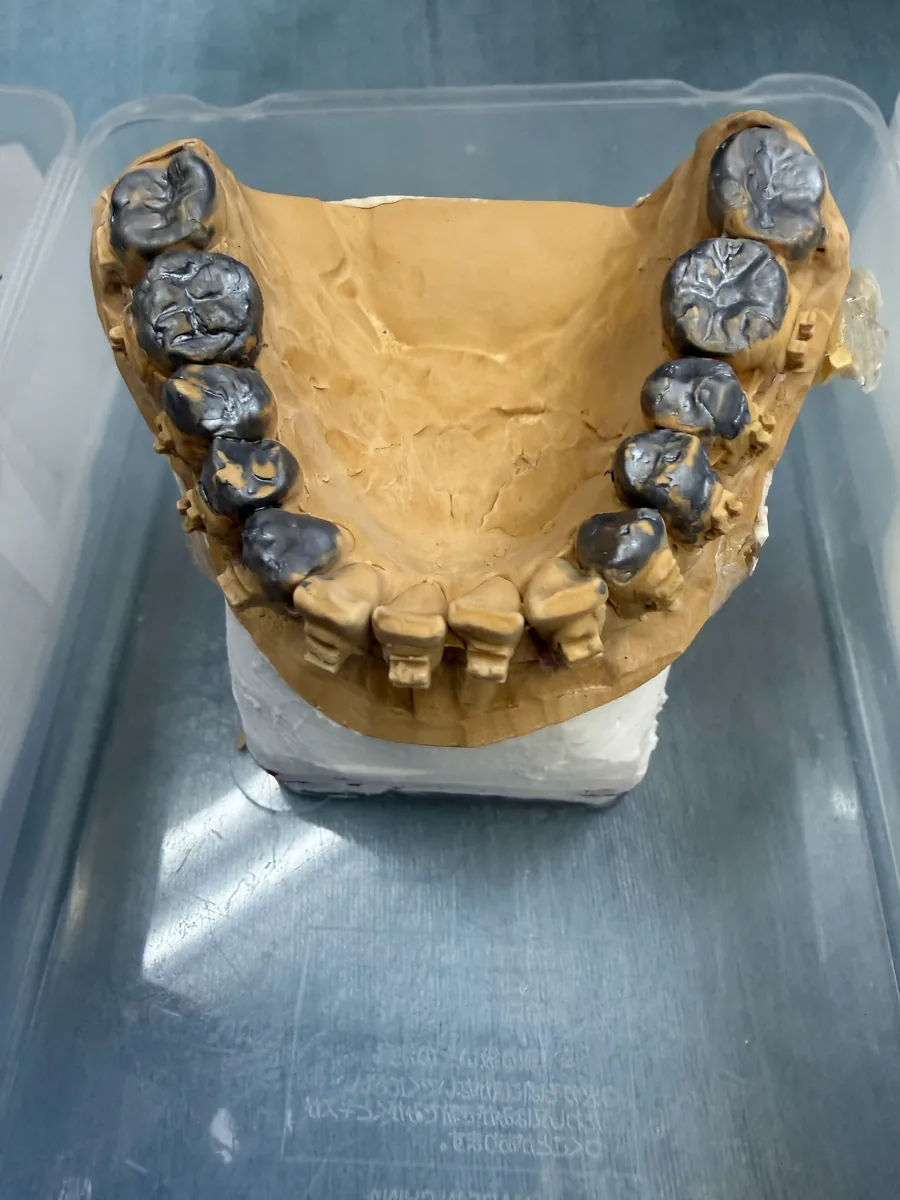
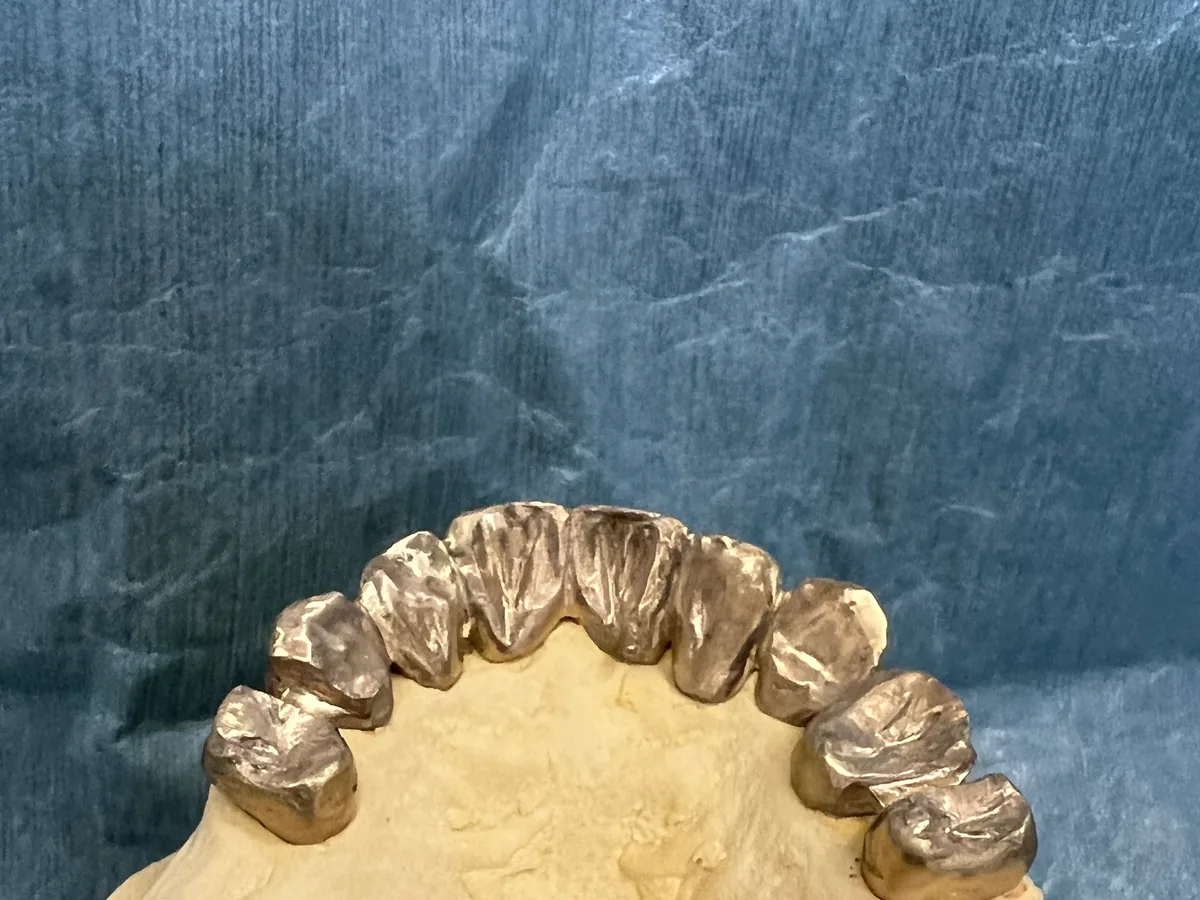
A metal overlay is a metal appliance placed over the biting surfaces of the teeth that expresses the "target position of the lower jaw for treatment" calculated from examinations, together with information on the bite.
The shape is made in wax, converted into metal by casting (pouring molten metal into a mould to produce the same shape in metal), and then fitted to the teeth in the mouth.
At our clinic, we call the target position of the lower jaw for treatment the "therapeutic jaw position".
In the treatment of temporomandibular disorders (TMD), a metal overlay is one of the appliances used at the stage of checking this therapeutic jaw position in the mouth.
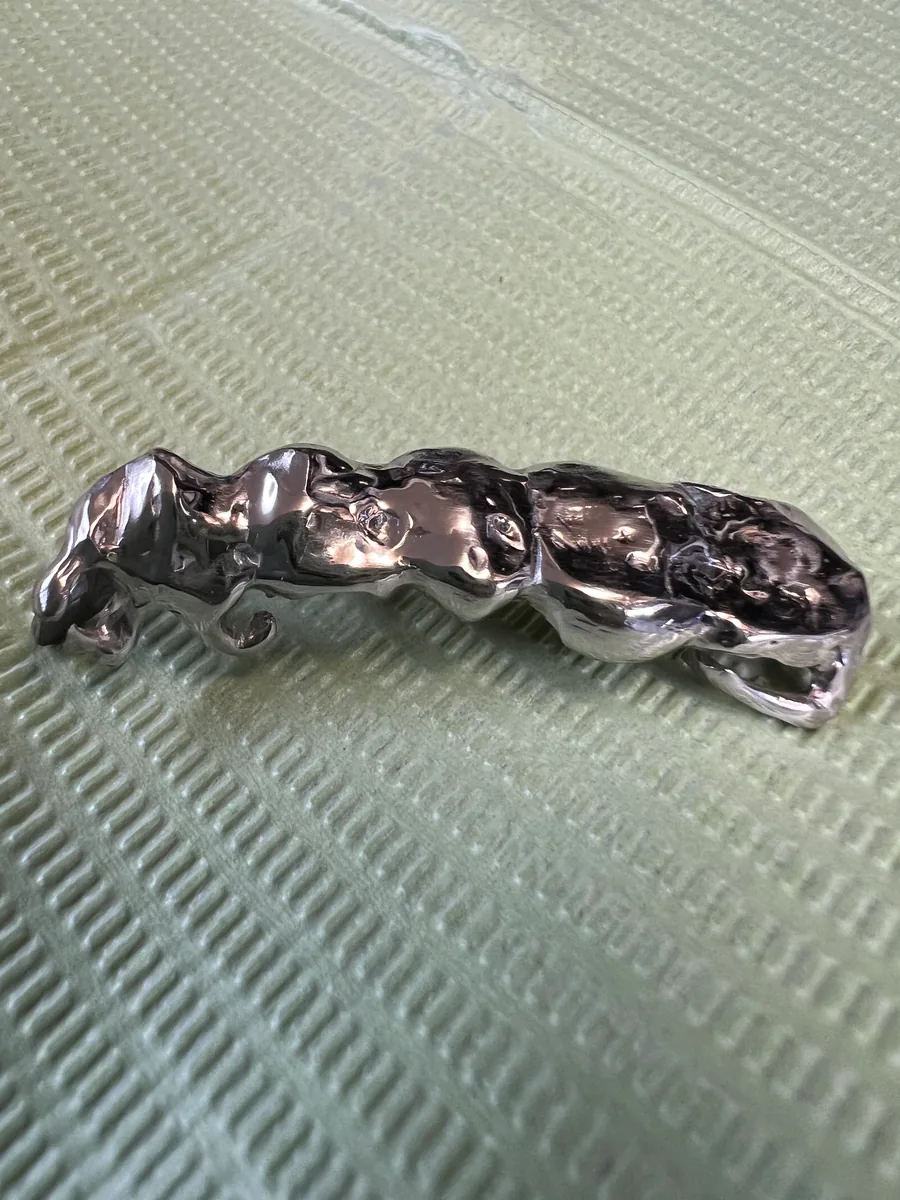
Several forms and names
The following names appear in the director's posts and earlier explanations.
- Metal overlay with the therapeutic jaw position: one that expresses the calculated therapeutic jaw position
- Occlusal metal overlay: one fitted to the biting surfaces of the teeth (occlusal surfaces). This is also the name of the appliance used in the director's research
- Removable overlay: a type that can be taken out
- Metal overlay for primary teeth: one fitted to primary teeth in the period when primary and permanent teeth are mixed
How a metal overlay works
A metal overlay is made in this order: the examination information is first given form on the casts and then transferred to the mouth.
- Identifying the problems through examinations: we examine the skeleton by analysing an X-ray of the head taken from the side (lateral cephalometric analysis), jaw joint movement with Cadiax, and the bite on an articulator.
- Calculating the therapeutic jaw position: based on three-dimensional information on the jaw joints (front to back, side to side and up and down), we determine the target position of the lower jaw for treatment.
- Setting it on the articulator: we set the calculated position on an articulator (a device on which casts of the upper and lower teeth are mounted to reproduce the position and movement of the jaw).
- Shaping in wax: on the casts of the teeth, we form in wax the information that is missing for biting in that position.
- Casting: the wax shape is converted into metal.
- Fitting and checking: the overlay is fitted to the teeth in the mouth, and symptoms and jaw movement are checked again.
The director explains this process as "transcribing" the information obtained from the examinations into the form of metal.
We place importance on an unbroken connection between the examination values (input) and the shape of the appliance that goes into the mouth (output).
For details of the articulator settings, please see the Girrbach Reference SL articulator page.
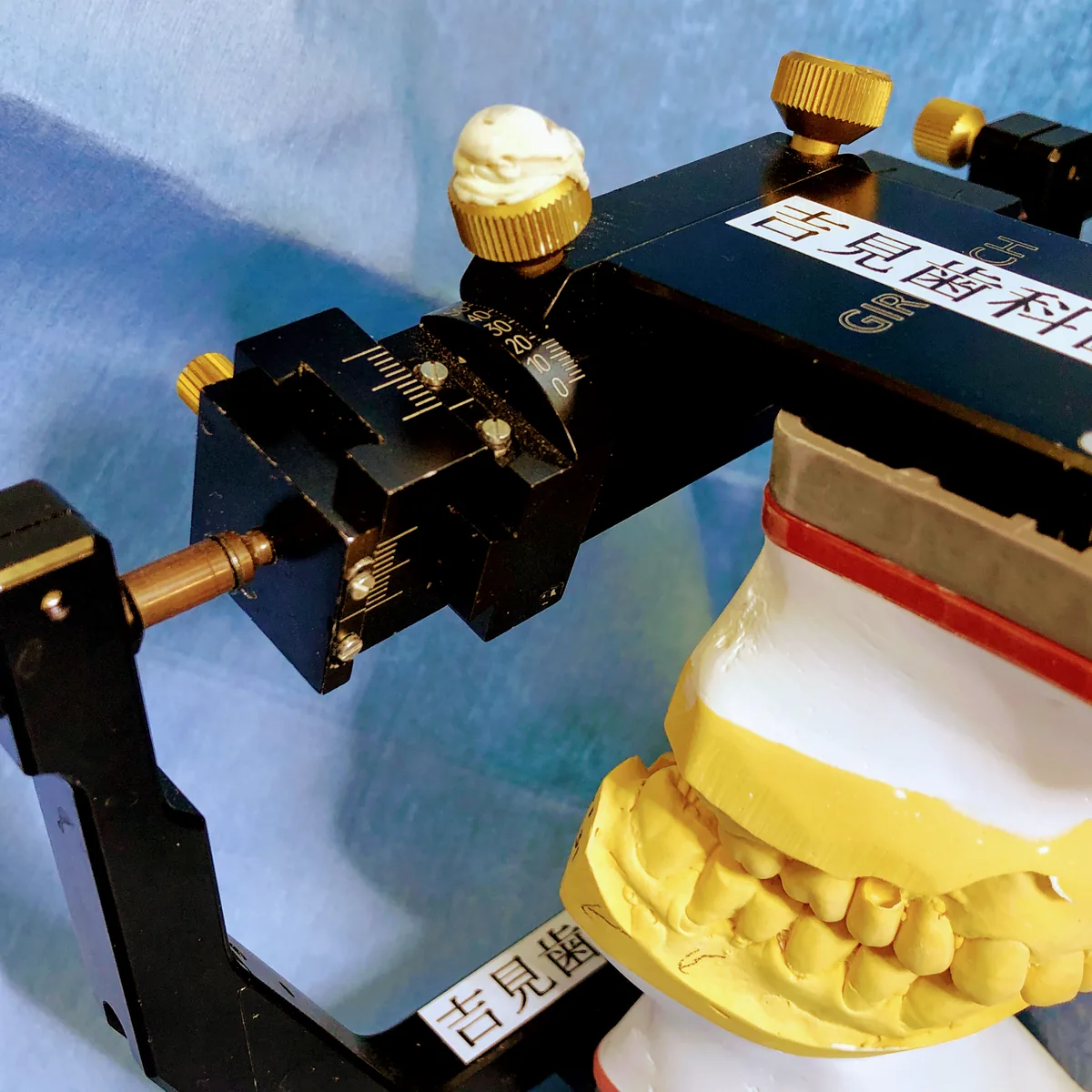
The information expressed in the metal form
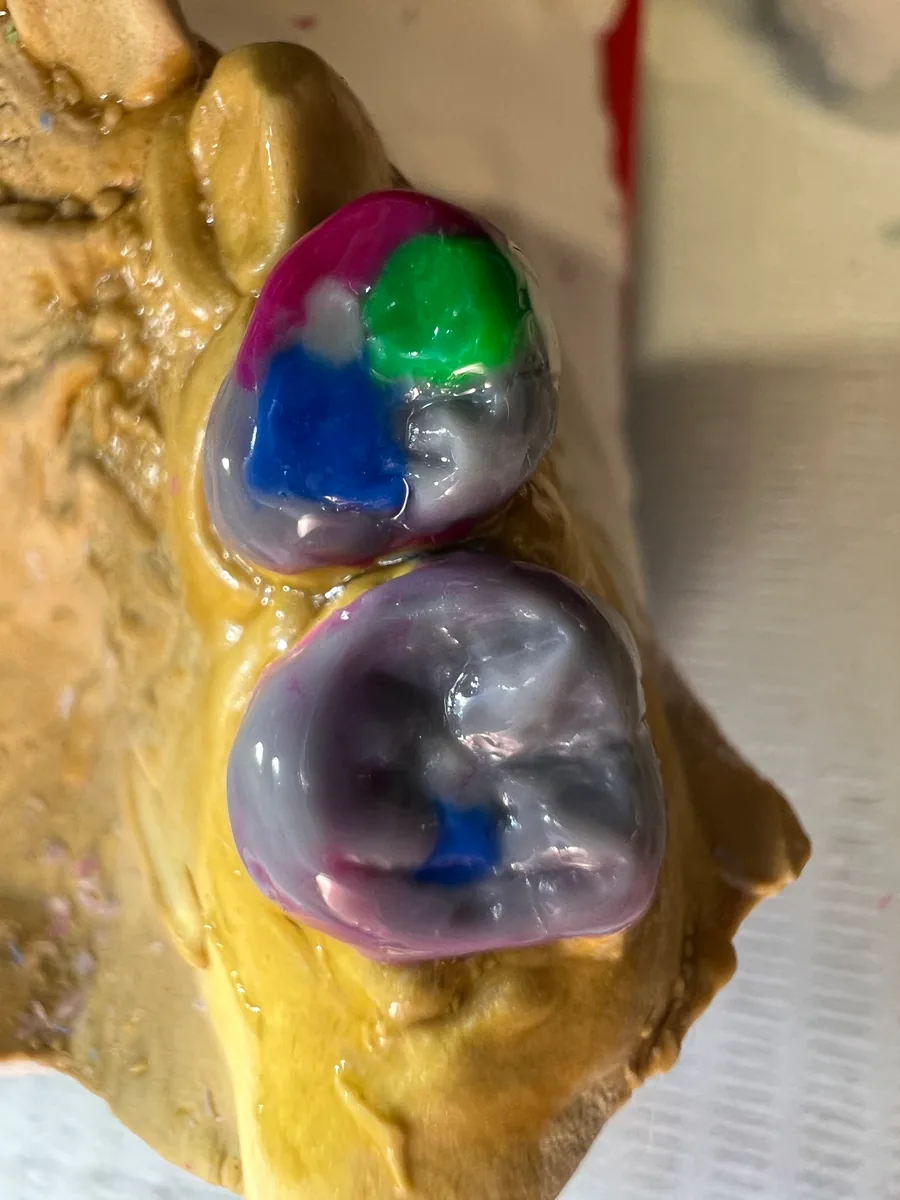
The photo shows the information to be built into primary back teeth, expressed in colour-coded wax.
Each colour stands for a particular type of information.
| Colour | Information it represents |
|---|---|
| White | Points that make contact in the position where the upper and lower teeth fit together most deeply (intercuspal position) |
| Blue | Areas left clear so that the teeth do not collide when the lower jaw moves backwards |
| Green | Surfaces that guide the movement when the lower jaw moves sideways |
| Red | Surfaces that guide the movement when the lower jaw moves forwards |
In this way, the shape is decided by assigning to each tooth the places that make contact when the teeth are brought together, and the places that guide the lower jaw or are kept out of contact when it moves.
Metal overlays with sequential guidance
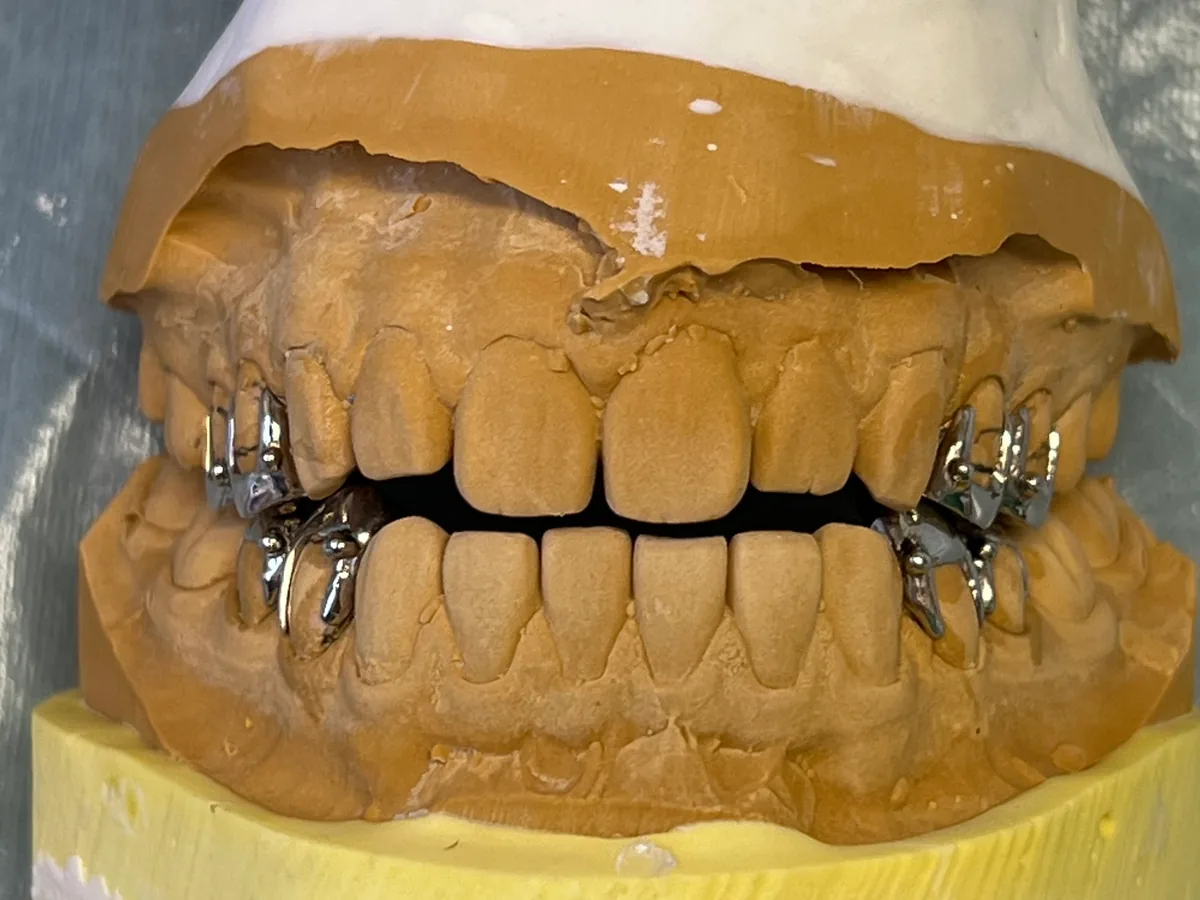
A bite that guides the lower jaw so that, when it moves sideways, the teeth separate in sequence starting from the back is called sequential occlusion.
The director calls a metal overlay given this guidance "SOMOTR".
With the lower jaw placed in the therapeutic jaw position, surfaces that guide the backward and sideways movements are built into the shape of the metal overlay.
For details of the approach, please see the sequential occlusion page.
Why we use metal overlays
To bring jaw joint movement and the bite into line
At our clinic, we regard TMD as a condition in which the three-dimensional movement of the jaw joints and the function of the bite are not in line with each other.
For this reason, an appliance is needed that expresses, on the actual teeth, the lower jaw position determined in the examinations, so that it can be checked.
To transfer the position decided on the casts to the mouth in the same form
At our clinic, the position decided on the articulator goes through a stage of being checked in the mouth before we move on to the next treatment.
A metal overlay is an appliance for copying the position decided on the articulator into metal form and transferring it to the mouth in that same form.
To make up for missing height and form
The director explains that, on the basis of the examination data, we make up for the functions of the bite that are missing.
A metal overlay is an appliance that makes up for missing height and form by placing metal over the biting surfaces of the teeth.
Because it can be rechecked in the same way after fitting
After fitting, too, we check changes in symptoms and record jaw movement again to confirm.
After treatment, we also record tooth contact during sleep to check whether the function of the shape we gave is being maintained.
In practice at our clinic
Where it comes in the course of TMD treatment
- At the first consultation, we ask about your concerns and the treatment you have had so far, check the condition of your mouth and explain the examinations needed.
- In the detailed examinations ("orthodontic work-up (bite examination)" in the fee table; 2–3 visits as a guide), we examine the skeleton, jaw joint movement, casts of the teeth and other aspects.
- We combine the examination results to calculate the therapeutic jaw position and set it on the articulator.
- In our in-house dental laboratory, we make the shape in wax and cast it to produce the metal overlay.
- We fit it in the mouth and check changes in symptoms and jaw movement.
- To maintain the confirmed bite over the long term, we make adjustments with orthodontic treatment, crowns or dentures as needed.
- After treatment, too, we check the bite during sleep where needed.
At the stage of checking in the mouth, we may also use metal splints or provisional restorations besides metal overlays.
We may also approach the calculated position in stages.
Photos: metal overlays on casts
When combined with orthodontic treatment
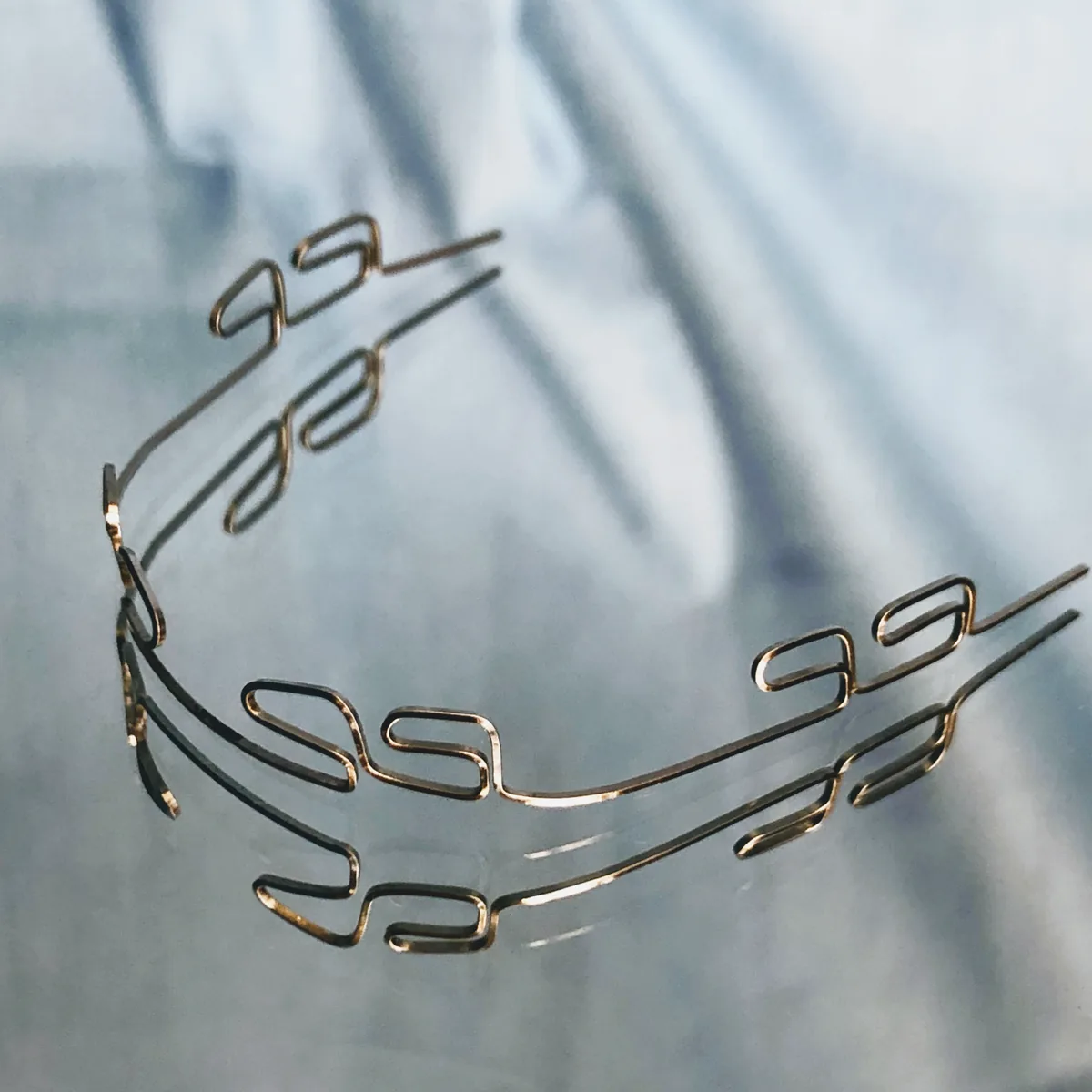
There is also a method in which bite information is first built into some of the teeth in metal and then carried over to the other teeth with an orthodontic wire.
For the wire, please see the MEAW (Multiloop Edgewise Archwire) page.
The period when primary and permanent teeth are mixed
In the period when primary and permanent teeth are mixed (the mixed dentition period), we may fit metal overlays carrying bite information to primary teeth.
The information to be built in is designed in colour-coded wax, as described above under "The information expressed in the metal form".
We also use it in research
In the director's research (a 2026 paper), 17 healthy young adults wore removable metal overlays on either their canines or their first molars, and heart rate variability, the pupillary light reflex and electromyography of the masseter muscle were recorded while they made tooth-grinding movements under different bite conditions.
These are findings from research carried out under set conditions; they do not indicate the cause of any individual patient's symptoms or the effect of treatment.
The recording methods are described on the heart rate variability (HRV), electromyography (EMG) and pupillary light reflex pages, and the research itself on the research and publications page.
Treatment duration, number of visits, fees and risks → Fees
What a metal overlay can and cannot do
What a metal overlay can do
- Express in the mouth, as a metal form on the teeth, the therapeutic jaw position calculated from examinations
- Give each tooth the points that make contact when the teeth are brought together and the surfaces that guide the lower jaw when it moves
- Make up for missing height and form of the bite by placing metal over the biting surfaces of the teeth
- Check changes in symptoms and jaw movement while it is being worn
- Carry the confirmed information over into orthodontic treatment, crowns or dentures
What it cannot do, and how we compensate
| What it cannot do | How we compensate |
|---|---|
| Determining the therapeutic jaw position itself | We calculate it from the examination records (Cadiax, lateral cephalometric analysis, Girrbach Reference SL articulator) |
| Changing the position or inclination of the teeth themselves | We move them with an orthodontic wire (MEAW) |
| Bringing the confirmed bite into a state that can be maintained over the long term | Where needed, we combine orthodontic treatment, crowns or dentures (STEP 5 on the TMD page) |
| Finding out how the teeth meet during sleep | We record this with BruxChecker |
| Determining the cause of general physical symptoms such as headaches and stiff shoulders | We do not determine this from the appliance alone. An assessment outside dentistry, such as in medicine, may also be helpful |
Whether the shape decided on the casts fits in the patient's mouth cannot be known until the appliance is fitted and used.
That is why we include a stage of checking after fitting.
How symptoms change, and the course leading up to confirmation, vary from person to person.
Frequently asked questions
- Is a metal overlay worn permanently?
At our clinic, we use it as one of the appliances for the stage at which the target position of the lower jaw for treatment is checked in the mouth.
Where needed, the confirmed bite is brought into a state that can be maintained over the long term with orthodontic treatment, crowns or dentures.
We explain the duration of treatment and the number of visits, including how long the overlay is worn, after the examinations and diagnosis.
- What examinations is it based on?
We make it by calculating the therapeutic jaw position from the results of examinations such as analysis of an X-ray of the head taken from the side (lateral cephalometric analysis), recording of jaw joint movement with Cadiax and analysis of the bite on the articulator.
The combination of examinations is decided according to your symptoms and the condition of your mouth.
- What is checked after it is fitted?
We check changes in symptoms and changes in jaw movement.
After treatment, we also record tooth contact during sleep to check whether the bite is being maintained.
- Is it also used for children?
In the period when primary and permanent teeth are mixed (the mixed dentition period), we may use metal overlays fitted to primary teeth.
Whether to use them is decided on the basis of the examination results.
- Where are metal overlays made?
They are made in our in-house dental laboratory, next to the treatment room.
The shape is made in wax and converted into metal by casting.
Related technologies and treatments
- Cadiax
- Girrbach Reference SL articulator
- Sequential occlusion
- MEAW (Multiloop Edgewise Archwire)
- All the technologies we use
- Temporomandibular disorders
- Orthodontic treatment that avoids extractions where possible
- Occlusion and autonomic nervous function
Sources we referred to
For the description of the research, we referred to the following paper. What we describe about our own methods is based on the director's posts and explanations.
Consultations and enquiries
Gibakai Medical Corporation
Yoshimi Dental Clinic
Square 2, Room 302 (third floor)
1-29-1 Tsukushino, Machida,
Tokyo 194-0001, Japan
TEL 042-795-1359 FAX 042-795-1398
Clinic days: Mon · Tue · Thu · Fri
10:00–13:00 / 14:30–18:00
A first visit begins with a first consultation (a private, non-insured service; 30 minutes to 1 hour) for examination and diagnosis. Questions about a diagnosis you received elsewhere are also covered within it.
In an emergency, such as being unable to chew or having severe symptoms, please call us on 042-795-1359 to discuss it.