What is the therapeutic jaw position?
The therapeutic jaw position is the position of the lower jaw that treatment aims for.
At our clinic, we calculate this position in three directions (front to back, side to side and up and down) from the jaw joint movement, skeleton and other data recorded in examinations.
The position of the lower jaw relative to the upper jaw is generally called the "mandibular position".
The academic literature uses the term "therapeutic mandibular position" (TRP) for a position that is planned and set as the goal of treatment.
It is the position that is set when, from analysis of jaw joint movement and other findings, it is judged that the current mandibular position needs to be changed.
In our treatment process, the therapeutic jaw position is decided after the detailed examinations, at the stage of designing the treatment plan.
The decided position is first represented on casts on the articulator, then given form as appliances or provisional restorations and checked in the mouth.
How the therapeutic jaw position works
Deciding the position and height in numbers
The jaw joints move in three dimensions.
For this reason, at our clinic we capture information on the jaw joints in three directions, along the x, y and z axes, and set the therapeutic jaw position on that basis.
In the general approach, the following are decided when determining the target position for treatment.
| What is decided | How it is generally decided |
|---|---|
| Position of the condyle (the lower-jaw part of the jaw joint) front to back, side to side and up and down | The way the condyle moves is recorded and analysed, and the position is decided as three-dimensional values with reference to the results |
| Height of the bite (vertical dimension of occlusion) | The aim is a height at which the skeleton is balanced. For example, on an X-ray of the head taken from the side, a height at which the upper and lower jaws are balanced front to back is planned, using the height of the lower part of the face as a guide |
Steps in deciding it
The target position for treatment is generally worked out in the following order.
- Deciding a reference position: to express positions in numbers, a reference position that can be recorded the same way repeatedly is decided. One approach, for example, takes as the reference the rearmost position of the condyle when the lower jaw is gently guided backwards.
- Examining the movement: displacement of the condyle, or a disturbance in its relationship with the tissue inside the joint (the articular disc), is said to show up in the records as a change in the way it moves.
- Deciding whether to change the position: it is judged whether the current position can be kept or needs to be changed.
- Deciding the target position and height: the position front to back, side to side and up and down, and the height of the bite, are decided.
- Checking whether the body adapts: when the height is changed substantially, for example, provisional appliances or provisional restorations are used to check carefully whether the body adapts to that position.
- Creating a bite that can maintain that position: the shape of the teeth that guide the lower jaw so that it does not slip backwards, and the inclination of the biting surfaces, are also taken into account.
Example: first releasing only part of the vertical compression
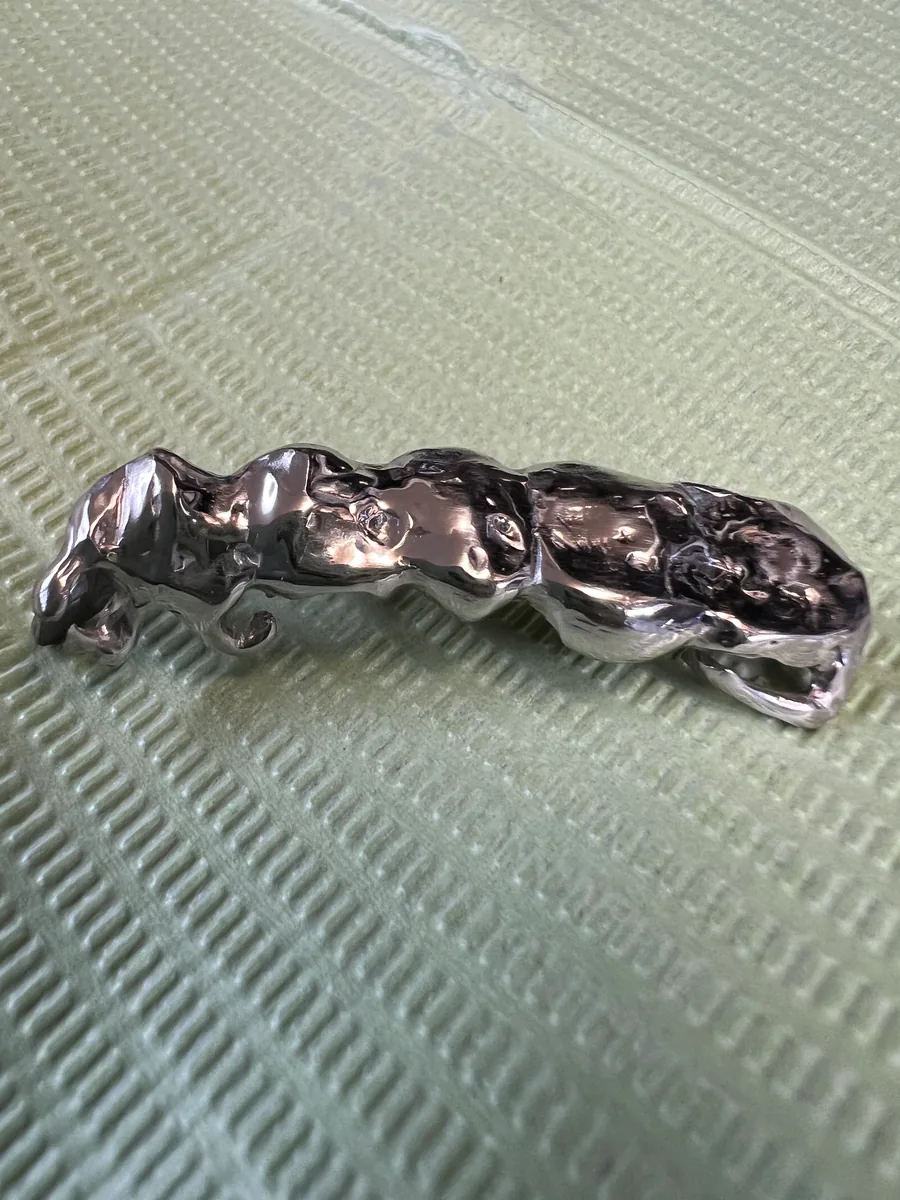
One of the director's posts, about a patient whose left jaw joint had been found to be under 3 mm of compression in the vertical direction, says: "First, release the pressure by 1 mm."
In this way, the therapeutic jaw position is considered as a target with both a direction and an amount.
The photo shows the metal overlay (a metal appliance placed over the biting surfaces of the teeth) that accompanied that post.
Why we calculate the therapeutic jaw position
To match the bite to the movement of the jaw joints
At our clinic, we aim to match the function of the bite to the three-dimensional movement of the jaw joints.
To do this, we first decide where to position the lower jaw.
To capture the pressure on the jaw joints in terms of direction and amount
The director regards releasing the pressure on the jaw joints and the surrounding tissues as central to the treatment of temporomandibular disorders (TMD).
The director's posts explain that the three-dimensional direction of that pressure is influenced by the state of the bite of the back teeth.
That is why, in this view, the target position needs to be known accurately as coordinates, and it must be possible to represent it on the casts.
To calculate it individually from that person's records
Both the skeleton and the way the jaw moves differ from person to person.
The director writes that the bite data are calculated by combining records of the skeleton, the three-dimensional movement of the jaw joints, tooth grinding during sleep and so on.
The therapeutic jaw position, too, is not decided from the values of a single examination; we consider these records together.
To check the calculated position in a form you can hold
The director believes that information gathered in examinations has no meaning unless it can be given form.
The calculated position is made into something that can be checked in the mouth, taking form in turn as casts on the articulator, appliances and provisional restorations.
In practice at our clinic
From examination to checking in the mouth
In TMD treatment, the therapeutic jaw position is handled in the following order.
- Recording: as needed, we record jaw joint movement with Cadiax, the skeleton with lateral cephalometric analysis, each individual tooth with a sectioned cast, and tooth contact during sleep with BruxChecker.
- Calculating: combining the records, we calculate the therapeutic jaw position front to back, side to side and up and down.
- Representing it on the casts: we set the calculated position on the articulator, on which casts of the upper and lower teeth are mounted.
- Checking in the mouth: the position on the casts is given form as an appliance or provisional restorations, which are placed in the mouth, and jaw movement is recorded again.
- Creating a bite that maintains it: as needed, we adjust the bite with orthodontic treatment, crowns or dentures so that it can maintain that position.
We do not carry out the same examinations for everyone; we choose them according to each person's symptoms and the condition of their mouth.
Device for representing the position on the articulator: Condylar repositioning variator
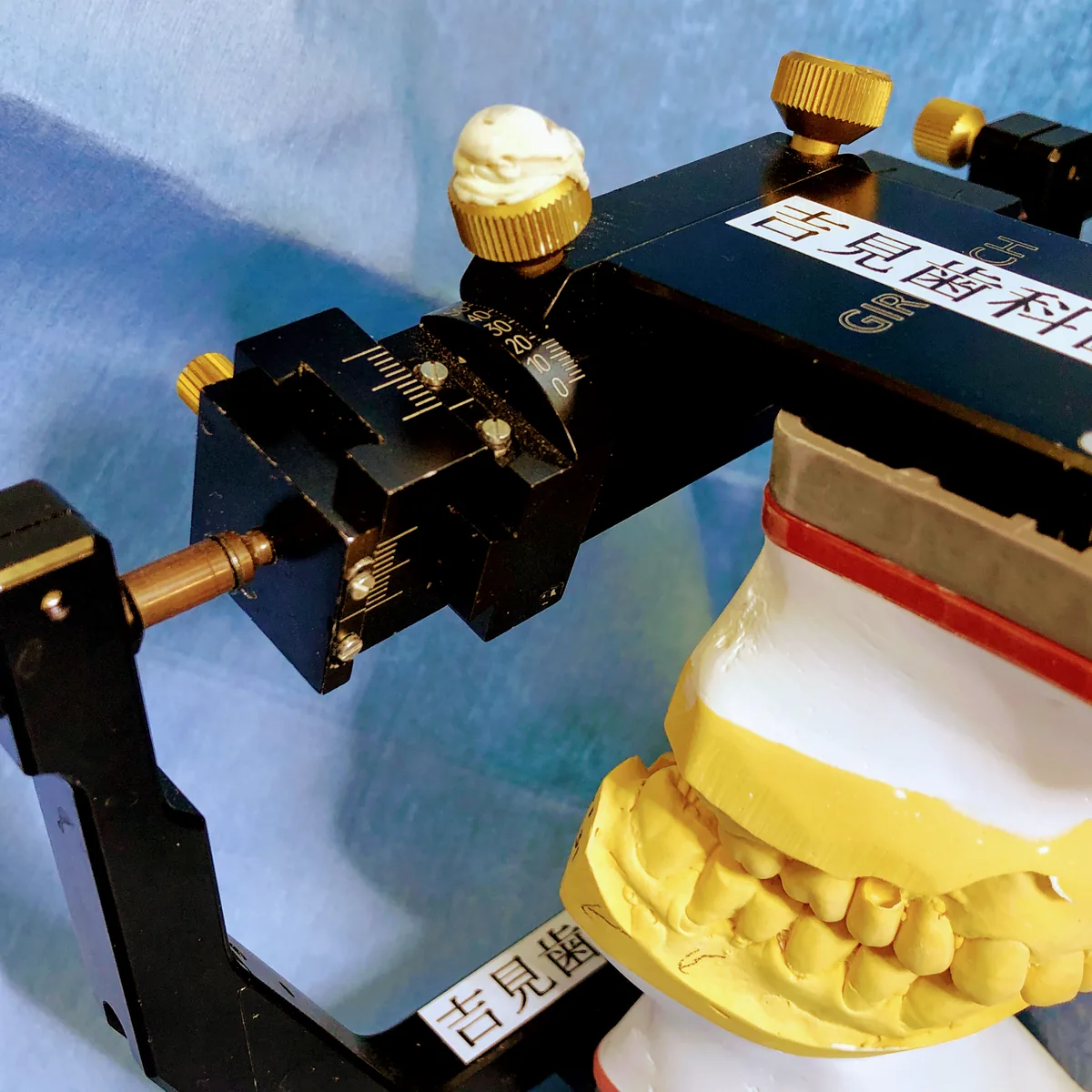
To represent the calculated therapeutic jaw position on the casts, we attach a device called a condylar repositioning variator to the articulator.
The director writes that, because the jaw joints move in three dimensions, a device that can also represent the target position in three dimensions is needed.
The articulator's manufacturer offers a device for setting the position of the condyles numerically in three directions, and states that it can be used for purposes such as setting the target position of the lower jaw for treatment.
The full set of values set on the articulator is described on the Girrbach Reference SL articulator page.
Transferring it to the mouth and checking it
The position decided on the casts is given form as appliances or provisional restorations and transferred to the mouth.
- Metal overlay: the director's posts include an example in which the therapeutic jaw position calculated from the Cadiax examination was expressed in a metal overlay.
- Metal splint: at our clinic, we sometimes use this as an appliance for checking the target jaw position for treatment in the mouth.
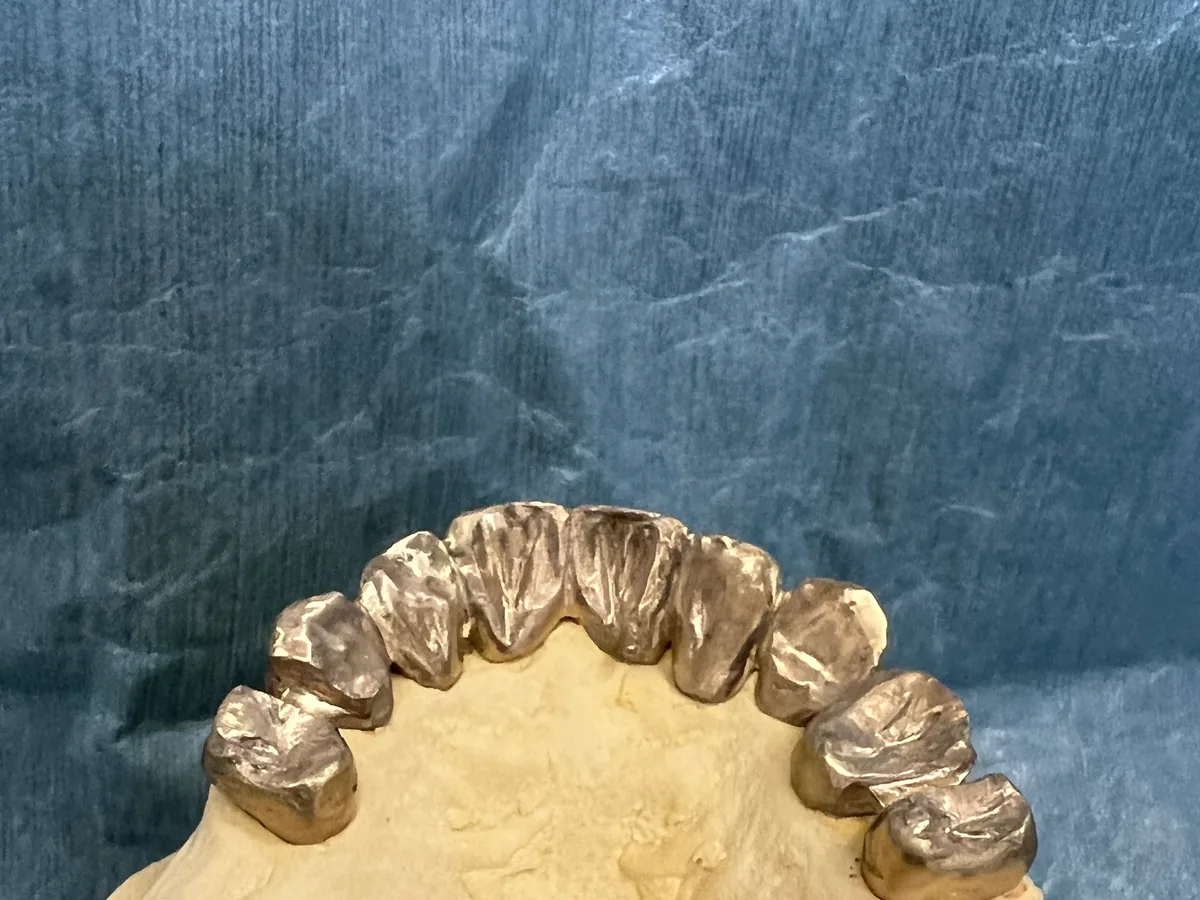
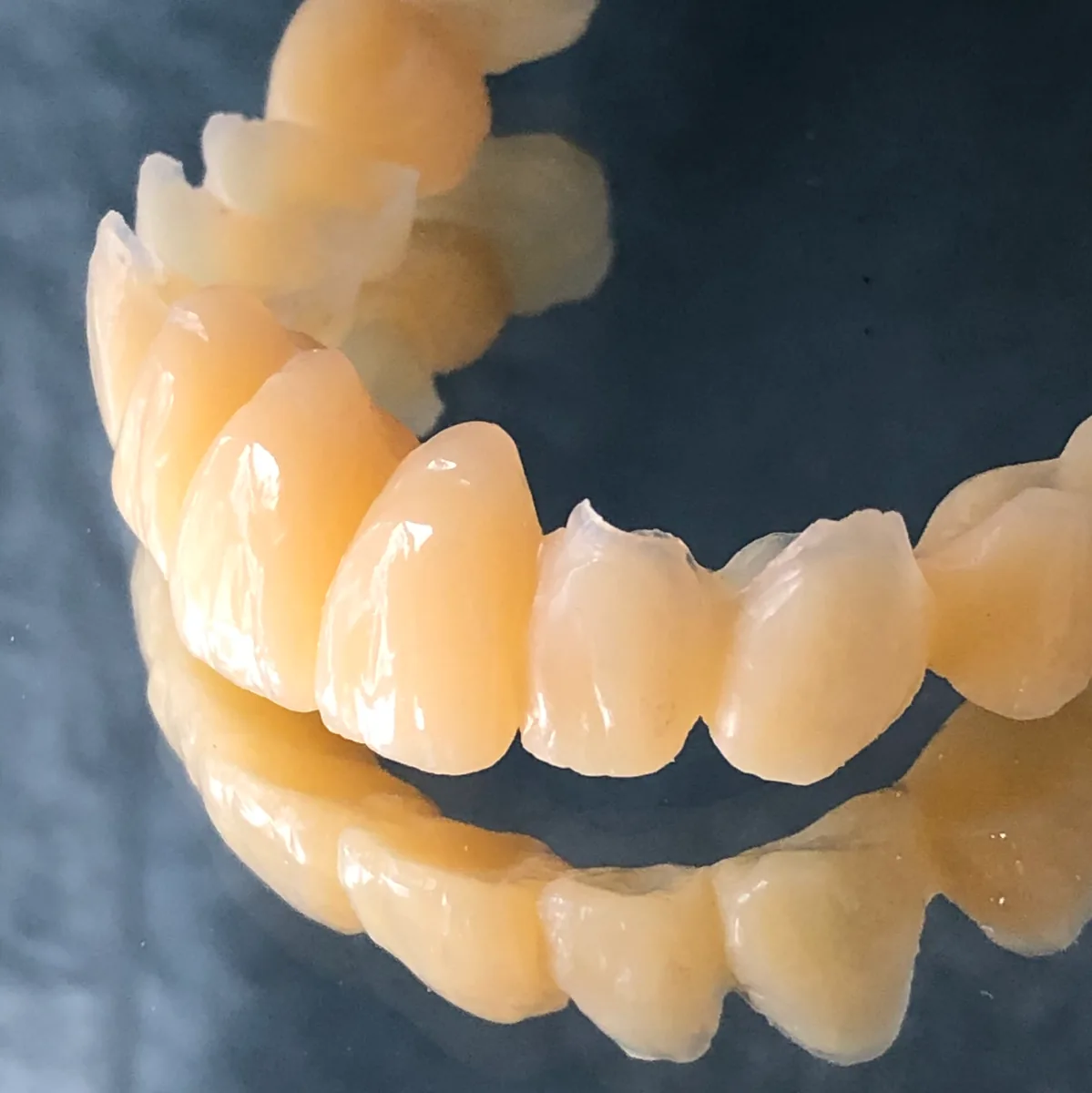
- Provisional restorations and provisional dentures: these are made based on the analysis of X-rays of the head taken from the side, the Cadiax records and other records, and we check their position and shape while you use them.
When transferring the position to provisional restorations, we use the same reference points on the articulator and in the mouth as a guide.
After an appliance is fitted, we record jaw movement again by the same method and check it together with any change in symptoms.
Photos: appliances for checking the therapeutic jaw position in the mouth
For orthodontic treatment and crowns
In orthodontic treatment, there is a method in which the target values are first put in place in the mouth with an appliance, and the teeth are moved afterwards.
We may also use an appliance in which the skeletal data and three-dimensional Cadiax data are built into a metal part, while another part gradually transfers those data to the natural teeth.
The director's posts also include an example combining a metal overlay expressing the therapeutic jaw position with orthodontic treatment.
To move the teeth, we use a wire for moving each tooth in three dimensions (MEAW).
For crowns, the angle of the cusp slopes of each tooth (cusp inclination), and their direction and distance, are decided with the therapeutic jaw position as the reference.
How the angle of each tooth is determined is explained on the sequential occlusion page.
After orthodontic treatment is finished, a retainer is used, and tooth contact during sleep is checked as needed.
For dentures
The director writes that TMD also occurs in people with complete dentures.
For dentures, we record jaw joint movement in a relaxed state with Cadiax and movement while clenching with intraoral gothic arch tracing, and combine these with mucosal records.
For complete dentures, the height of the bite and the inclination of the biting surfaces are decided from the skeletal analysis of the X-ray of the head taken from the side, and the angle of the cusp slopes of the artificial teeth from the Cadiax records.
With provisional dentures for people with TMD, the first aim is to release the force acting on the jaw joints.
Treatment duration, number of visits, fees and risks → Fees
What the therapeutic jaw position can and cannot do
What the therapeutic jaw position can do
- Express the target position of the lower jaw for treatment as values front to back, side to side and up and down
- Bring the records of jaw joint movement, the skeleton, the teeth and tooth contact during sleep together into a single target
- Set the target position on casts on the articulator
- Check the position on the casts in the mouth, through appliances and provisional restorations
- Serve as a common reference when working out the bite for orthodontic treatment, crowns and dentures
What it cannot do, and how we compensate
| What it cannot do | How we compensate |
|---|---|
| Assessing the skeleton or deciding the height of the bite from jaw joint records alone | Examining the skeleton with lateral cephalometric analysis |
| Finding out the orientation and height of each individual tooth | Checking with a sectioned cast |
| Finding out how the teeth make contact during sleep | Recording with BruxChecker |
| Finding out how the lower jaw moves while clenching (for dentures) | Recording with intraoral gothic arch tracing |
| Finding out whether the position decided on the casts fits in that person's mouth | Checking while metal overlays or provisional restorations and provisional dentures are in use, and recording jaw movement again |
| Creating a bite that maintains the decided position over the long term | Designing the shape of the teeth according to the concept of sequential occlusion, and moving the teeth with MEAW as needed |
| Determining the causes of symptoms such as headaches and stiff shoulders | We do not determine this from the therapeutic jaw position alone. Where needed, we recommend an assessment in another field, such as medicine |
It is generally said that the position of the human lower jaw does not stabilize easily, and that changing it makes use of the body's process of getting used to the new position (adaptation).
It is also said that when the height of the bite is changed substantially, it is necessary to assess carefully, with provisional appliances or provisional restorations, whether the body adapts.
The director, too, writes that what can be known in numbers at the time of examination is the approximate target position.
In the director's view, deviations from it arise from differences in how the body adapts and from factors other than the bite.
The therapeutic jaw position is not a value that promises a change in symptoms or a treatment result. Results vary from person to person.
Frequently asked questions
- What position does the therapeutic jaw position refer to?
It is the position of the lower jaw, relative to the upper jaw, that treatment aims for.
At our clinic, we consider the jaw joint position in three directions: front to back, side to side and up and down.
- Will the position of my bite be changed?
Whether to change the position of the lower jaw is decided from the examination results.
In general, too, it is said that the first step is to judge whether the position needs to be changed, and that a target position is decided when it does.
- Is the therapeutic jaw position decided in one go?
The calculated position is transferred to the mouth with appliances or provisional restorations, and checked by recording jaw movement again.
One of the director's posts, about a patient found to have 3 mm of compression in the vertical direction, says that 1 mm of it is to be released first.
- How is the position decided on the casts transferred to the mouth?
The position decided on the articulator is given form as a metal overlay, a metal splint, provisional restorations or similar.
When it is transferred to provisional restorations, the same reference points as on the articulator are used as a guide.
- Is the position of the lower jaw also considered for people with dentures?
Yes. For dentures, too, the position of the lower jaw (the jaw position) is decided based on records.
We combine the jaw joint records in the relaxed and clenched states with the skeletal and mucosal records to work out the bite of the artificial teeth.
- Once the therapeutic jaw position has been decided, will my symptoms go away?
The therapeutic jaw position is a target: the position that treatment aims for. Calculating the position does not determine how symptoms will change.
We check it using appliances, and proceed while also recording changes in jaw movement and tooth contact. Results vary from person to person.
Related technologies and treatments
- Cadiax
- Girrbach Reference SL articulator
- Metal overlay
- Provisional restorations and provisional dentures
- All the technologies we use
- Temporomandibular disorders & orthodontic treatment that avoids extractions where possible: how treatment proceeds
- Dentures (precision dentures): examinations
Sources we referred to
For the general explanations (the concept of the therapeutic mandibular position and the device for setting the condyle position in three directions), we referred to the following published sources. What we describe about our own methods is based on the director's posts and explanations.
- Sato S, Aoki S. Concept of therapeutic mandibular position and its clinical application (Part 1). The Journal of the Academy of Clinical Dentistry. 2013;33(3):254-262 (in Japanese; PDF)
- GAMMA Dental, "Instrumental diagnostics" (manufacturer)
Consultations and enquiries
Gibakai Medical Corporation
Yoshimi Dental Clinic
Square 2, Room 302 (third floor)
1-29-1 Tsukushino, Machida,
Tokyo 194-0001, Japan
TEL 042-795-1359 FAX 042-795-1398
Clinic days: Mon · Tue · Thu · Fri
10:00–13:00 / 14:30–18:00
A first visit begins with a first consultation (a private, non-insured service; 30 minutes to 1 hour) for examination and diagnosis. Questions about a diagnosis you received elsewhere are also covered within it.
In an emergency, such as being unable to chew or having severe symptoms, please call us on 042-795-1359 to discuss it.