What is intraoral gothic arch tracing?
Intraoral gothic arch tracing is a method in which a small recording device is placed in the mouth to record the paths of the lower jaw as it moves.
At our clinic, we use it when making dentures to record the traces of lower jaw movement while clenching (with close to maximum muscle force).
It is generally known as the "gothic arch tracing method".
"Tracing" means recording movement by drawing it as a line.
It has long been used, for example in making dentures, as one method of determining the horizontal relationship between the upper and lower jaws and of diagnosing lower jaw movement.
The name comes from the shape of the figure that is drawn.
The paths traced when the lower jaw is moved to the left and right take a shape like an arrowhead or the pointed arch of a Gothic building.
"Intraoral" means a method in which the recording device is placed inside the mouth.
A method in which the device is placed outside the mouth is called an "extraoral" method.
How intraoral gothic arch tracing works
Based on explanations in the academic literature and a glossary of terms, we describe the general mechanism in four steps.
- Attaching the device: a flat plate (the tracing plate) is attached to one of the jaws, upper or lower, and a small pointed projection (the tracing pin) to the opposite jaw.
- Supporting at a single central point: the tip of the projection rests on the plate, so that the upper and lower jaws are supported at a single point, roughly in the centre. This point of support is called the central bearing point. It is a mechanism for distributing the biting force evenly over the whole of the supporting area.
- Moving the lower jaw: with the projection kept against the plate, the lower jaw is moved forwards and to the left and right. The projection moves across the plate and leaves its path behind.
- Reading the figure: the paths of the movements to the left and right form an arrow-like figure with an apex. This apex is generally considered to indicate a reference position of the lower jaw.
In the general method, this recording is said to be made after the height between the upper and lower jaws when biting (the vertical dimension of occlusion) has been determined.
The mechanism of support at a single central point is said to have been devised by the Swiss dentist Alfred Gysi in 1910.
How we record it
In the general method, the projection draws lines on ink applied to the plate to make the record.
At our clinic, we use a device with a part that supports the upper and lower jaws at a single central point (the central bearing point).
The recording is made while clenching.
Lower jaw movement while clenching is recorded as traces left in resin.
Why we use intraoral gothic arch tracing
Because movement while clenching cannot be recorded with Cadiax
At our clinic, we record jaw joint movement with a device called Cadiax.
What Cadiax can record is movement with the jaw relaxed.
Jaw joint movement while clenching cannot be recorded with Cadiax.
So when making dentures, we combine it with intraoral gothic arch tracing.
The differences between the two records are as follows.
| Point of comparison | Cadiax | Intraoral gothic arch tracing |
|---|---|---|
| State of the jaw during recording | Relaxed | Clenching |
| How it is recorded | Recorded electronically, with instruments attached to the head and the lower jaw | Recorded as traces left in resin, with a device in the mouth |
| What is recorded | Three-dimensional movement of each of the left and right jaw joints | Traces of lower jaw movement while clenching |
| When we use it at our clinic | Temporomandibular disorders (TMD), orthodontic treatment, dentures, crowns | When making dentures |
Because dentures work on the gums
Dentures work while resting on the gums (mucosa).
The amount of force on the gums is completely different when you bite lightly and when you clench hard.
The amount by which the denture sinks also changes with differences in biting force and in the thickness of the gums.
The director believes that a denture needs to express both states: when relaxed and when force is applied.
To consider jaw movement and the shape of the mucosa together
The shape of the gums (mucosa) also changes with how force is applied.
At our clinic, we work out the shape of the denture by combining the record of jaw joint movement from Cadiax and the traces of lower jaw movement from gothic arch tracing with records of the mucosa when relaxed, under force and in between.
For details on mucosal records, please see the mucosal records page.
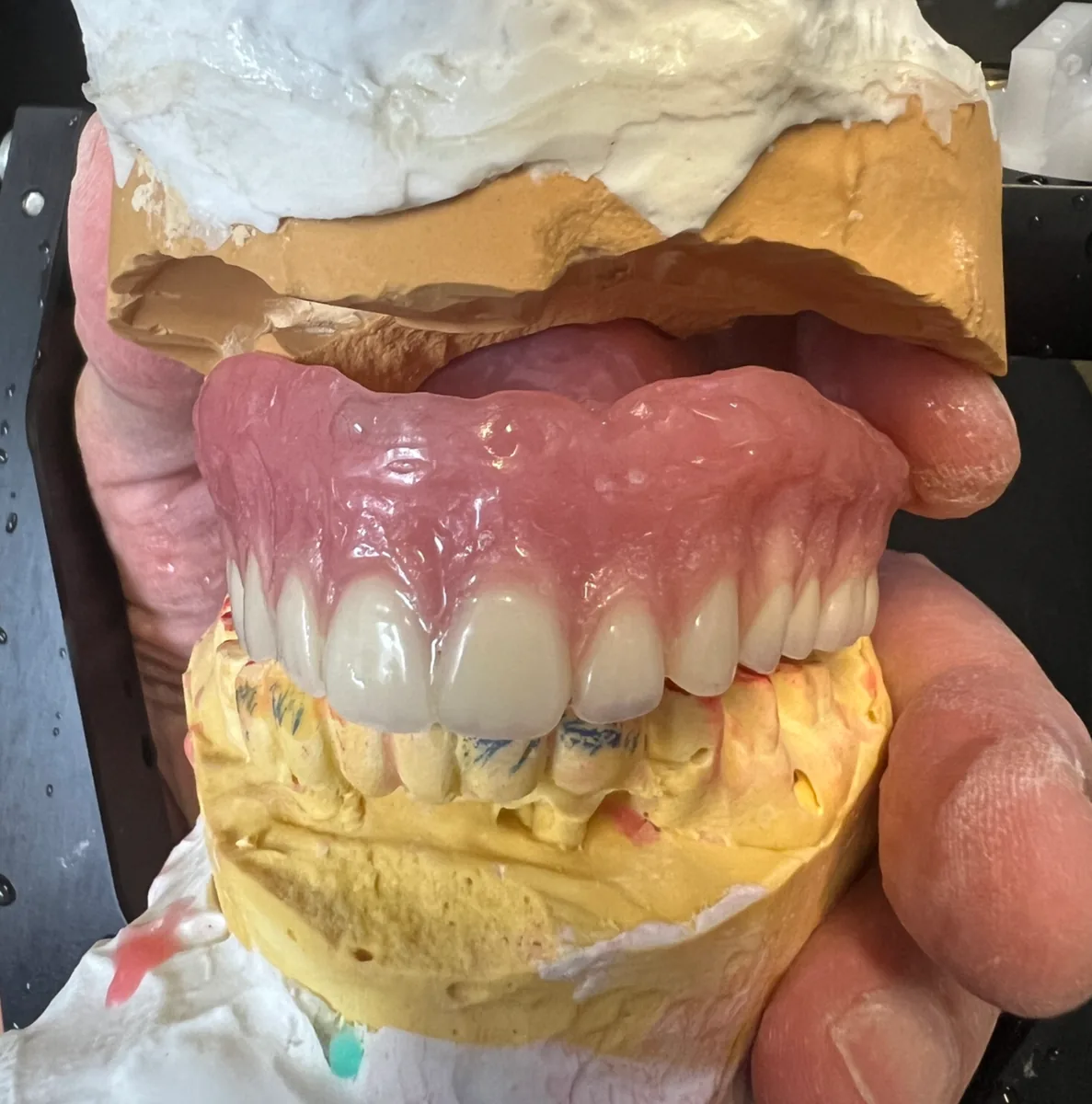
Because we make dentures with the same approach as for people who have their teeth
At our clinic, we build the bite of a denture with the same approach as the bite of people who have their teeth.
For this reason, when making dentures too, we record the skeleton and jaw movement and work out the bite from those records.
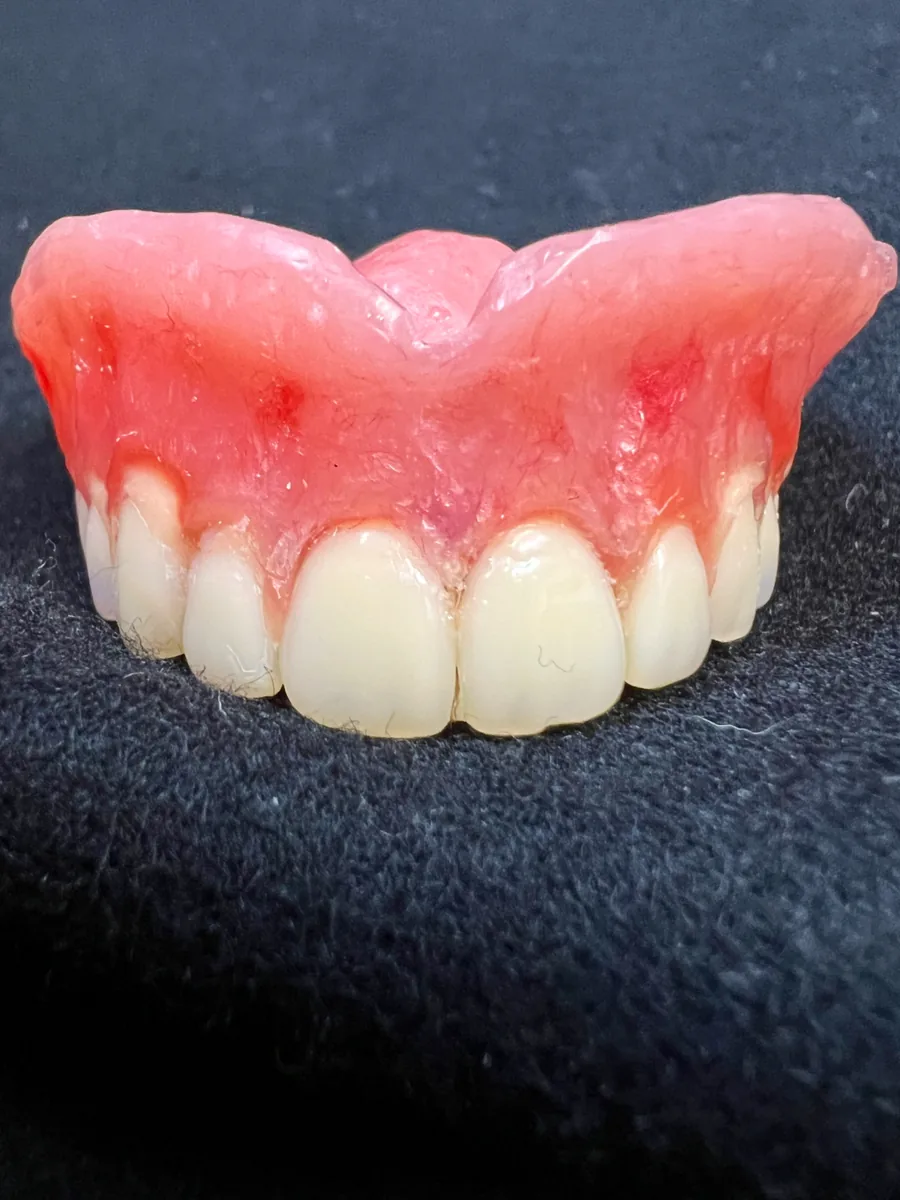
To aim for dentures you can chew with and use for a long time
The director's goals for a denture are both that you can chew with it and that it can be used for a long time.
To that end, he places importance on taking proper records of the two states and expressing them in the shape of the denture.
How long a denture can actually be used varies from person to person.
In practice at our clinic
Within the course of denture treatment
Intraoral gothic arch tracing is one of the examinations carried out when making dentures.
In the examinations for dentures, we combine records such as the following according to the condition of your mouth.
- Cadiax: jaw joint movement in a relaxed state
- Lateral cephalometric analysis: the skeleton. We consider the height between the upper and lower jaws when biting (the vertical dimension of occlusion) and the inclination of the plane on which the teeth are arranged (the occlusal plane)
- Intraoral gothic arch tracing: traces of lower jaw movement while clenching
- Mucosal records: the shape of the mucosa when relaxed, under force and in between
The skeletal and jaw movement records are set on the articulator, and we work out the position of the artificial teeth and the inclination of the biting surfaces.
For complete dentures, we work out the angle of the slopes of the artificial teeth's cusps (cusp inclination) from the Cadiax records.
The mucosal records are used to express the shape when relaxed, under force and in between in the shape of the denture.
The step of arranging the artificial teeth from the records is described on the artificial tooth arrangement page, and the device on which the records are set on the Girrbach Reference SL articulator page.
After that, you use a provisional denture so that its function and appearance can be checked, and then we make the final denture.
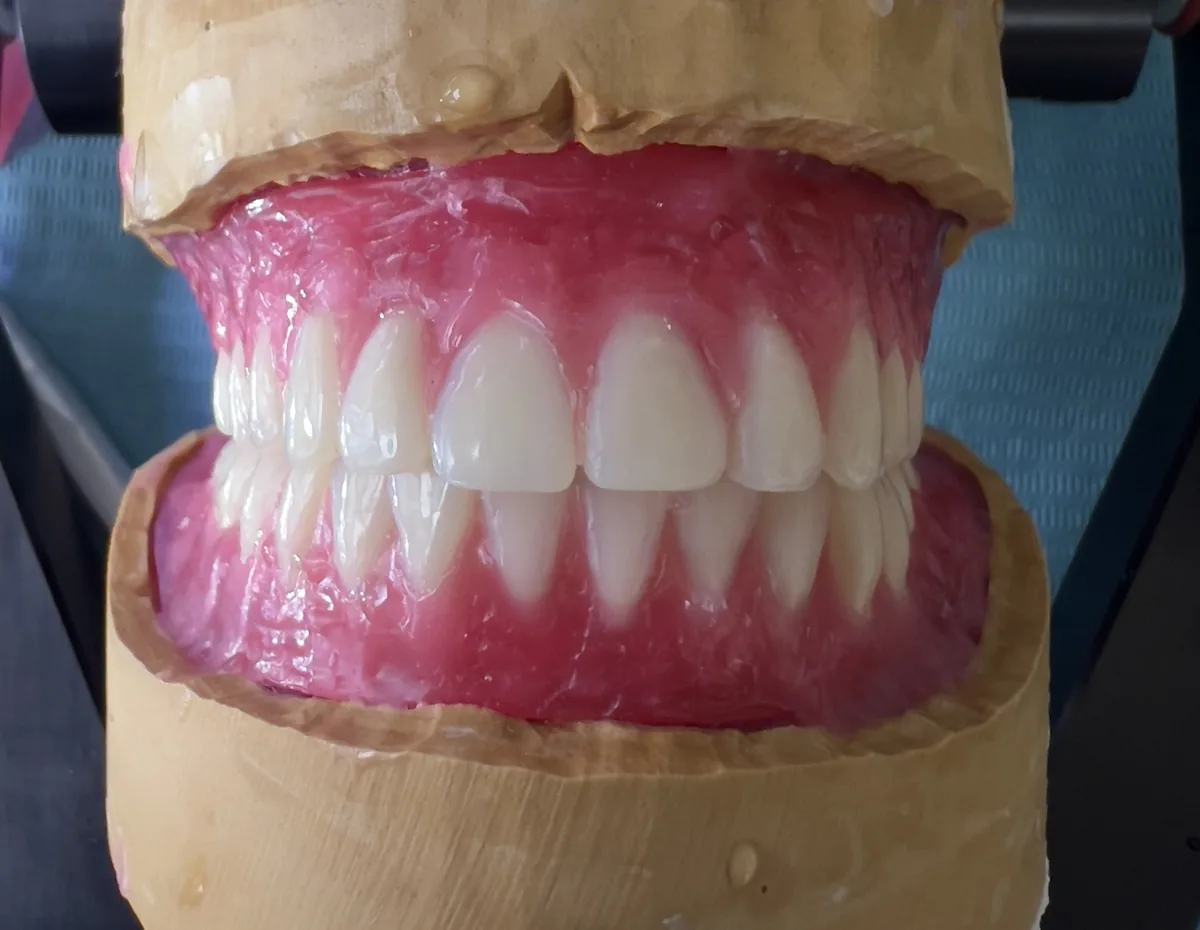
What we ask you to do during recording
During recording, we ask you to clench firmly with the device in your mouth.
In the general method, the record is made by moving the lower jaw forwards and to the left and right while the projection stays against the plate.
It is said that some people get used to these movements quickly, while others need to practise several times.
Which dentures it is used for
In the director's posts, this recording is presented in examples of making complete dentures.
We choose which examinations to carry out according to the condition of your mouth, such as whether any teeth remain.
Treatment duration, number of visits, fees and risks → Fees
What intraoral gothic arch tracing can and cannot tell us
What intraoral gothic arch tracing can tell us
- Traces of lower jaw movement while clenching (with close to maximum muscle force)
- Traces of lower jaw movement while clenching (traces left in resin)
- In general, the shape of the traced figure and the position of its apex. These are said to provide clues for working out the horizontal relationship between the upper and lower jaws
What it cannot tell us, and how we compensate
| What it cannot tell us | How we compensate |
|---|---|
| Jaw joint movement in a relaxed state | Cadiax |
| Three-dimensional movement of each of the left and right jaw joints, and its time course | Cadiax |
| The skeleton, and the height between the upper and lower jaws when biting (the vertical dimension of occlusion) | Lateral cephalometric analysis |
| The shape of the mucosa that supports the denture | Mucosal records |
| Whether the bite worked out from the records fits in the mouth | Checking while you use a provisional denture |
In addition, it is generally said that the results of this recording may vary depending on the materials used, the skill of the person making the recording, and the patient's understanding and cooperation.
In people who find it difficult to move the lower jaw as intended, recording may also be difficult.
Frequently asked questions
- How is it different from Cadiax?
Cadiax records the movement of the left and right jaw joints in three dimensions with the jaw relaxed.
Intraoral gothic arch tracing records movement while clenching, using a device in the mouth.
When making dentures, we use both records together.
- When is it carried out?
At our clinic, we carry it out as one of the records taken when making dentures.
We choose which examinations to carry out according to the condition of your mouth.
- What do I do during the recording?
With the recording device in your mouth, we ask you to clench firmly.
In the general method, you then move your lower jaw forwards and to the left and right in that state to make the record.
- Why is it called "intraoral"?
Because the recording device is placed inside the mouth to make the record.
A method in which the device is placed outside the mouth for recording is called an extraoral method.
- What are the records used for?
Together with the Cadiax records and the mucosal records, they are used to work out the shape of the denture.
Related technologies and treatments
- Cadiax
- Mucosal records
- Lateral cephalometric analysis
- Artificial tooth arrangement
- Dentures (precision dentures): examinations
- All the technologies we use
Sources we referred to
For the general explanations (how the gothic arch tracing method works, and its terminology), we referred to the following published sources. What we describe about our own methods is based on the director's posts and explanations.
- Kodama N, Atsuta I, Matsumaru Y, Matsuda K. Back to the basics: is Gothic arch tracing really necessary? Annals of Japan Prosthodontic Society. 2018;10(1):16-22 (in Japanese)
- The Academy of Prosthodontics, "The Glossary of Prosthodontic Terms, Ninth Edition". J Prosthet Dent. 2017;117(5S) (PDF)
- Quintessence Publishing, [Encyclopedia of Dental Clinical Examinations], "[Gothic arch tracing]" (in Japanese)
- Quintessence Publishing, [New Encyclopedia of Occlusion], "[Extraoral tracing]" (in Japanese)
Consultations and enquiries
Gibakai Medical Corporation
Yoshimi Dental Clinic
Square 2, Room 302 (third floor)
1-29-1 Tsukushino, Machida,
Tokyo 194-0001, Japan
TEL 042-795-1359 FAX 042-795-1398
Clinic days: Mon · Tue · Thu · Fri
10:00–13:00 / 14:30–18:00
A first visit begins with a first consultation (a private, non-insured service; 30 minutes to 1 hour) for examination and diagnosis. Questions about a diagnosis you received elsewhere are also covered within it.
In an emergency, such as being unable to chew or having severe symptoms, please call us on 042-795-1359 to discuss it.