What are mucosal records?
Mucosal records are records for capturing the shape of the gums (mucosa) that support a denture according to how biting force is applied, and expressing it in the shape of the denture.
At our clinic, we capture the shape of the gums in three states, "relaxed", "under force" and "in between", and make use of this in designing the denture.
A denture works while resting on the gums.
The gums are soft, and when you bite they are pressed down and sink.
How they sink also changes with the strength of the biting force.
So at our clinic, we also anticipate the shape of the gums during biting and express it in the inner surface of the denture.
We combine this record with two records of jaw joint movement (in a relaxed state and while clenching) to design the denture.
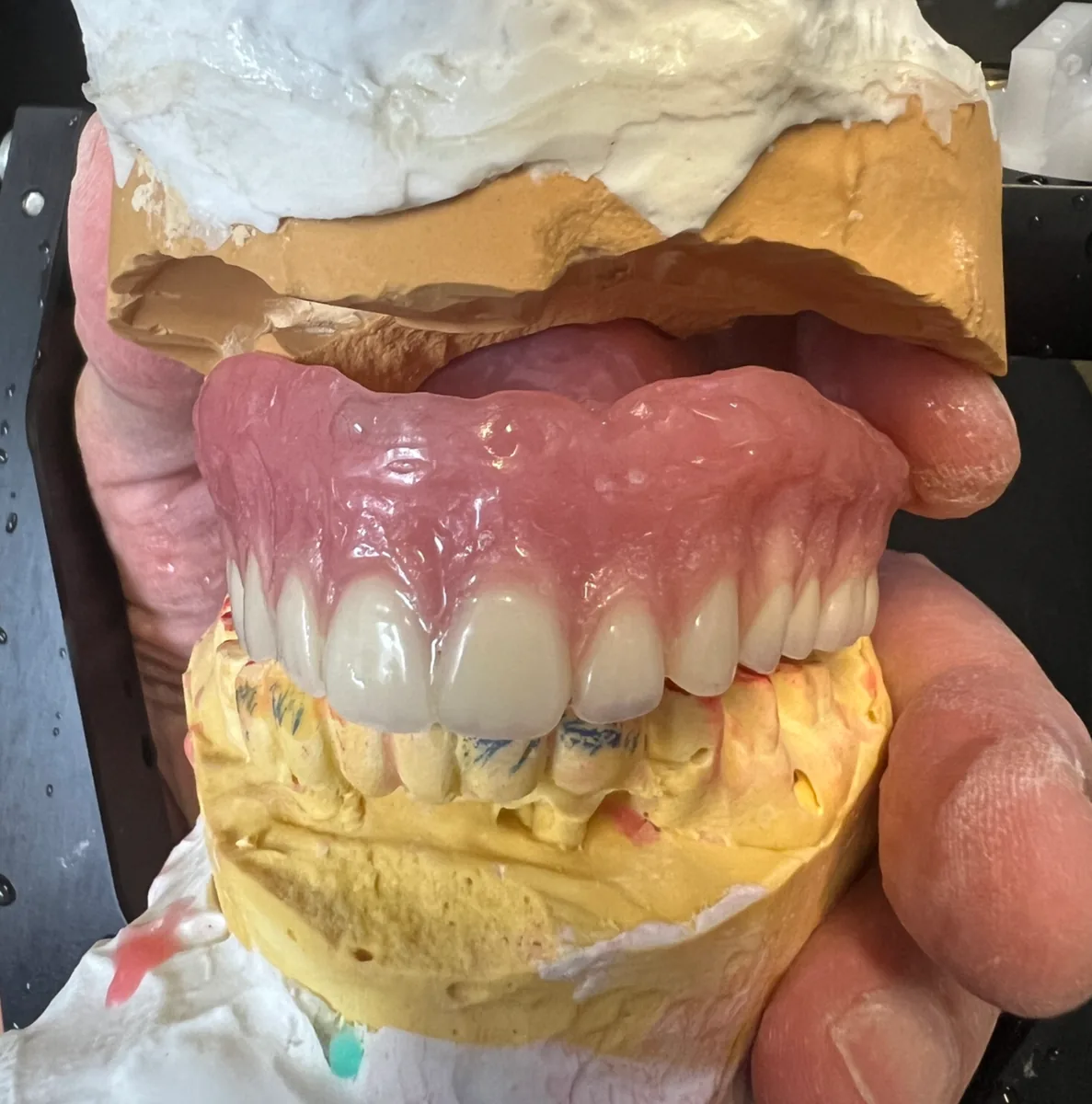
How mucosal records work
The gums sink differently depending on location and force
The thickness and properties of the gums that support a denture differ from place to place.
How much they sink also changes depending on whether the biting force is strong or weak.
At our clinic, we design dentures considering the balance of the amounts of sinking that arise from differences in biting force and in the thickness of the mucosa.
In the partial dentures of people who still have some of their teeth, both the remaining teeth and the gums support the denture.
The director explains that when you bite, the gums move about ten times as much as the teeth.
The raised ridge formed by the bone that used to support the teeth (the alveolar bone), which remains after the teeth are lost, is generally called the residual ridge.
The residual ridge is covered with mucosa and serves as the foundation that supports the denture.
The bone under a denture may be gradually resorbed as the denture is used.
We capture three states
The amount of force the gums receive is completely different when you bring your teeth together lightly and when you clench.
For this reason, at our clinic we record the shape of the gums and the movement of the jaw joints in the following combinations.
| State | What we record |
|---|---|
| Relaxed | Shape of the gums / jaw joint movement (Cadiax) |
| Under force (when clenching) | Shape of the gums / jaw joint movement (intraoral gothic arch tracing) |
| In between | Shape of the gums |
Both jaw joint movement and the shape of the gums change with how force is applied.
The director says that those who make dentures need to take these differences into account.
Where on the denture the records are expressed
The director sums up what is important in complete dentures in the following three points.
- Express, in the inner surface of the denture (the surface that touches the gums), the anticipated shape of the gums during biting.
- Take an impression of the shape of the tongue and cheek mucosa in motion, and reflect it in the shape of the outer surface of the denture.
- Express, in the bite of the denture, the position in which the lower jaw settles.
The third point, the position of the lower jaw and the bite, is worked out from the skeletal and jaw joint records (artificial tooth arrangement).
Photos: the inside and outside of dentures
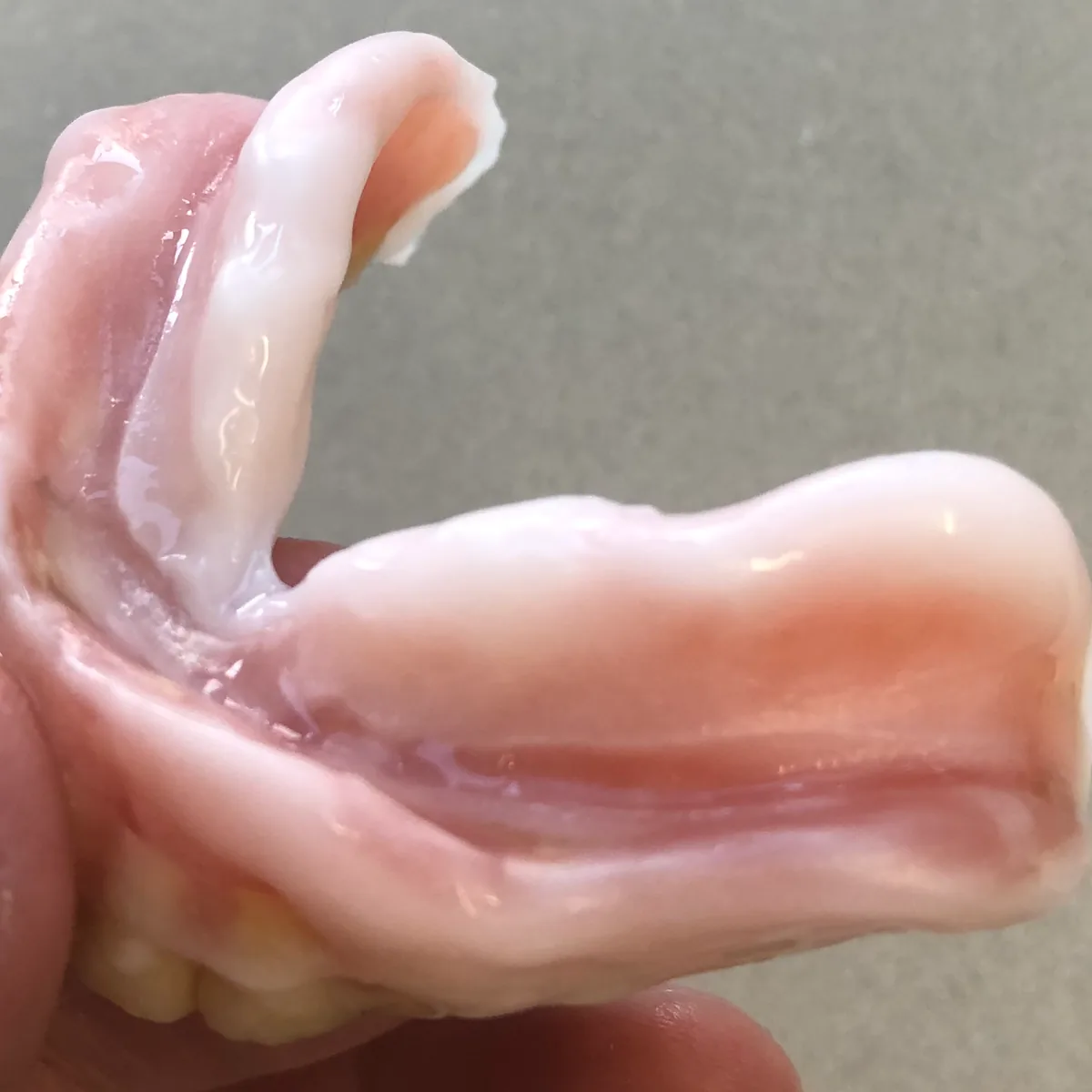
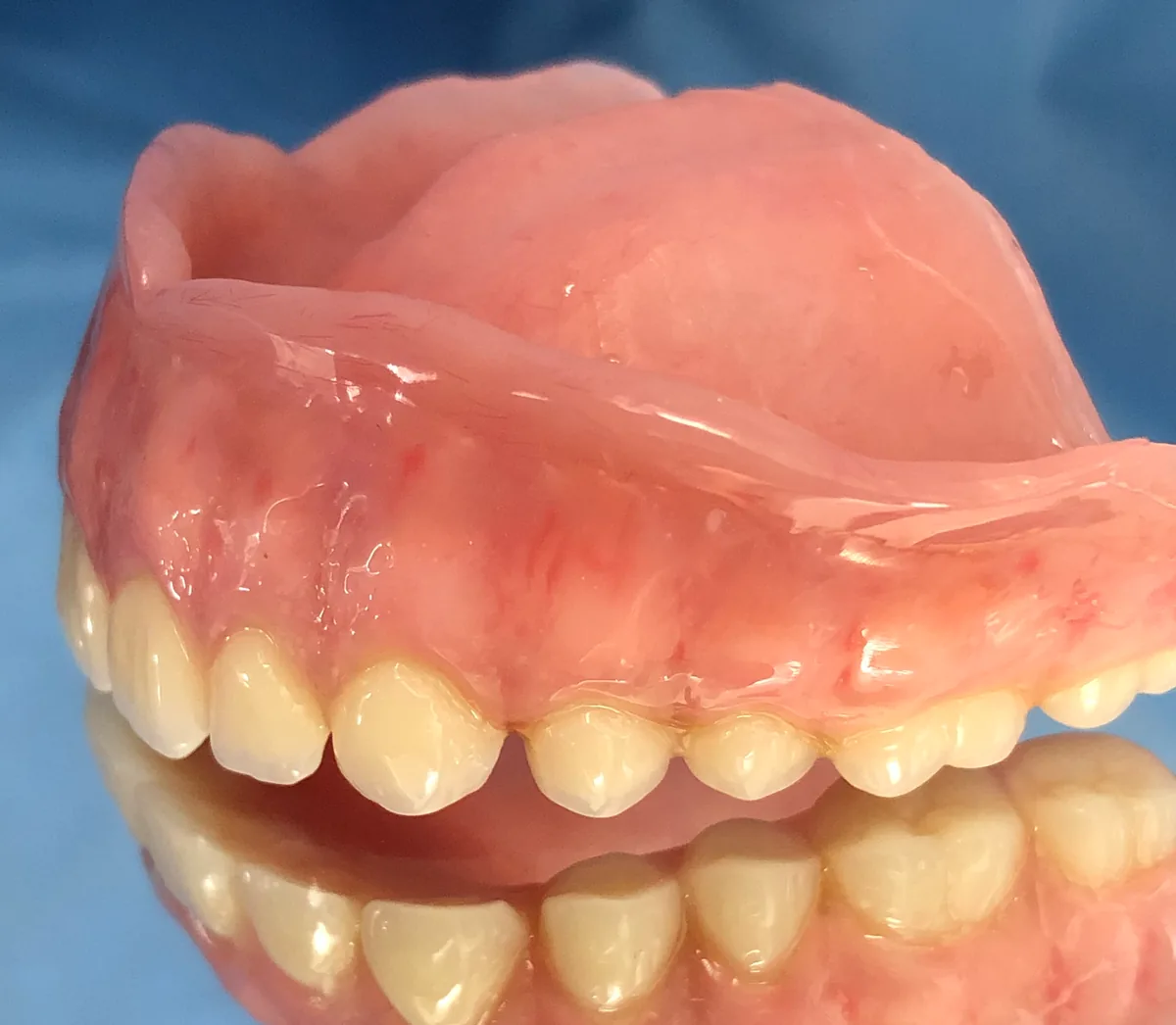
Where the metal framework touches the gums
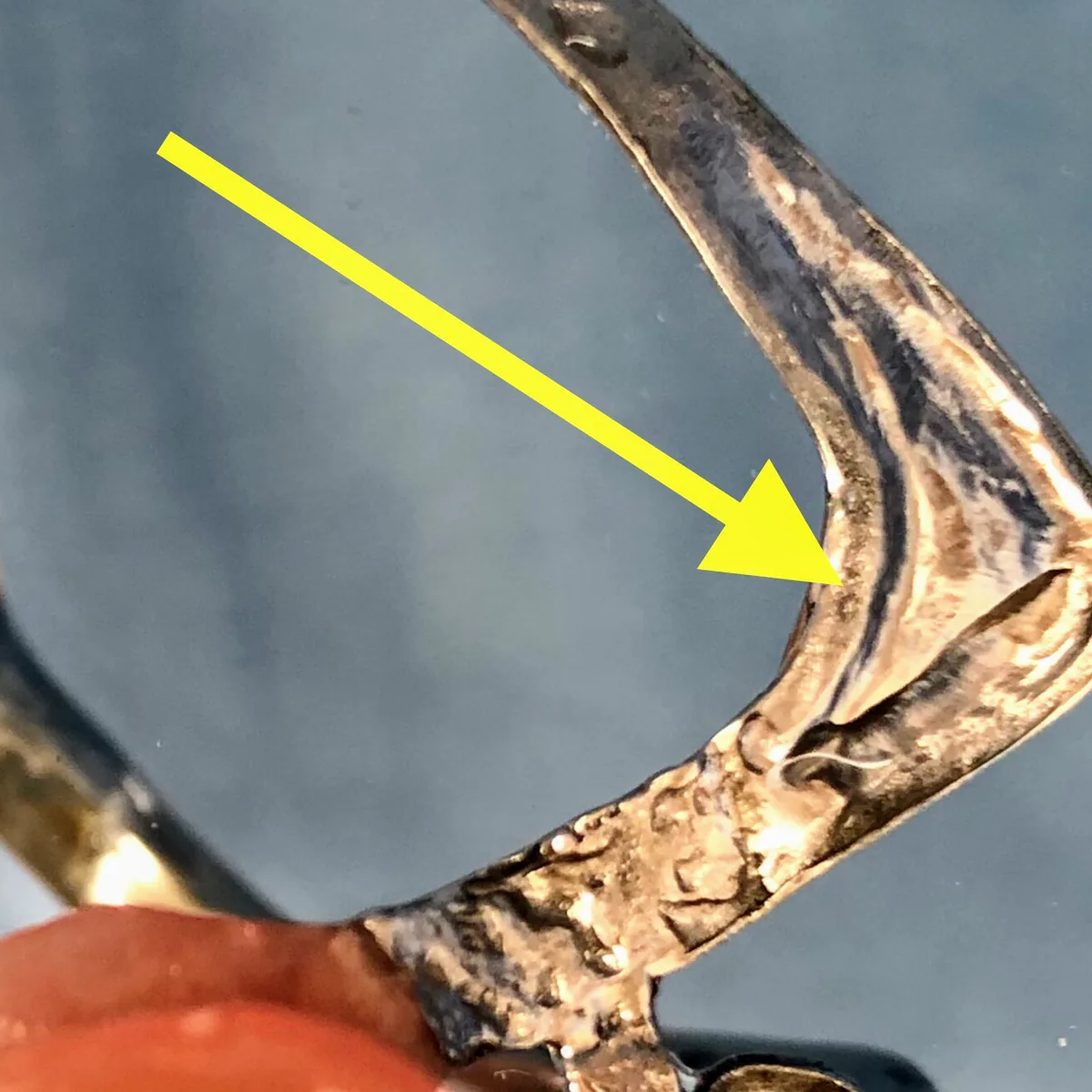
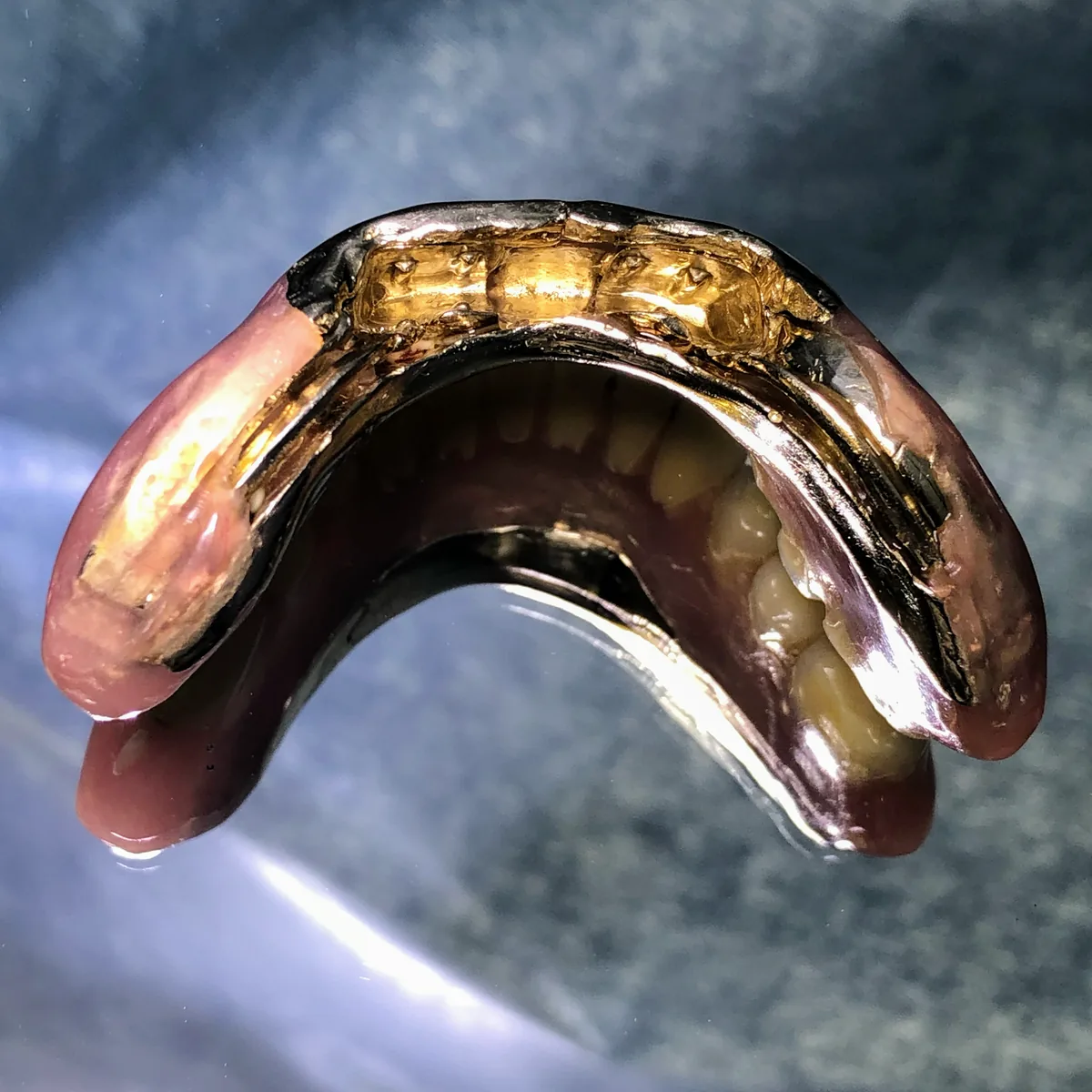
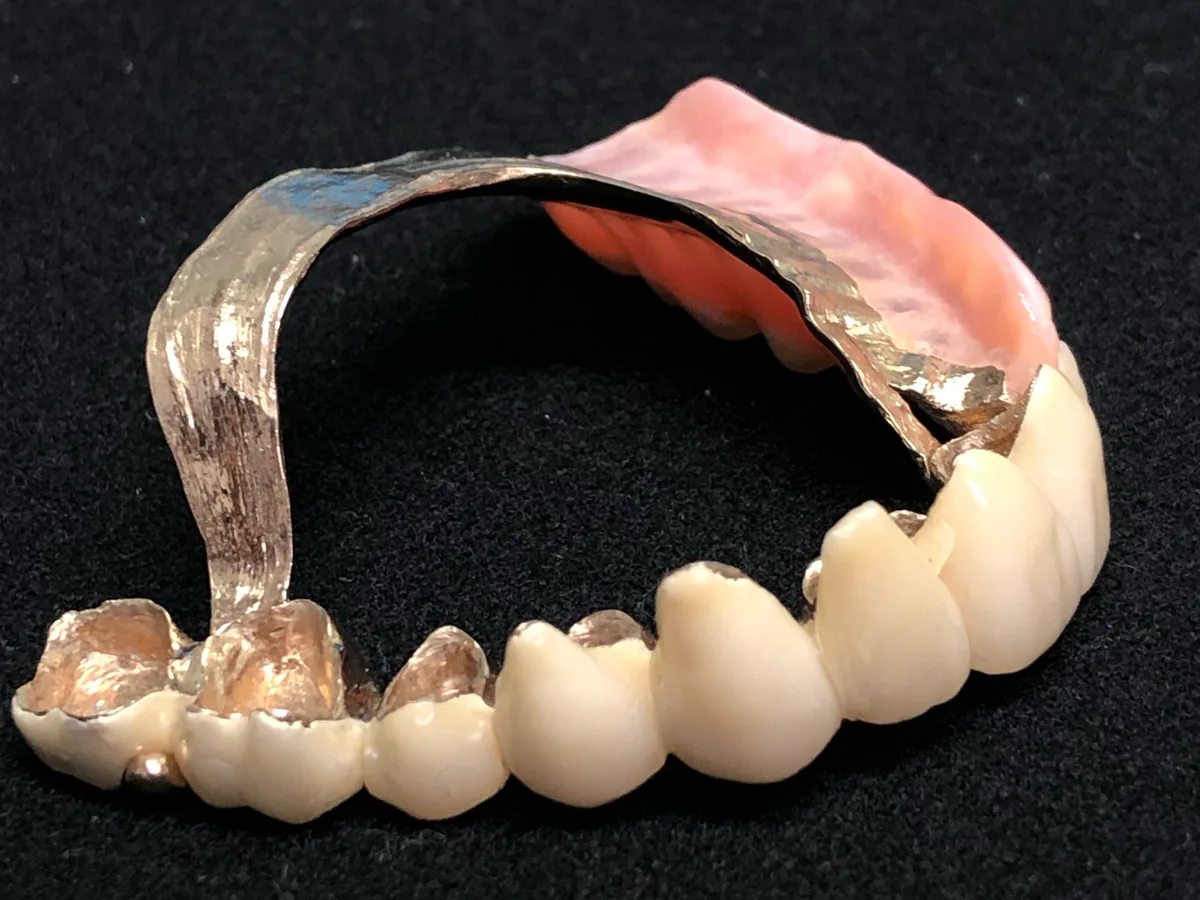
In dentures that use a metal framework (the skeleton of the denture), we also consider the shape of the places where the framework touches the gums and the tongue.
In the mouth, the tongue is the part most likely to feel discomfort.
We therefore reflect the shape of the tongue in the shape of the framework.
Air passing in and out between the gums and the framework is also a cause of discomfort.
At our clinic, we add a small raised ridge (a barrier) called "beading" along the edge of the framework as a way of reducing discomfort.
Why we use mucosal records
Because a denture needs to be stable on the gums
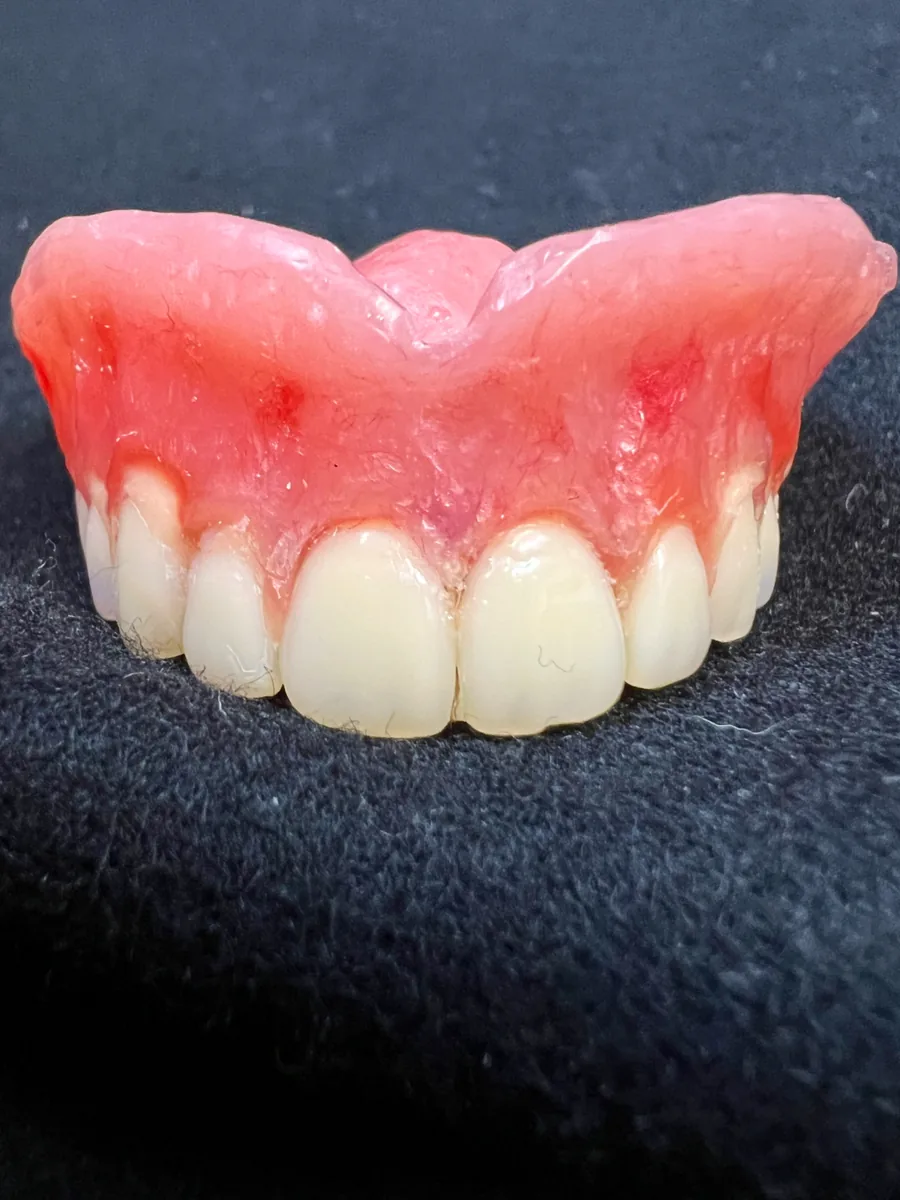
Unlike treatments in which the teeth remain, such as orthodontic treatment, with dentures we have to consider how the denture will be stable on the mucosa.
The director considers three-dimensional records of the jaw joints to be essential for this purpose as well.
Because the force on the gums differs between biting lightly and clenching
A denture works on the gums both when the teeth are brought together lightly and when you clench firmly.
We aim to express in the shape of the denture not just one of these states but both, and even the state in between.
Because we want to distribute pressure evenly during biting
The director believes it is important to know the types and properties of the mucosa well, and to distribute the pressure on the gums evenly while the denture is working during biting.
This approach does not change even for complete dentures for people with extensive resorption of the residual ridge bone.
Because dentures are used for a long time
Dentures are something you use for a long time.
The director says that, with that long course in mind, it is important to take proper records of the two states and to express them accurately in the shape of the denture.
In practice at our clinic
Within the process of making a denture
Mucosal records are taken as part of the examinations and design when a denture is made.
Whether it is a complete denture supported by the gums alone or a partial denture supported by the remaining teeth and the gums, we consider its stability on the mucosa.
- At the first consultation, we ask about any problems with your current denture and the treatment you have had so far, and check the condition of your mouth.
- In the detailed examinations, we record the skeleton (lateral cephalometric analysis) and jaw joint movement (Cadiax, intraoral gothic arch tracing), and also capture the shape of the gums. We also take impressions of the shape of the tongue and cheeks in motion.
- Based on the records, we design the denture on casts mounted on an articulator, together with the position of the artificial teeth (artificial tooth arrangement) and the shape of the framework (denture design based on the finite element method).
- In fabrication, we allow for the discrepancies caused by shrinkage of the resin as it sets (polymerization shrinkage) and shrinkage of platinum-gold alloy when it is cast (casting shrinkage), and apply correction values (casting, platinum-gold alloy).
- While you use a provisional denture, we check how it works as a denture (provisional restorations and provisional dentures).
- After the final denture has been fitted, we continue to check the condition of the gums and the denture and make adjustments as needed.
Changes over time
When the bone under the denture resorbs, the shape of the gums also changes.
At our clinic, we take this change into account from the design stage and continue to check the condition after the denture has been fitted (Dentures: for long-term use).
Treatment duration, number of visits, fees and risks → Fees
What mucosal records can and cannot tell us
What mucosal records can tell us
- The difference in the shape of the gums between the relaxed state and when force is applied
- The shape of the gums in the state in between
- Differences in the thickness and properties of the mucosa from place to place, and in how it sinks
- The shape of the tongue and cheek mucosa in motion
What they cannot tell us, and how we compensate
| What they cannot tell us | How we compensate |
|---|---|
| Jaw joint movement in a relaxed state | Cadiax |
| Jaw joint movement while clenching | Intraoral gothic arch tracing |
| The skeleton, and the height between the upper and lower jaws | Lateral cephalometric analysis, artificial tooth arrangement |
| The forces on the supporting teeth in partial dentures | Denture design based on the finite element method |
| Discrepancies in shape arising during fabrication | Correction values that allow for shrinkage of the resin and metal (casting) |
| Changes in the bone and gums after the denture comes into use | Checking progress and making adjustments after fitting ("For long-term use" on the dentures page) |
Frequently asked questions
- What is recorded in mucosal records?
They capture the shape of the gums (mucosa) that support the denture in three states: relaxed, under force and in between.
We also take impressions of the shape of the tongue and cheeks in motion and reflect it in the outer surface of the denture.
- Are they different from the records of jaw movement?
They are separate records.
The records of jaw movement are Cadiax, which records the relaxed state, and intraoral gothic arch tracing, which records the clenched state.
At our clinic, we combine these two jaw movement records with the mucosal records to design the denture.
- I have been told that my gums have become thin. Can a denture be made for me?
First, we examine the condition of the gums and the bone beneath them.
Even for complete dentures for people with extensive bone resorption, we place importance on knowing the types and properties of the mucosa well and distributing the pressure evenly when biting.
We explain what kind of denture could be considered based on the results of the examinations.
- Does the shape of the gums change as the denture is used?
In general, the bone under a denture may resorb over time, and the shape of the gums may also change.
At our clinic, we take this change into account from the design stage and continue to check the condition after the denture has been fitted.
- Do even the shapes of the tongue and cheeks matter for a denture?
Yes. The mucosa of the tongue and cheeks touches the outer surface of the denture.
At our clinic, we take impressions of the shape of the tongue and cheeks in motion and reflect it in the shape of the outer surface of the denture.
In dentures that use a metal framework, we also reflect the shape of the tongue in the framework.
Related technologies and treatments
- Intraoral gothic arch tracing
- Cadiax
- Artificial tooth arrangement
- Denture design based on the finite element method
- All the technologies we use
- Dentures (precision dentures): our approach to complete and partial dentures
- Dentures (precision dentures): for long-term use
Sources we referred to
For the general explanations (the meaning of terms), we referred to the following published sources. What we describe about our own methods is based on the director's posts and explanations.
Consultations and enquiries
Gibakai Medical Corporation
Yoshimi Dental Clinic
Square 2, Room 302 (third floor)
1-29-1 Tsukushino, Machida,
Tokyo 194-0001, Japan
TEL 042-795-1359 FAX 042-795-1398
Clinic days: Mon · Tue · Thu · Fri
10:00–13:00 / 14:30–18:00
A first visit begins with a first consultation (a private, non-insured service; 30 minutes to 1 hour) for examination and diagnosis. Questions about a diagnosis you received elsewhere are also covered within it.
In an emergency, such as being unable to chew or having severe symptoms, please call us on 042-795-1359 to discuss it.