What is occlusal plane measurement?
Occlusal plane measurement is an examination that uses an instrument to express as a number the inclination of the plane where the upper and lower teeth meet (the occlusal plane).
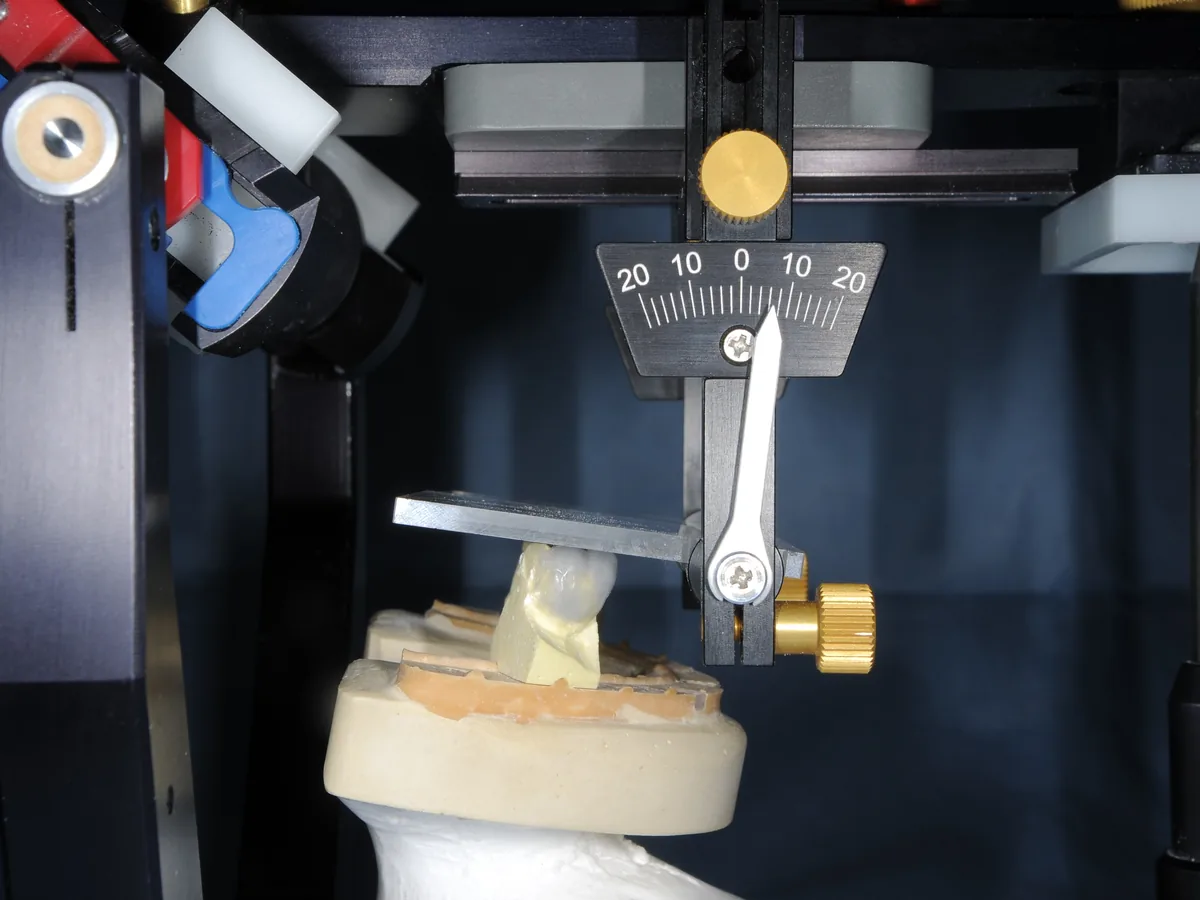
At our clinic, we measure it on casts of the teeth mounted on an articulator, by placing a graduated instrument against the biting surfaces of the teeth.
The occlusal plane generally refers to the average plane formed by the tips of the front teeth and the biting surfaces of the back teeth.
Because the actual row of teeth is not flat but gently curved, the occlusal plane is thought of as a plane that averages out that curve.
In making dentures, the plane used as a guide when arranging the artificial teeth is also called the occlusal plane.
How occlusal plane measurement works
Taking the measurement in the photo as an example, we describe the process in four steps.
- Making the casts: we take impressions of the teeth and make casts of the dental arches.
- Mounting on the articulator: the casts are mounted on an articulator. An articulator is a device on which casts of the upper and lower teeth are mounted to reproduce the positional relationship of the jaws.
- Placing the plate on the biting surface: the flat plate of the measuring instrument is placed against the biting surface of a tooth. The photo shows a measurement on the lower first molar (the sixth tooth from the front).
- Reading the inclination on the scale: the inclination of the plate is read off the scale.
GAMMA Dental of Austria, which also makes Cadiax, offers an instrument for measuring the inclination of the occlusal plane on the articulator in degrees and for adjusting it.
According to the manufacturer, it is used not only in instrumental examination but also in the process of creating tooth shapes in wax.
The reference plane for analysis
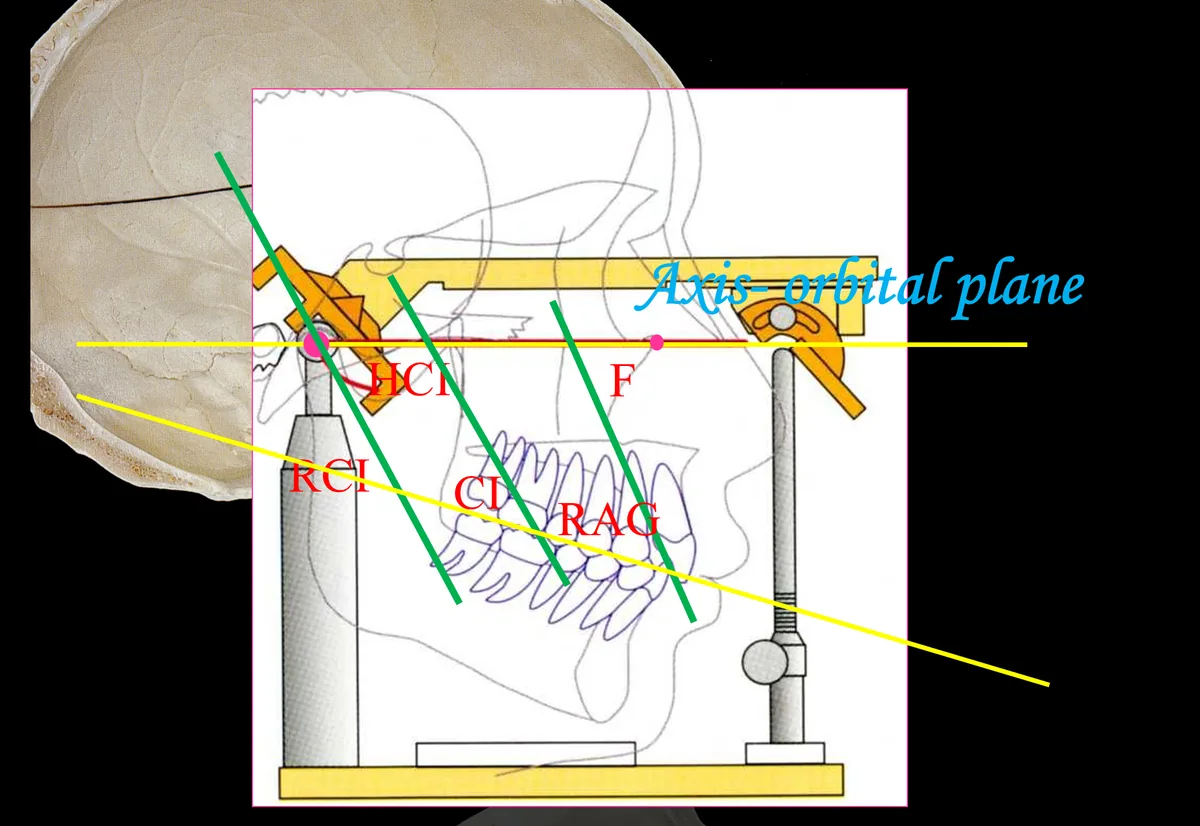
At our clinic, we always use the axis-orbital plane as the reference plane for analysing the bite.
Information analysed against this reference can be represented on the articulator.
The reference plane is explained on the lateral cephalometric analysis page, and the articulator on the Girrbach Reference SL articulator page.
Its place in research
Research by Professor Sadao Sato and colleagues has reported that there may be a relationship between the inclination of the occlusal plane of the upper back teeth and the front-to-back position of the lower jaw.
A study of people with maxillary protrusion has reported a relationship between a steep inclination of the occlusal plane of the back teeth and a lower jaw that is small and set back.
These are research findings and do not indicate the results of treatment for any individual.
Why we use occlusal plane measurement
To grasp deviations in inclination as numbers
Expressing the inclination of the biting surfaces as a number makes it possible to see how far it deviates from the normal range.
To consider how to correct it and how long treatment will take
The length of treatment differs depending on whether the inclination of the biting surfaces is corrected with orthodontic treatment or with crowns or similar restorations.
On the other hand, even if the method of correction differs, the target bite is the same.
The measured values serve as a basis for considering the treatment options.
Because we consider the inclination of the back teeth to be related to the position of the lower jaw
The director considers the inclination of the biting surfaces of the row of back teeth to be related to the front-to-back position of the lower jaw.
For this reason, the angle at which orthodontic treatment acts on the biting surfaces of the back teeth differs between maxillary protrusion and mandibular protrusion.
Because with dentures, the plane on which to arrange the artificial teeth has to be decided
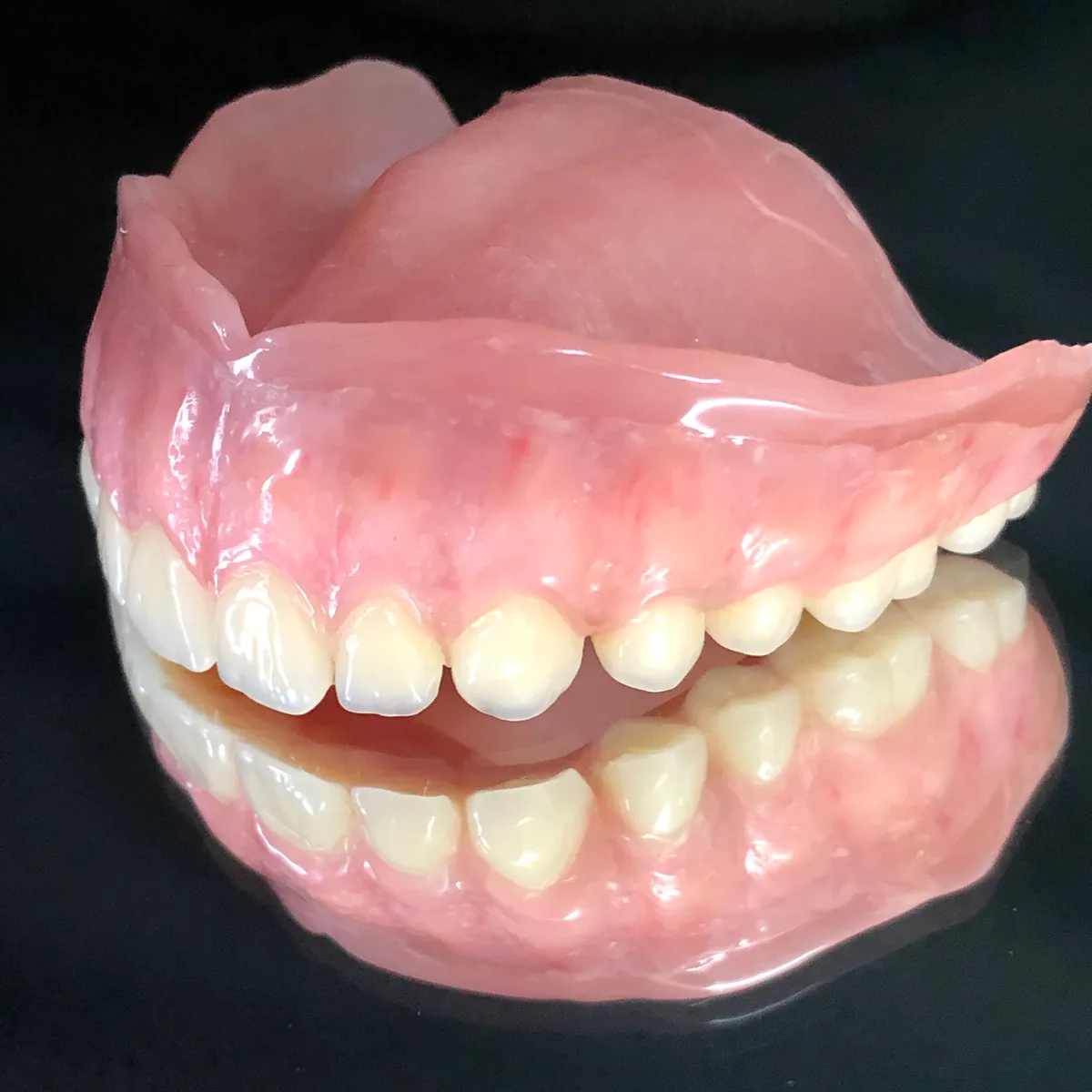
For complete dentures, the inclination of the plane on which the artificial teeth are arranged has to be decided.
At our clinic, we set the occlusal plane based on skeletal information from lateral cephalometric analysis.
For details, please see the lateral cephalometric analysis and artificial tooth arrangement pages.
In practice at our clinic
As part of the detailed examinations
Occlusal plane measurement is carried out in the course of examining the bite, using casts made from impressions of the teeth.
In the fee table, too, a photo of occlusal plane measurement is shown in the "Orthodontic work-up (bite examination)" entry.
The measurement is made on the casts.
What we ask of the patient is to have impressions of the teeth taken.
Orthodontics
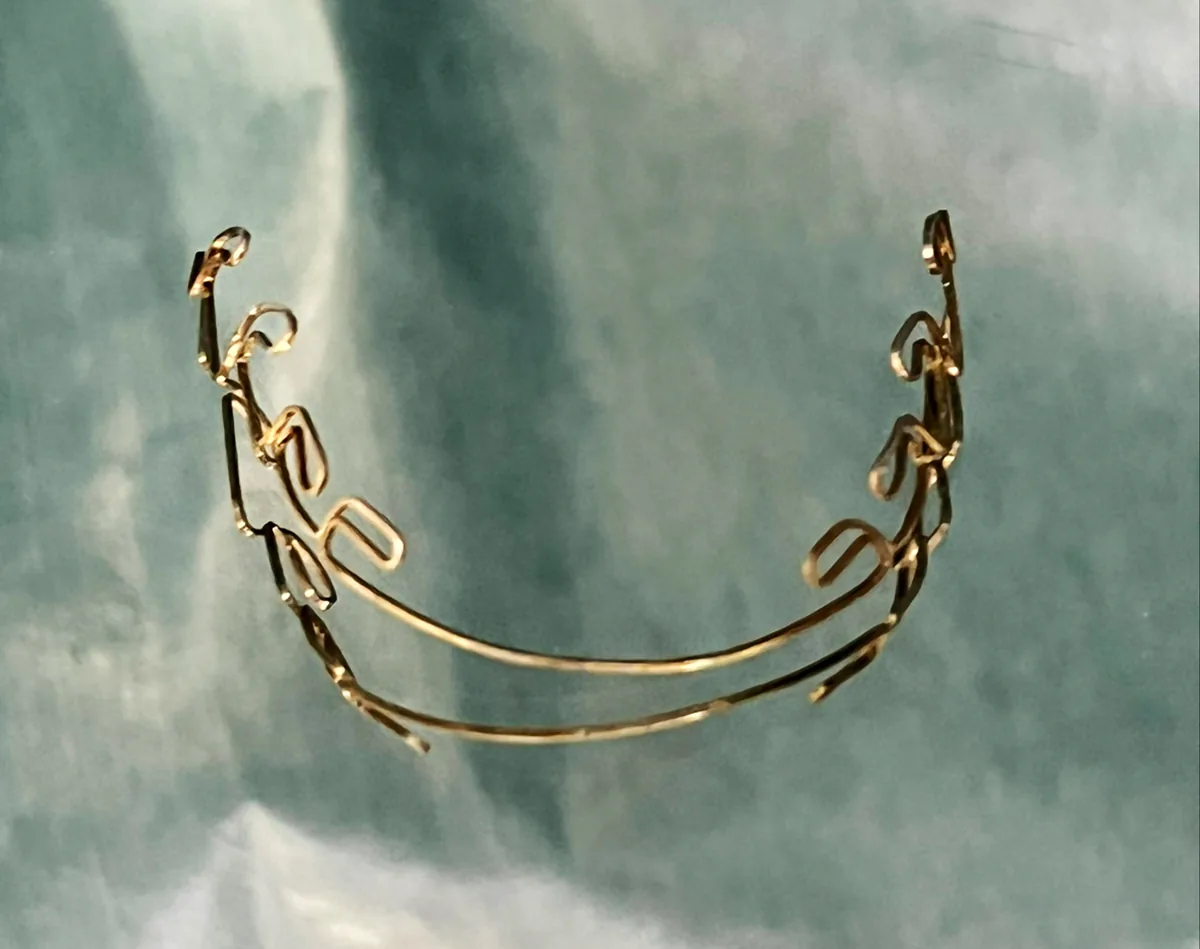
Orthodontic treatment may involve correcting the inclination of the biting surfaces of the back teeth.
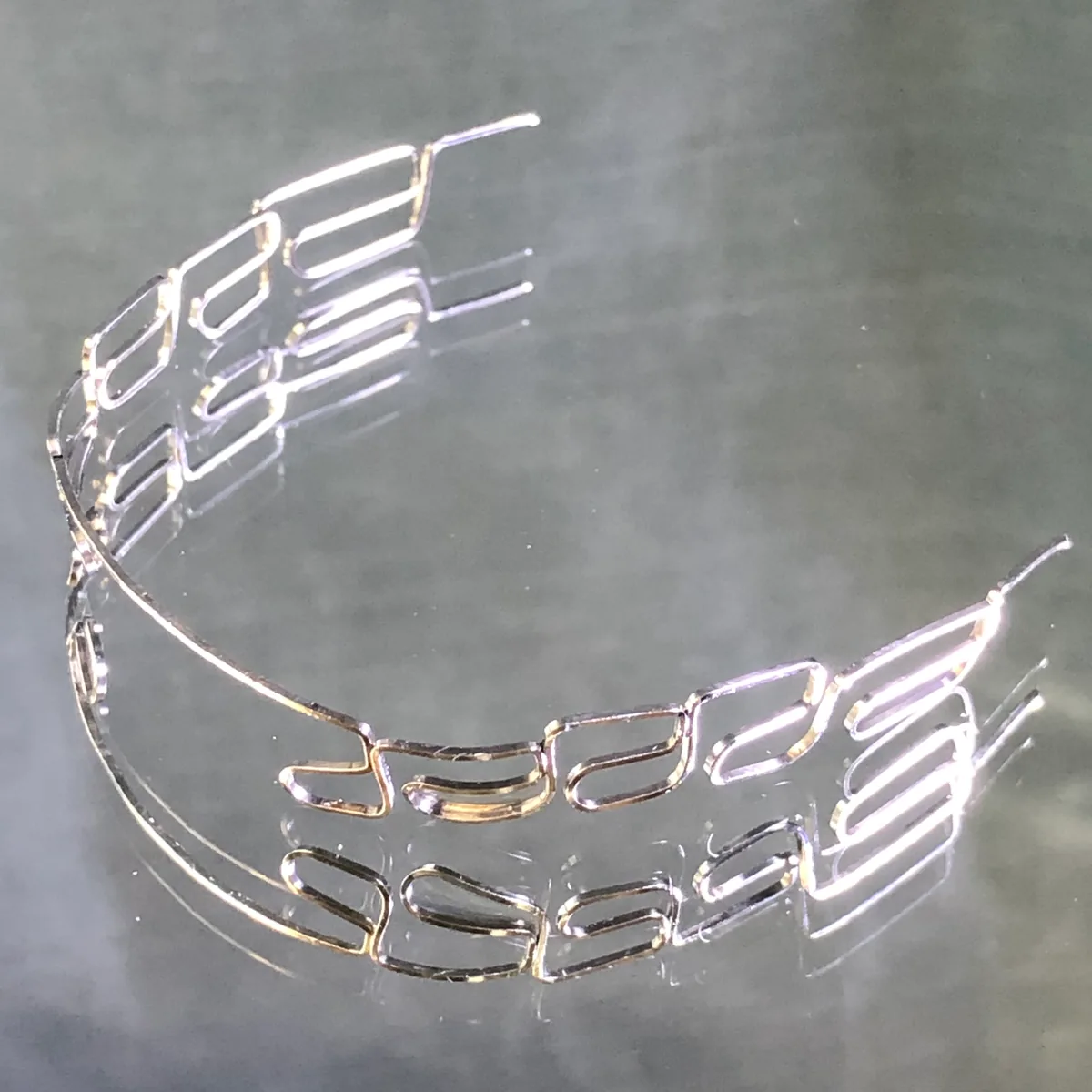
At our clinic, we move the teeth with a wire with loops bent into it (MEAW), taking into account the height and inclination of each tooth.
For the wire, please see the MEAW page.
Temporomandibular disorders
In the treatment of temporomandibular disorders (TMD), correcting the inclination of the biting surfaces may be one of the goals of treatment.
Crowns
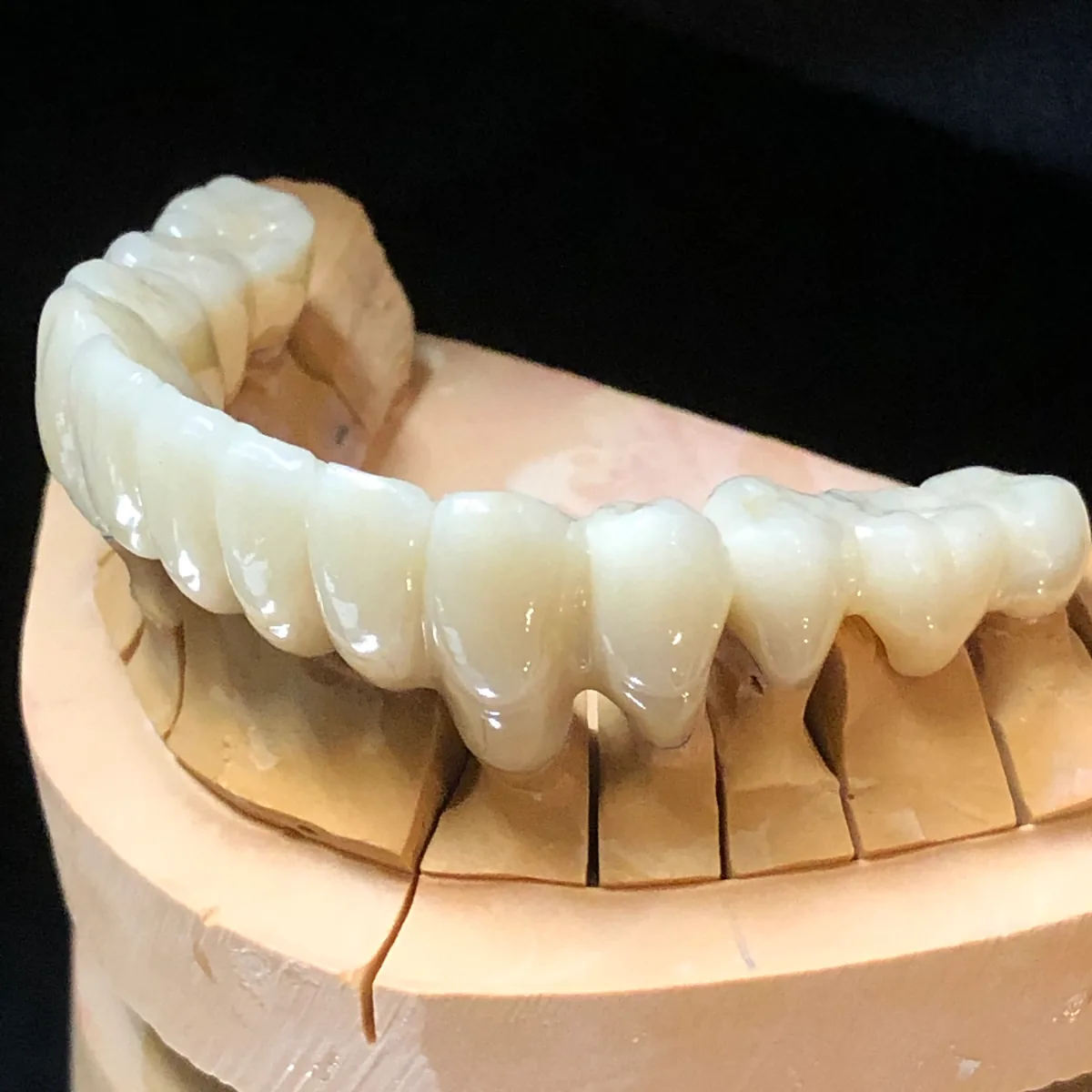
The inclination of the biting surfaces can also be corrected through the shape of crowns or similar restorations.
Together with other examinations
We do not decide the treatment plan on the basis of occlusal plane values alone.
We consider them together with the skeleton, jaw joint movement, the condition of each individual tooth and other factors.
Treatment duration, number of visits, fees and risks → Fees
What occlusal plane measurement can and cannot tell us
What occlusal plane measurement can tell us
- The inclination of the biting surfaces of the teeth (as a number)
- The degree of deviation from the normal range
- Clues for considering how to correct it (orthodontic treatment, or crowns or similar restorations)
What it cannot tell us, and how we compensate
| What it cannot tell us | How we compensate |
|---|---|
| Jaw joint movement | Cadiax |
| Skeletal structure (relationship between the upper and lower jaws, facial height) | Lateral cephalometric analysis |
| The orientation and inclination of each tooth | Sectioned cast |
| Tooth contact during sleep | BruxChecker |
| Whether a bite with a corrected inclination fits in the mouth | Checking while you use provisional restorations or provisional dentures |
In addition, the cause of symptoms cannot be determined from the inclination values of the biting surfaces alone.
Frequently asked questions
- What is the occlusal plane?
It is the plane where the upper and lower teeth meet.
It is thought of as the average plane formed by the tips of the front teeth and the biting surfaces of the back teeth.
- Is it measured in the mouth?
No. Casts made from impressions of the teeth are mounted on an articulator, and the measurement is made on them.
What we ask of the patient is to have impressions of the teeth taken.
- If the inclination is off, is treatment necessary?
The measured value is one piece of information for considering treatment.
We consider it together with the results of other examinations, and explain the treatment options and the cost, duration and number of visits for each.
The examination results may lead to a decision not to carry out orthodontic treatment.
- What is the difference between orthodontic treatment and crowns?
The difference is whether the inclination of the biting surfaces is corrected by moving the teeth or through the shape of crowns or similar restorations.
The length of treatment varies with the method.
With either method, the target bite is the same.
- Is the occlusal plane also considered for dentures?
Yes. For complete dentures, we set the occlusal plane based on skeletal information from lateral cephalometric analysis.
Related technologies and treatments
- Sectioned cast
- Girrbach Reference SL articulator
- Lateral cephalometric analysis
- MEAW
- Temporomandibular disorders & orthodontic treatment that avoids extractions where possible: examinations
- Dentures (precision dentures): examinations
- Thorough diagnosis before treatment (14 examination items)
- All the technologies we use
Sources we referred to
For the general explanations (the meaning of the occlusal plane, the measuring instrument and the research), we referred to the following published sources. What we describe about our own methods is based on the director's posts and explanations.
- The Academy of Prosthodontics, "The Glossary of Prosthodontic Terms, Ninth Edition". J Prosthet Dent. 2017;117(5S) (PDF)
- GAMMA Dental, "Instrumental Diagnostics" (manufacturer)
- Tanaka EM, Sato S. Longitudinal alteration of the occlusal plane and development of different dentoskeletal frames during growth. Am J Orthod Dentofacial Orthop. 2008;134(5):602.e1-11
- Fushima K, et al. Significance of the cant of the posterior occlusal plane in class II division 1 malocclusions. Eur J Orthod. 1996;18(1):27-40
Consultations and enquiries
Gibakai Medical Corporation
Yoshimi Dental Clinic
Square 2, Room 302 (third floor)
1-29-1 Tsukushino, Machida,
Tokyo 194-0001, Japan
TEL 042-795-1359 FAX 042-795-1398
Clinic days: Mon · Tue · Thu · Fri
10:00–13:00 / 14:30–18:00
A first visit begins with a first consultation (a private, non-insured service; 30 minutes to 1 hour) for examination and diagnosis. Questions about a diagnosis you received elsewhere are also covered within it.
In an emergency, such as being unable to chew or having severe symptoms, please call us on 042-795-1359 to discuss it.