What is a sectioned cast?
A sectioned cast is a cast of the dental arch that has been cut apart between the teeth so that each tooth can be removed and checked individually.
At our clinic, we make them to check the teeth one by one when examining the bite.
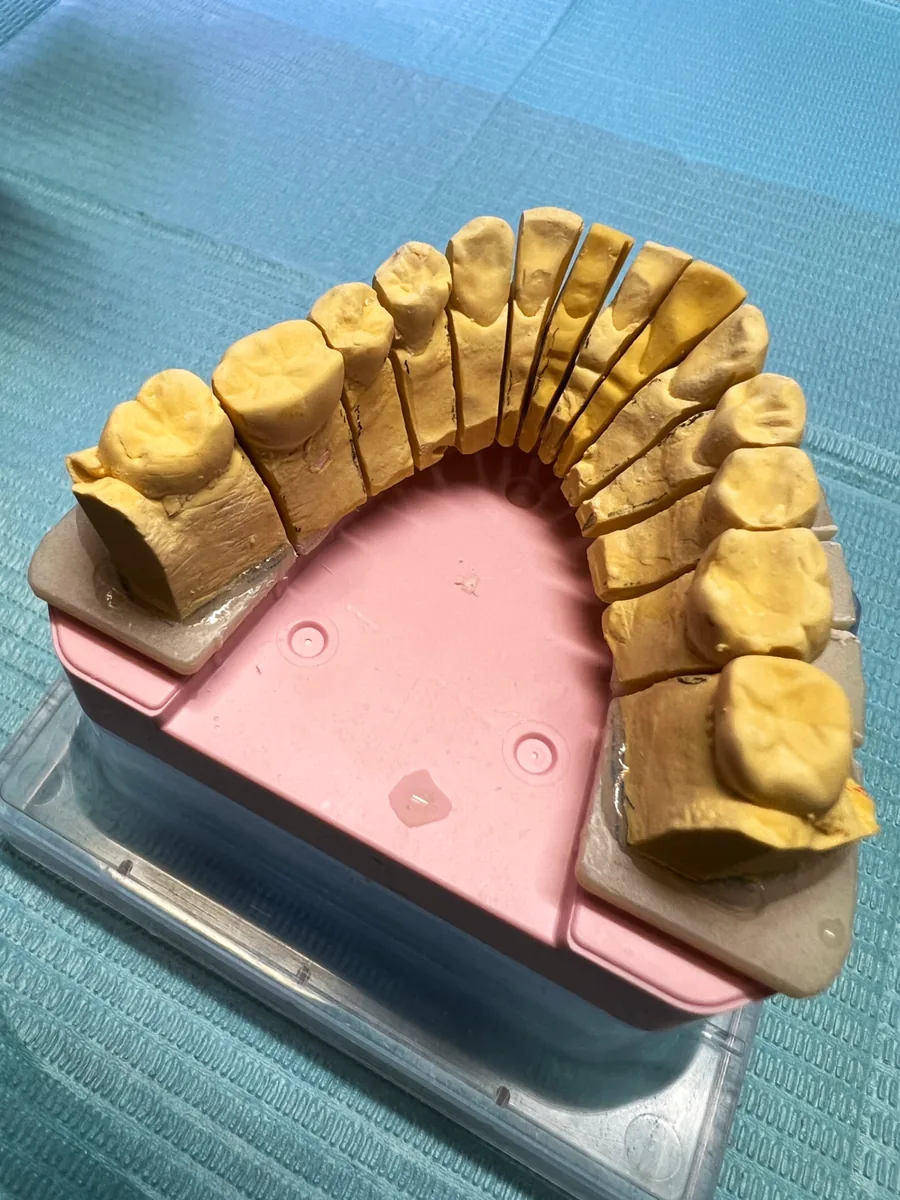
The method of making the tooth sections of a cast removable, so that they can be put back accurately in their original positions, is generally used in making crowns.
In that case, the parts made removable are mainly those such as teeth that have been prepared for crowns.
Our sectioned casts are for examining the bite.
In the cast in the photo, every tooth in the dental arch has been separated individually.
How a sectioned cast works
We describe the general way of making one in four steps.
- Taking impressions: a mould of the teeth in your mouth (an impression) is taken.
- Making the cast: plaster is poured into the impression to make a cast of the dental arch.
- Cutting between the teeth: the teeth of the cast are cut apart one by one.
- Allowing them to be put back in place: the separated teeth are set up so that they can be returned to their original positions on the base. Generally, their positions are aligned with metal pins (dowel pins) or similar.
What we check tooth by tooth
With a sectioned cast, we check the following for each tooth.
- Which direction the tooth faces
- How much the tooth is tilted
- The height of the tooth
- The state of contact with the neighbouring teeth and the opposing teeth
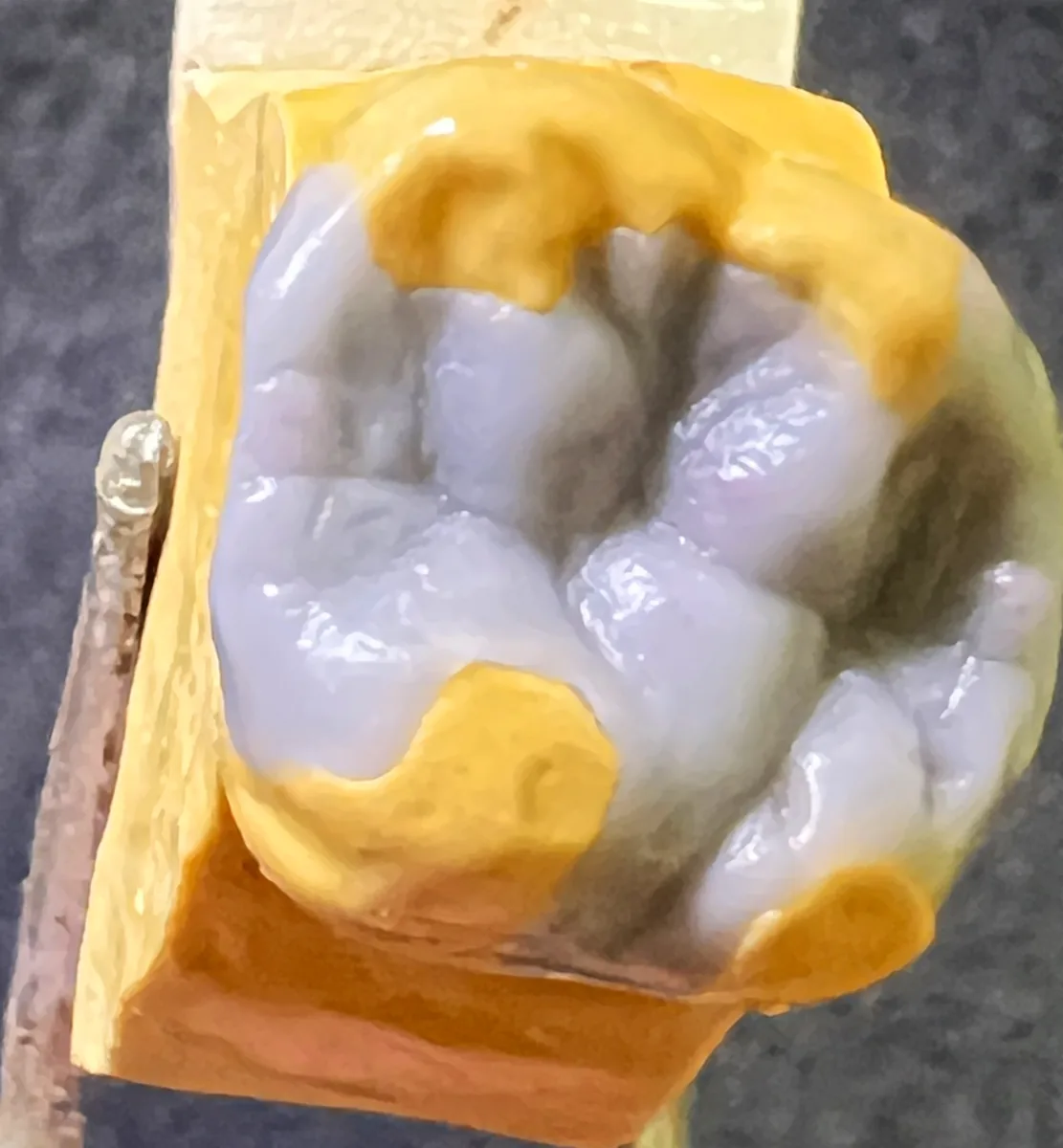
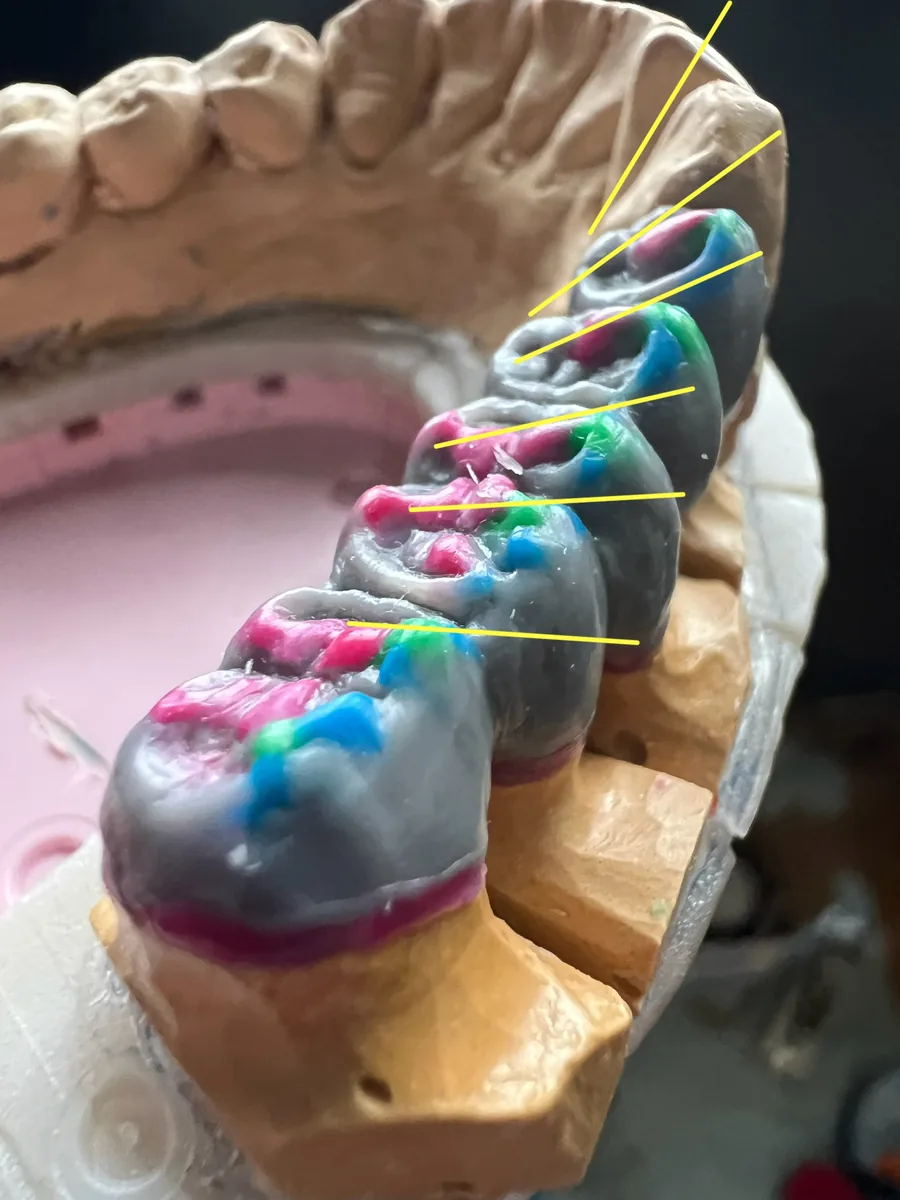
When the shapes are made, each tooth is given an angle for the slopes of its cusps (the peaks of the tooth).
This angle is called the cusp inclination.
Why we use sectioned casts
To diagnose each tooth individually
We make sectioned casts in the examination of the bite in order not only to look at the dental arch as a whole but also to diagnose each tooth individually.
The director regards the sectioned cast as the most basic procedure in our clinic's approach to occlusion (Austrian gnathology).
For details of the approach, please see the Austrian gnathology page.
Because the suitable height and angle differ from tooth to tooth
Each tooth has a height and angle that suit it.
The direction of the tooth axis also differs from tooth to tooth.
So at our clinic, we deal with each tooth separately and work out its angle.
To decide the cusp angle tooth by tooth
At our clinic, we set the cusp inclination for each tooth individually.
The angle is calculated from records of jaw joint movement and other data.
With every tooth separated, each one can be given its own angle.
How the angles are calculated and set on the articulator is described on the Girrbach Reference SL articulator page.
In practice at our clinic
As part of the detailed examinations
For temporomandibular disorders (TMD) and orthodontic treatment, we make sectioned casts from impressions as part of the detailed examinations.
In the fee table, too, a photo of a sectioned cast is shown in the "Orthodontic work-up (bite examination)" entry.
What we ask of the patient is to have impressions of the teeth taken.
We do not carry out the same examinations for everyone; we choose them according to the symptoms and the condition of the mouth.
TMD and orthodontics
In planning orthodontic treatment, what we have checked on the sectioned cast serves as a basis for considering the direction in which to move each tooth.
In our orthodontic treatment, we move the teeth with a wire with loops bent into it (MEAW), taking into account the front-to-back, side-to-side and up-and-down position and the inclination of each tooth.
For the wire, please see the MEAW page.
Dentures (for people with remaining teeth)
For dentures for people who still have some of their own teeth, we also check the position, inclination and contact of the remaining teeth.
The sectioned cast is one of the records used for this.
Crowns
When making crowns, we create the tooth shapes in wax on the sectioned cast (wax-up).
Because each tooth can be removed, the shapes can be created with the height and angle of each tooth in mind.
Photos: creating tooth shapes on a sectioned cast
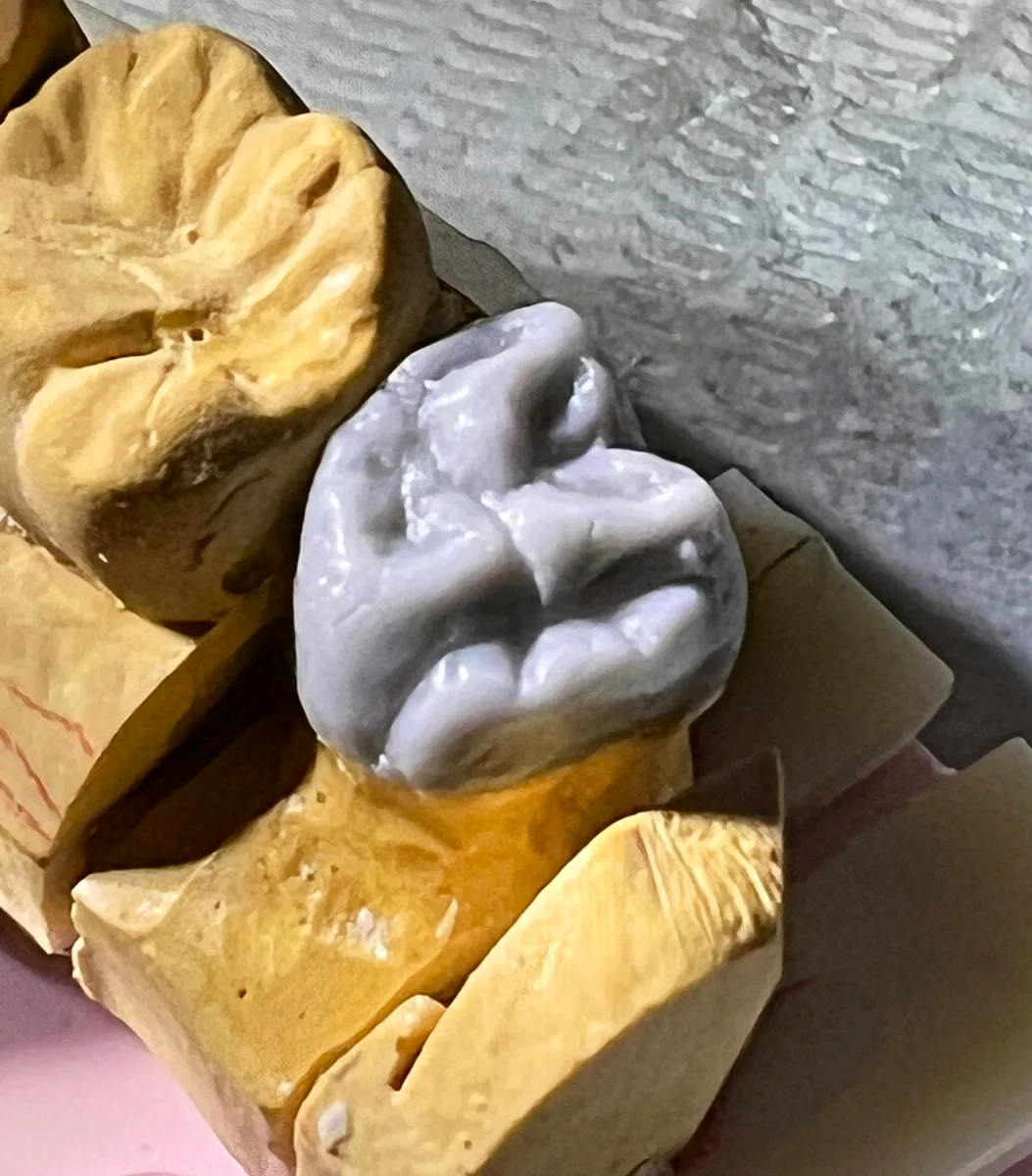
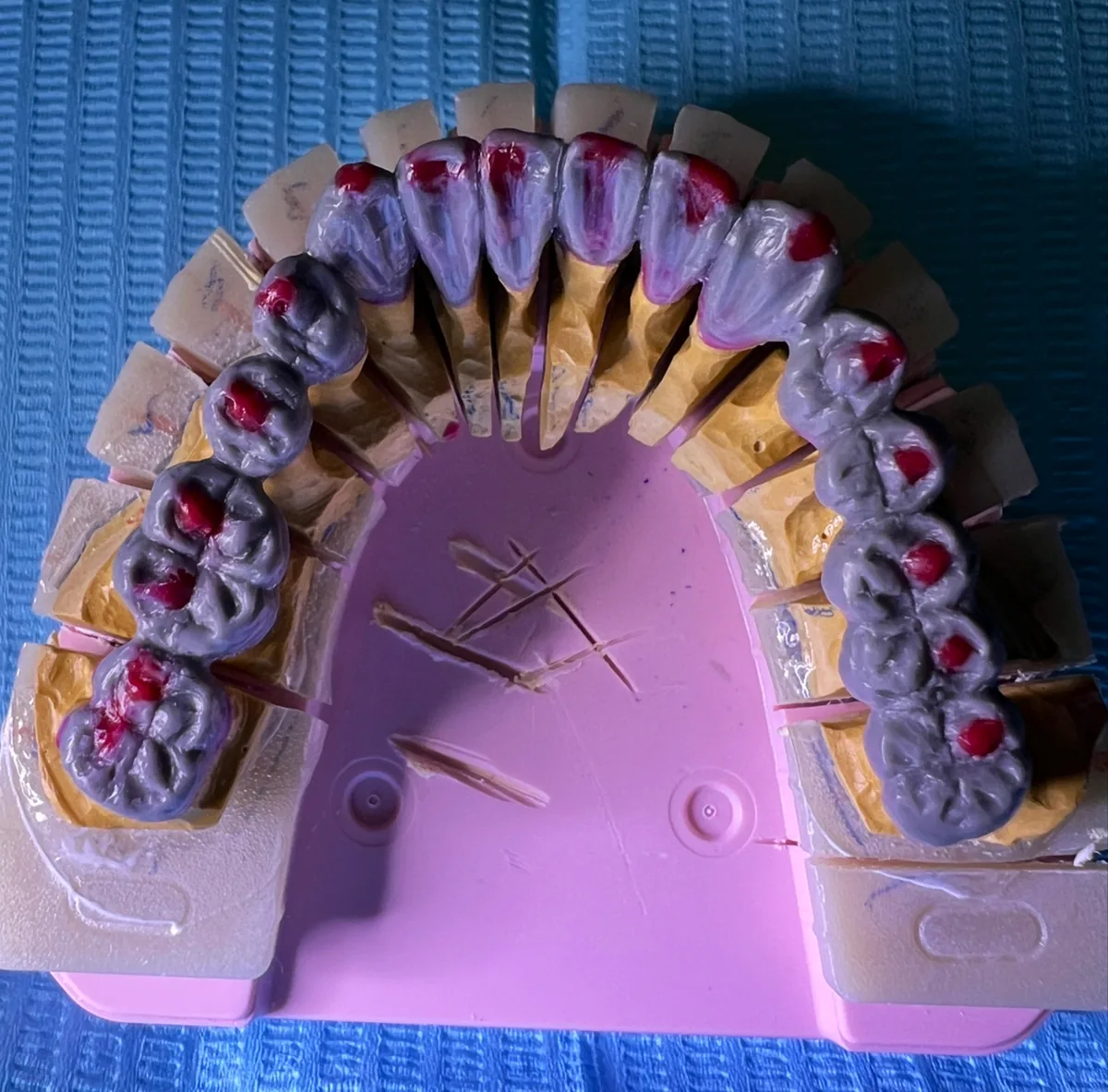
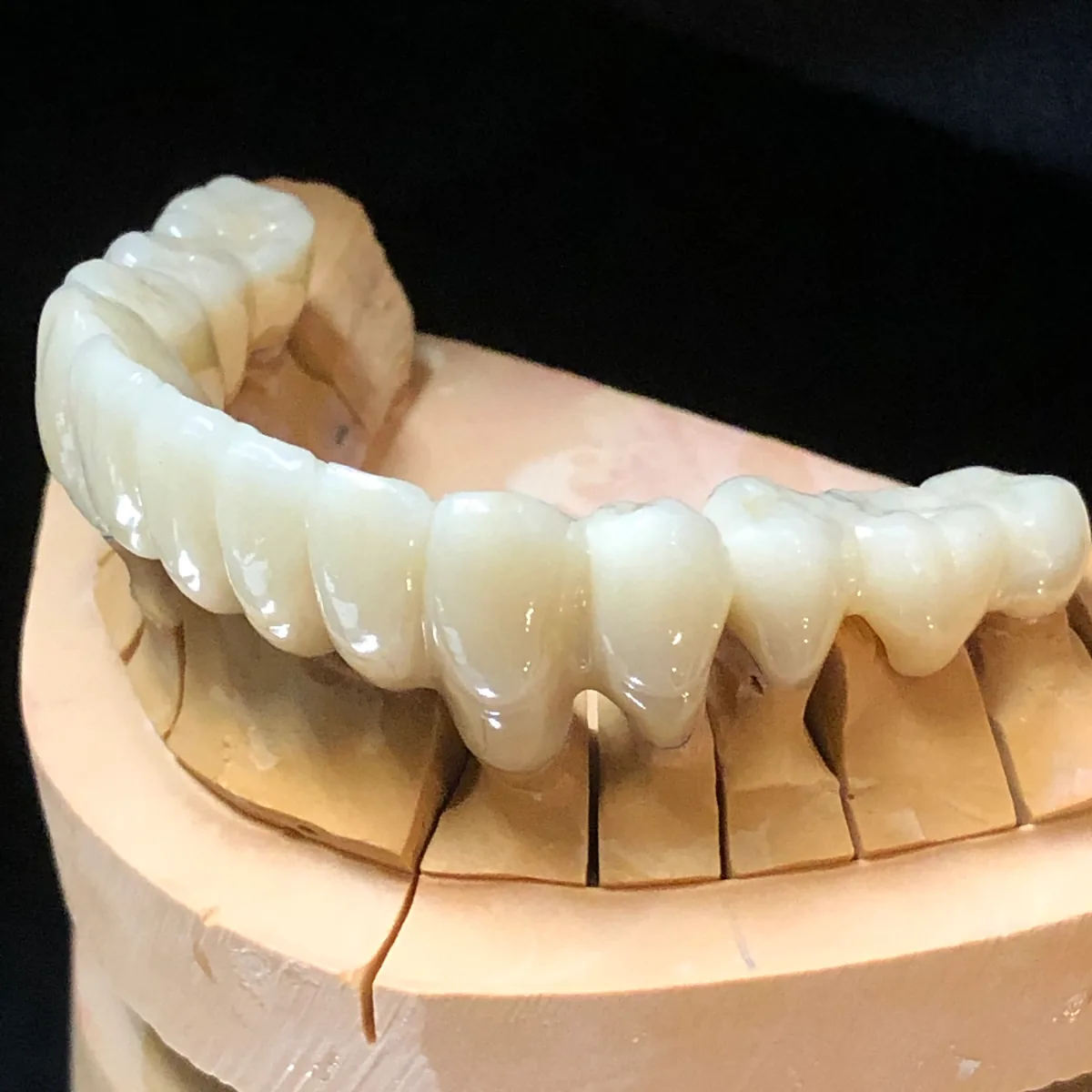
The shape made in wax is then converted into a material such as zirconia.
For details of the process, please see the wax-up page.
Combining it with other technologies
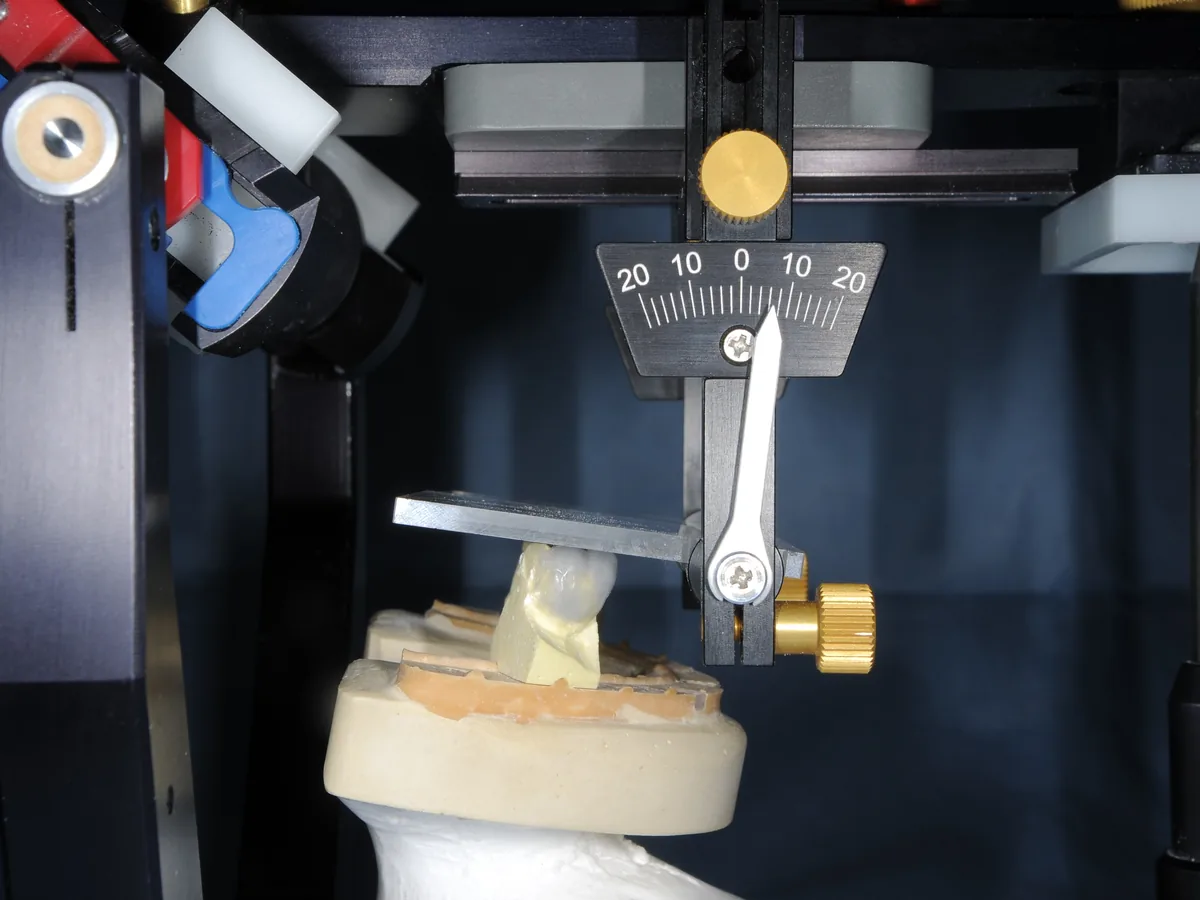
The casts of the teeth are used mounted on an articulator.
After setting the values measured in the examinations on the articulator, we check the bite in the context of the position and movement of the jaw.
We may also measure the inclination of the biting surface of a single tooth on casts mounted on the articulator.
For details, please see the occlusal plane measurement page.
Treatment duration, number of visits, fees and risks → Fees
What a sectioned cast can and cannot tell us
What a sectioned cast can tell us
- The orientation, inclination and height of each tooth
- The state of contact with the neighbouring teeth and the opposing teeth
- A basis for working out the shape of each tooth (wax-up)
What it cannot tell us, and how we compensate
| What it cannot tell us | How we compensate |
|---|---|
| Jaw joint movement | Cadiax |
| Skeletal structure (relationship between the upper and lower jaws, facial height) | Lateral cephalometric analysis |
| The bite in the context of the position and movement of the jaw | Checking with the casts mounted on the Girrbach Reference SL articulator |
| Tooth contact during sleep | BruxChecker |
| The condition of the gums that support the teeth (periodontal tissues) | Examinations such as periodontal pocket depth measurement (periodontal disease page) |
| Whether the shape worked out on the casts fits in the mouth | Checking while you use provisional restorations or provisional dentures |
In some cases, whether a bite worked out on the casts really suits that person only becomes clear once it is actually used.
So at our clinic, we include a stage of checking while you use provisional restorations or similar.
Frequently asked questions
- How is it different from an ordinary dental cast?
In an ordinary cast, the dental arch is in one piece.
A sectioned cast is cut apart between the teeth, so each tooth can be removed and checked individually.
- What does the patient do when a sectioned cast is made?
We take impressions of your teeth.
The cast is made from those impressions.
- Which examination is it part of?
For TMD and orthodontic treatment, it is made as part of the detailed examinations.
In the fee table, a photo is shown in the "Orthodontic work-up (bite examination)" entry. The guide number of visits (2–3) refers to this examination as a whole.
- Is it also used for dentures and crowns?
Yes. For dentures for people with remaining teeth, it is used to check each remaining tooth individually.
For crowns, we create the shape of each tooth on the sectioned cast.
- Is the bite decided on the casts alone?
No. The sectioned cast is one of the records for checking the teeth one by one.
We consider it together with the records of jaw joint movement and the skeleton, and check while you use provisional restorations or similar.
Related technologies and treatments
- Occlusal plane measurement
- Girrbach Reference SL articulator
- Wax-up
- Austrian gnathology
- Temporomandibular disorders & orthodontic treatment that avoids extractions where possible: examinations
- Dentures (precision dentures): examinations
- All the technologies we use
Sources we referred to
For the general explanations (the system of casts with removable tooth sections, and the terminology), we referred to the following published sources. What we describe about our own methods is based on the director's posts and explanations.
Consultations and enquiries
Gibakai Medical Corporation
Yoshimi Dental Clinic
Square 2, Room 302 (third floor)
1-29-1 Tsukushino, Machida,
Tokyo 194-0001, Japan
TEL 042-795-1359 FAX 042-795-1398
Clinic days: Mon · Tue · Thu · Fri
10:00–13:00 / 14:30–18:00
A first visit begins with a first consultation (a private, non-insured service; 30 minutes to 1 hour) for examination and diagnosis. Questions about a diagnosis you received elsewhere are also covered within it.
In an emergency, such as being unable to chew or having severe symptoms, please call us on 042-795-1359 to discuss it.