What is denture design based on the finite element method?
Denture design based on the finite element method is an approach to partial denture design that Professor Rudolf Slavicek, who served as professor of prosthodontics at the University of Vienna, devised on the basis of finite element analysis.
The shape of the denture is determined so that, as far as possible, the teeth supporting the partial denture receive only forces of a physiological direction and magnitude.
A partial denture is worn with the parts that hold it in place (retentive components) engaging the remaining teeth.
A tooth engaged by a retentive component is called an abutment tooth.
The finite element method is, in general, a way of applying force conditions to a model of a shape built on a computer and calculating the internal forces (stress) and deformation (strain) that arise within it.
It is called the "finite element method" because the calculation is made by dividing the shape into small elements.
In dentistry, too, it is used in research that examines the forces acting on teeth and dentures.
At our clinic, we design each person's partial denture individually, in line with this design approach based on the professor's analyses.
The director learned this approach directly from the professor in 2000.
At our clinic, our approach to the bite is based on the concepts of Professor Sadao Sato, and our approach to denture design on those of Professor Slavicek (Austrian gnathology).
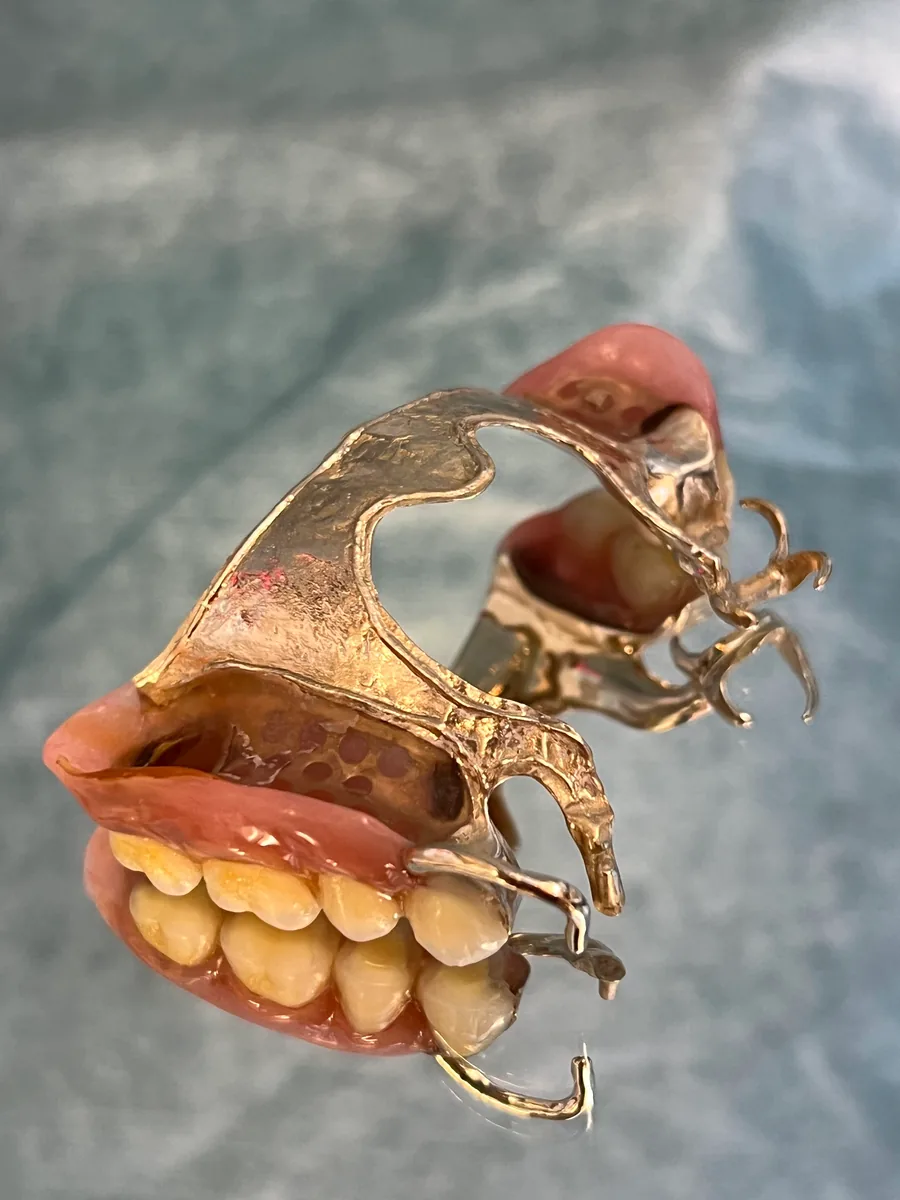
How denture design based on the finite element method works
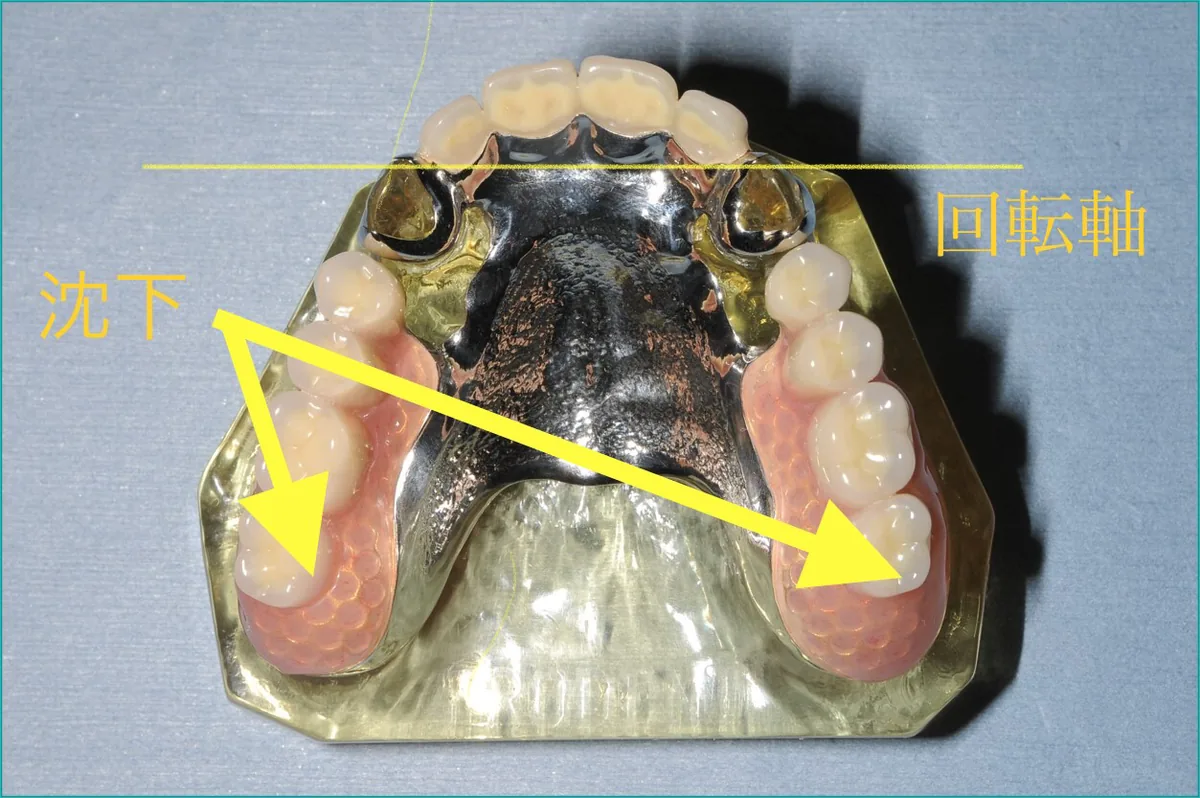
A partial denture sinks and rotates when you bite
The parts of a partial denture that fill in areas such as where the back teeth have been lost rest on the gums.
When you bite, these parts press on the gums and sink.
At that moment, the denture moves as if rotating about an axis near the supporting teeth.
In the photo, the line running across near the front supporting teeth is the axis of rotation, and the part with the back artificial teeth sinks towards the gums.
Three forces acting on the supporting teeth
When the denture moves in this rotating way, the following three forces act on the supporting teeth (abutment teeth).
| Force | Direction in which it acts on the tooth | The director's view |
|---|---|---|
| Extrusive force | Lifting the tooth | Not physiological, even when small |
| Tipping force | Tilting the tooth | Physiological within a certain range |
| Intrusive force | Pushing the tooth towards its root | Physiological within a certain range |
Around the root of a tooth there is a thin tissue called the periodontal ligament, which works as a sensor (mechanoreceptor) that detects the pressure on the tooth.
The director believes that when a tooth is pushed towards its root, the body can respond to that force through its reflex mechanisms.
On the other hand, the director explains that the extrusive force, which lifts the tooth, is a force that teeth only began to receive with the introduction of dentures, and that the body has not yet developed a reflex pattern for responding to it.
For this reason, we design with the aim of eliminating the extrusive force or keeping it as small as possible.
The professor analysed how these forces act in terms of physics and turned the results into a form that can be used in actual denture design.
Teeth and gums sink differently
A partial denture is supported both by the remaining teeth and by the gums where teeth are missing.
The director explains that when you bite, the gums move about ten times as much as the teeth.
It is generally said that in partial dentures replacing missing back teeth, because the supporting teeth and the gums sink differently, a large force tending to tilt the supporting tooth next to the toothless area backwards can act on it through the rigid metal framework.
At our clinic, we apportion this difference in sinking through the design of the framework and the attachments.
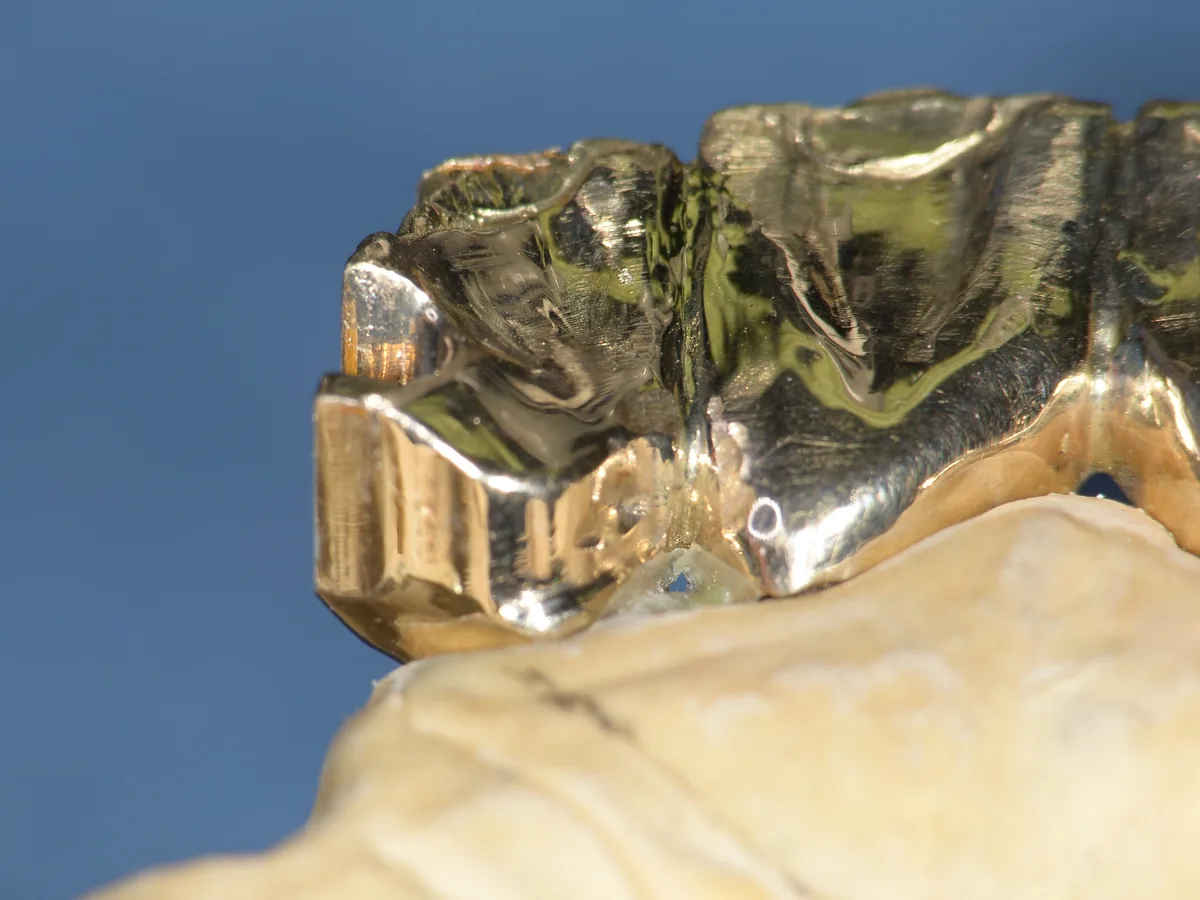
Within the framework, we separate rigid parts from parts that move
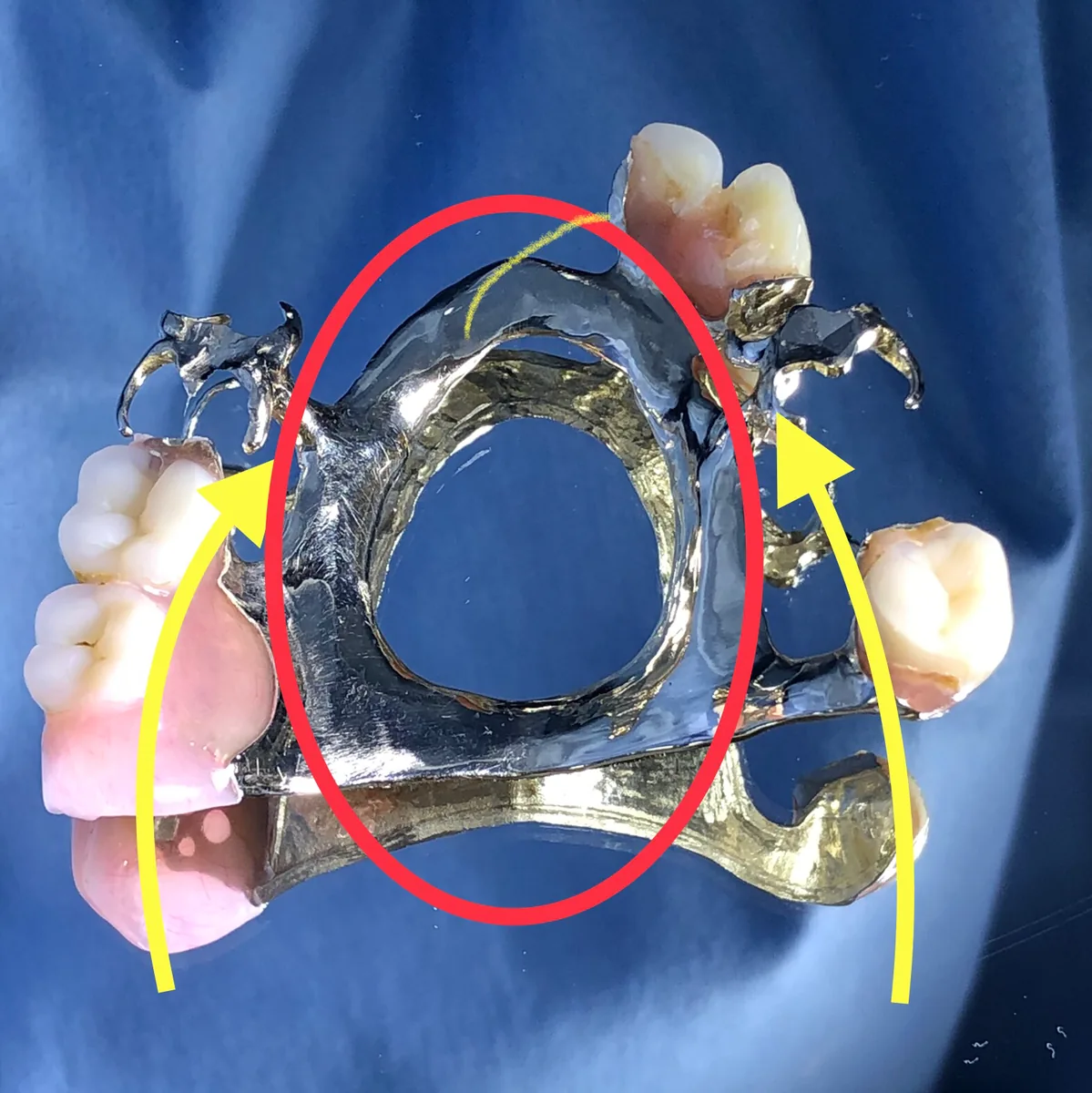
The metal part that forms the skeleton of the denture (the framework) is not made equally rigid everywhere.
The area in the red circle in the photo is the part that gives the framework as a whole a high degree of rigidity.
Making this part rigid keeps the movement of the moving parts, indicated by the yellow arrows, consistent.
The director believes that when the denture moves in the same way every time you bite, the information sent from the mouth to the brain also becomes consistent.
We change how the framework flexes through the shape of its cross-section
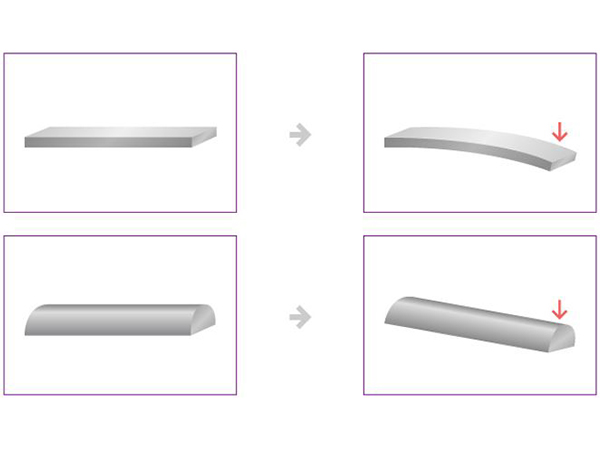
Even with the same metal, how it flexes changes with the shape of its cross-section.
Parts with a flat cross-section flex when force is applied.
Parts with a half-round cross-section resist flexing and transmit the force as it is.
So for teeth that are likely to be subjected to pressure, we create a mechanism that relieves the pressure through a part with a flat cross-section.
Conversely, where we want force to be transmitted reliably, we use a framework with a half-round cross-section to prevent deformation.
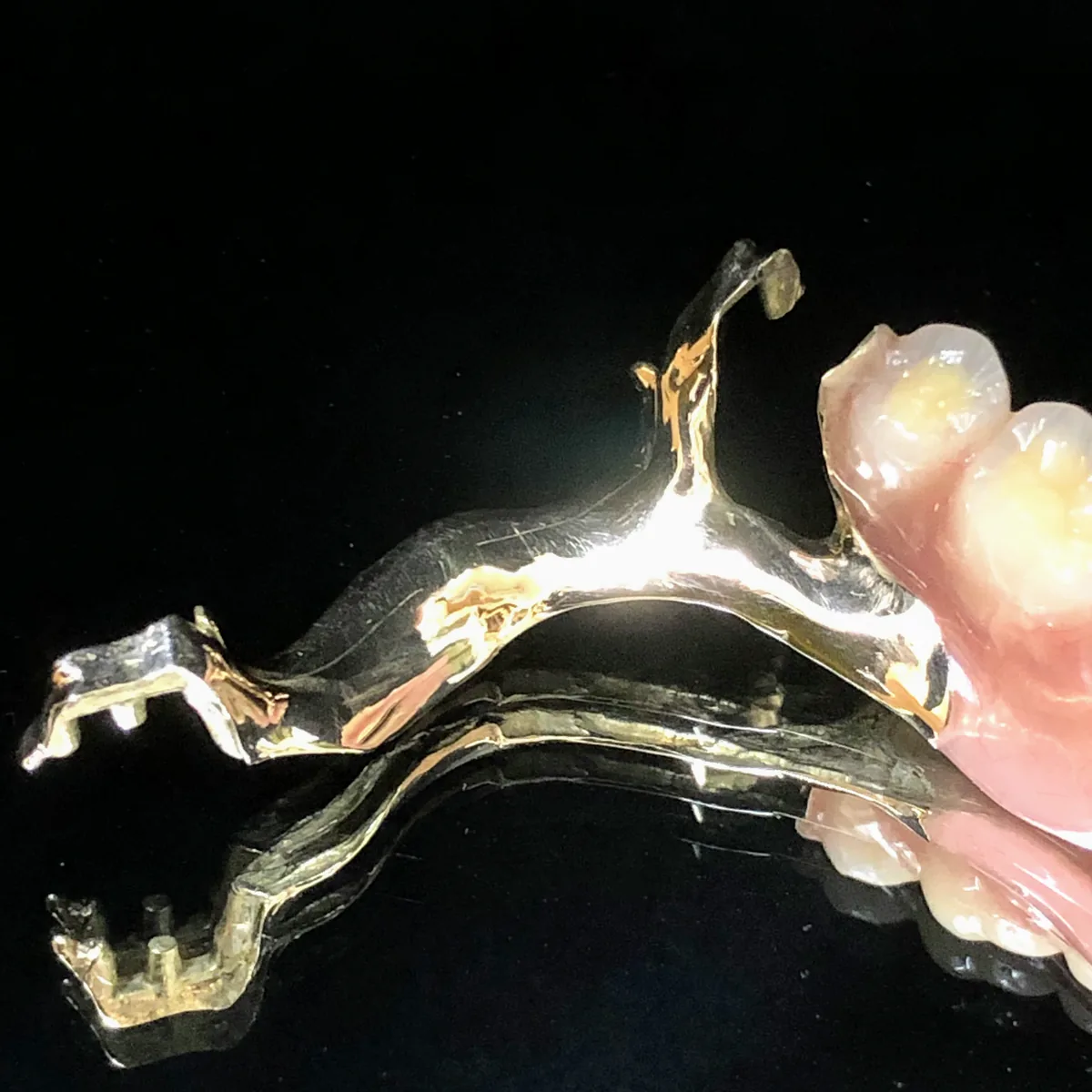
The role of the framework connecting the left and right sides
The metal framework connecting the left and right sides is made to bring together the functions the denture needs.
In partial dentures, the function of resisting the denture coming out is generally called "retention", and the function of resisting sideways movement of the denture is called "bracing".
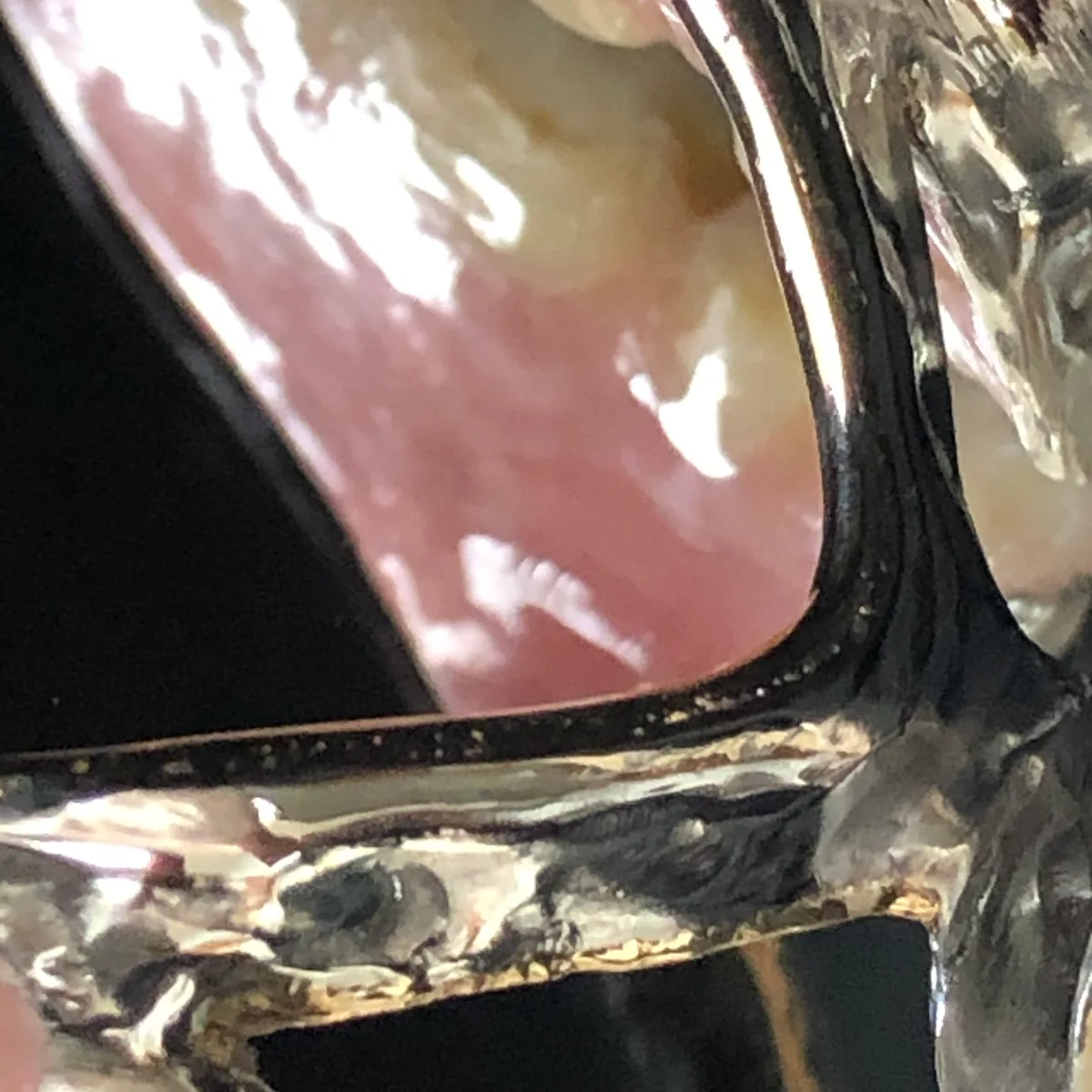
In a lower denture, the part that connects the left and right sides (the lingual bar) needs to be especially rigid, even compared with the other parts of the denture.
Some are made of platinum-gold alloy and cobalt-chromium with a hollow, tube-like structure to increase their overall rigidity (platinum-gold alloy).
Photos: frameworks connecting the left and right sides
Why we adopt denture design based on the finite element method
Because we want to adjust the forces on the supporting teeth
The director considers control of the forces on the supporting teeth to be essential in partial denture design.
The design of the parts that connect the denture to the teeth, such as attachments, is especially important, because force acts directly on the remaining teeth and the surrounding tissues.
Because we want to transmit physiological forces to the periodontal ligament
The periodontal ligament is a sensor that detects pressure.
The director believes that the kind of force transmitted to it influences the long-term course of the denture.
Because we consider both daytime function and tooth grinding during sleep
At our clinic, we finish the fine details of the shape of the framework and the artificial teeth with both daytime and night-time function in mind.
For the daytime, we shape them so that functions such as chewing, swallowing and speaking can be carried out without strain on the body.
For the night-time, we give them a shape in which the biting surfaces and the movement of the jaw joints are in harmony, so that tooth grinding during sleep can be kept within a physiological range.
Because the director has himself revised his approach to design
Around 1991, the director was mainly making dentures of a type in which the denture is supported with the way force is applied to the supporting teeth entirely fixed (rigid support).
Later, he adopted Professor Slavicek's concept, which regards the periodontal ligament as a "sensory receptor", and revised his approach to design.
The director believes that whether a design is good or bad cannot be judged over a short period such as 4–5 years, but should be judged by looking at the long-term course of many dentures.
He also believes that the work is not over once a denture has been made, and that appliances, too, should be reviewed in line with advances in science.
In practice at our clinic
What we consider in designing a partial denture
When designing a partial denture, we mainly consider the following.
- Examination records: the remaining teeth, the gums (mucosa), the skeleton and jaw movement (sectioned cast, mucosal records, lateral cephalometric analysis, Cadiax)
- How the denture sinks when you bite, and about what axis it rotates
- The direction and magnitude of the forces on the supporting teeth, and the position and shape of the retentive components and attachments to match them
- Which parts of the framework to make rigid and which to allow to move, and the shape of the cross-sections
- The direction of insertion and removal, and the direction in which force is transmitted when you bite (parallel milling)
Giving it form, and checking it
The designed shape is made in wax and converted into metal by casting (wax-up, casting).
The provisional denture is also given the same mechanisms as the final denture, and we check it while you use it (provisional restorations and provisional dentures).
After the denture is fitted, we continue to check its progress and make adjustments or repairs as needed.
Even if the type of metal used changes, the design approach stays the same.
Photos: partial dentures designed with this approach
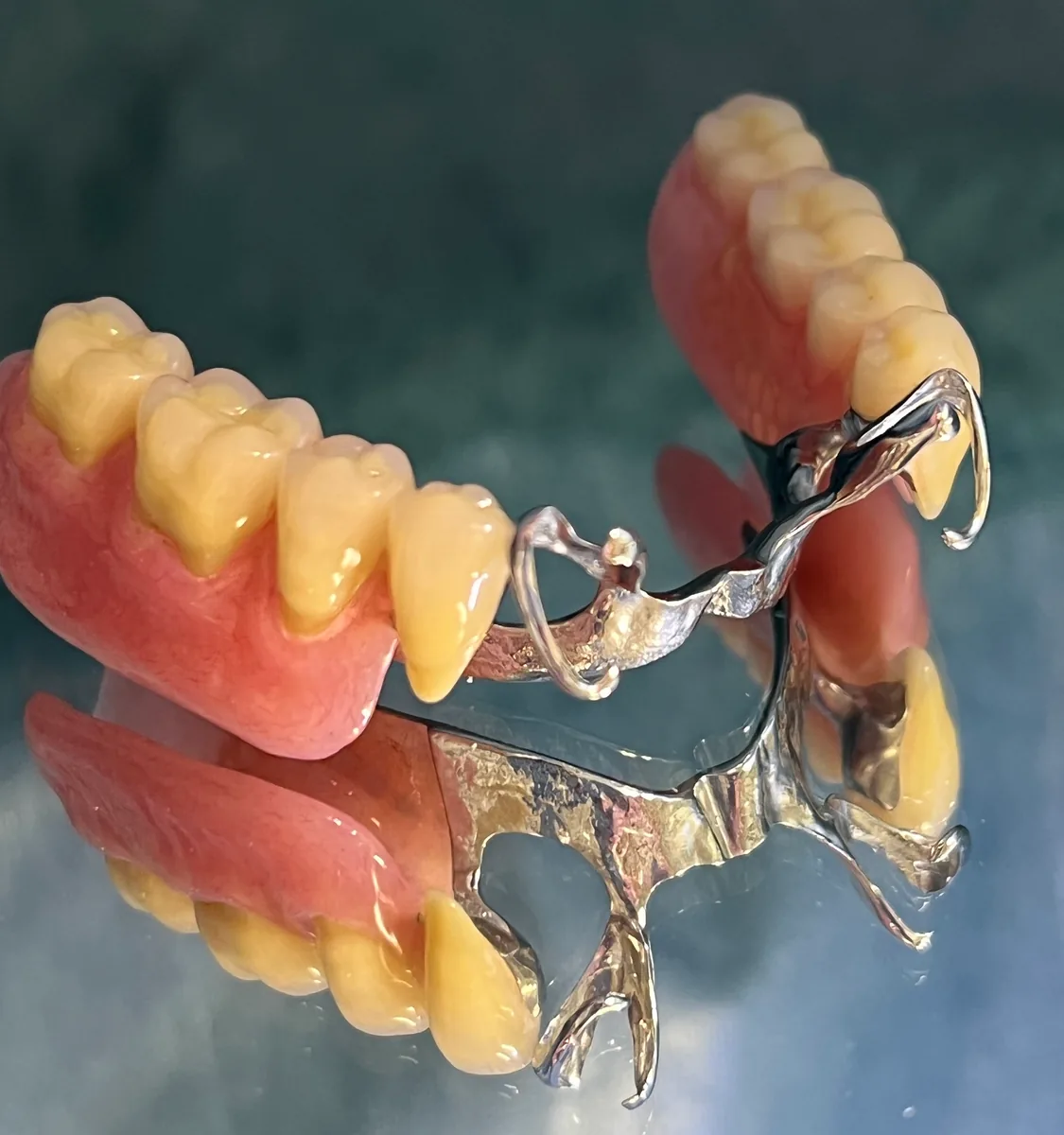
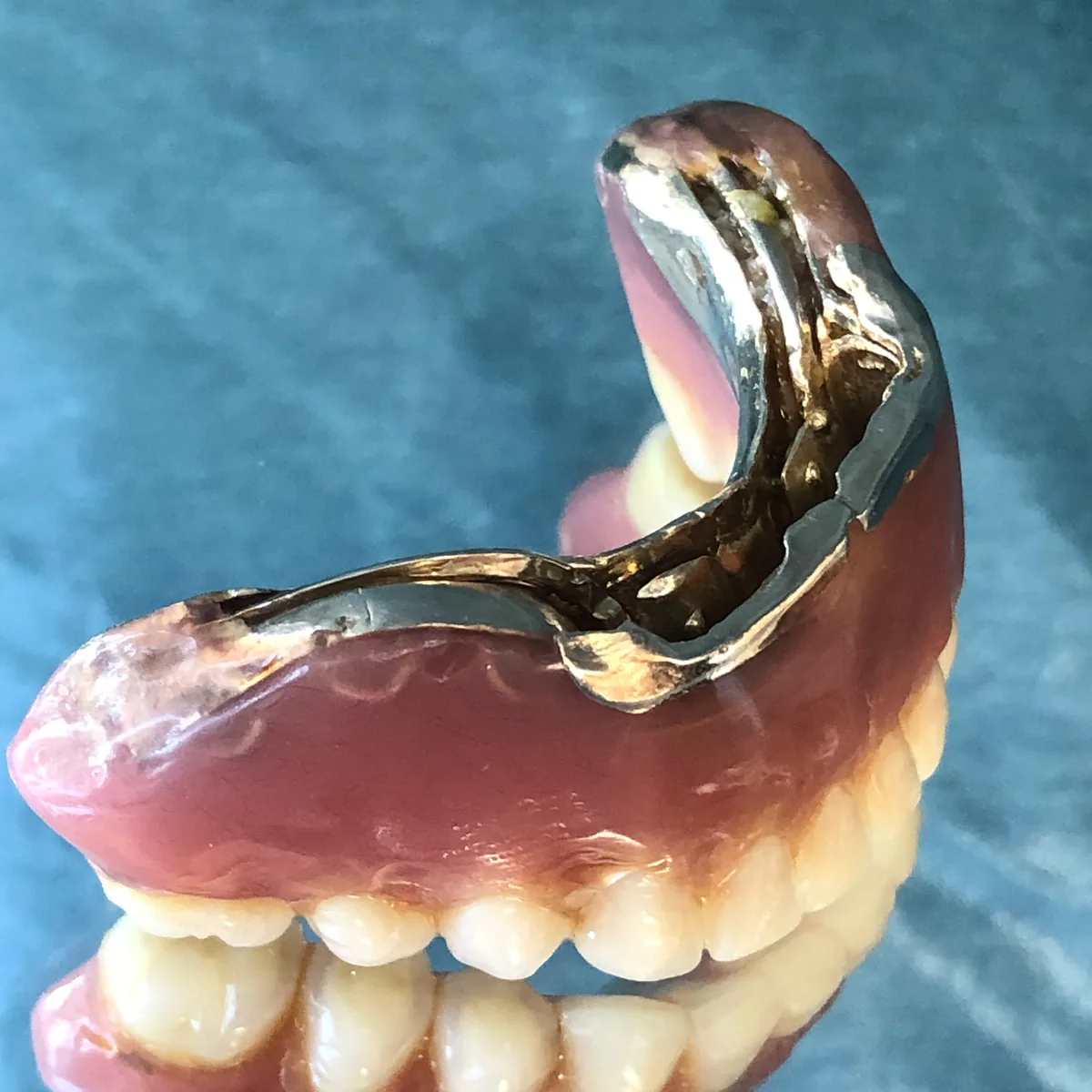
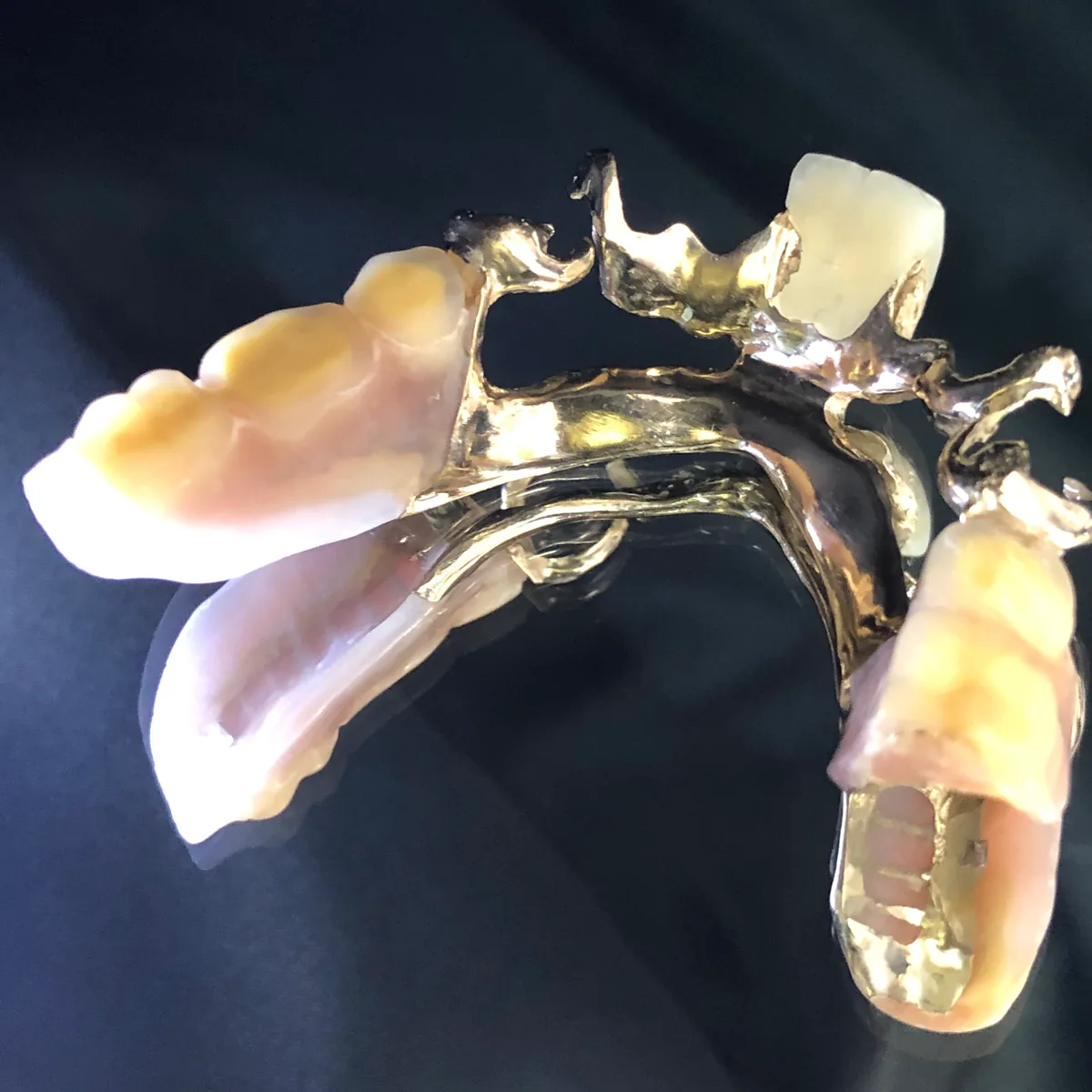
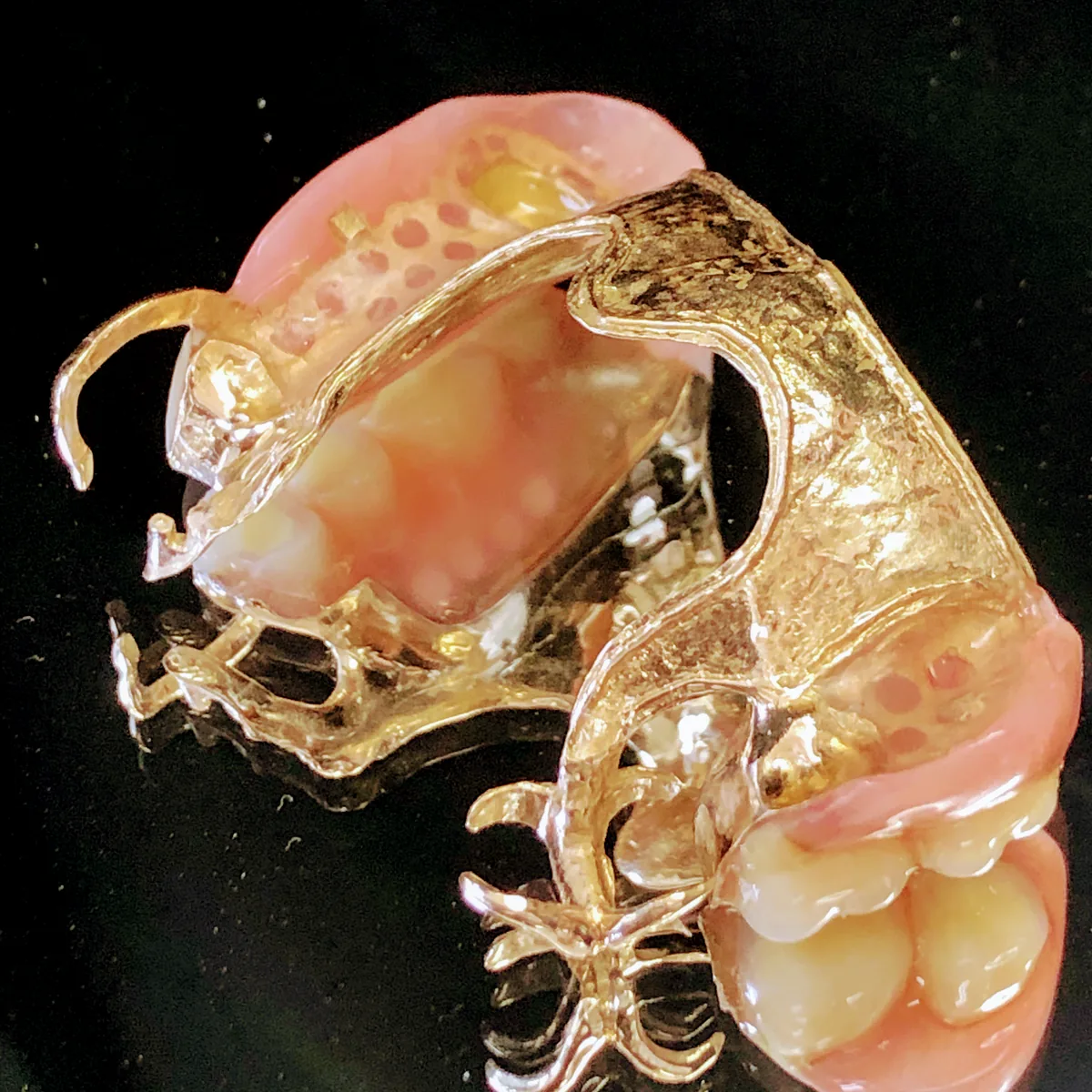
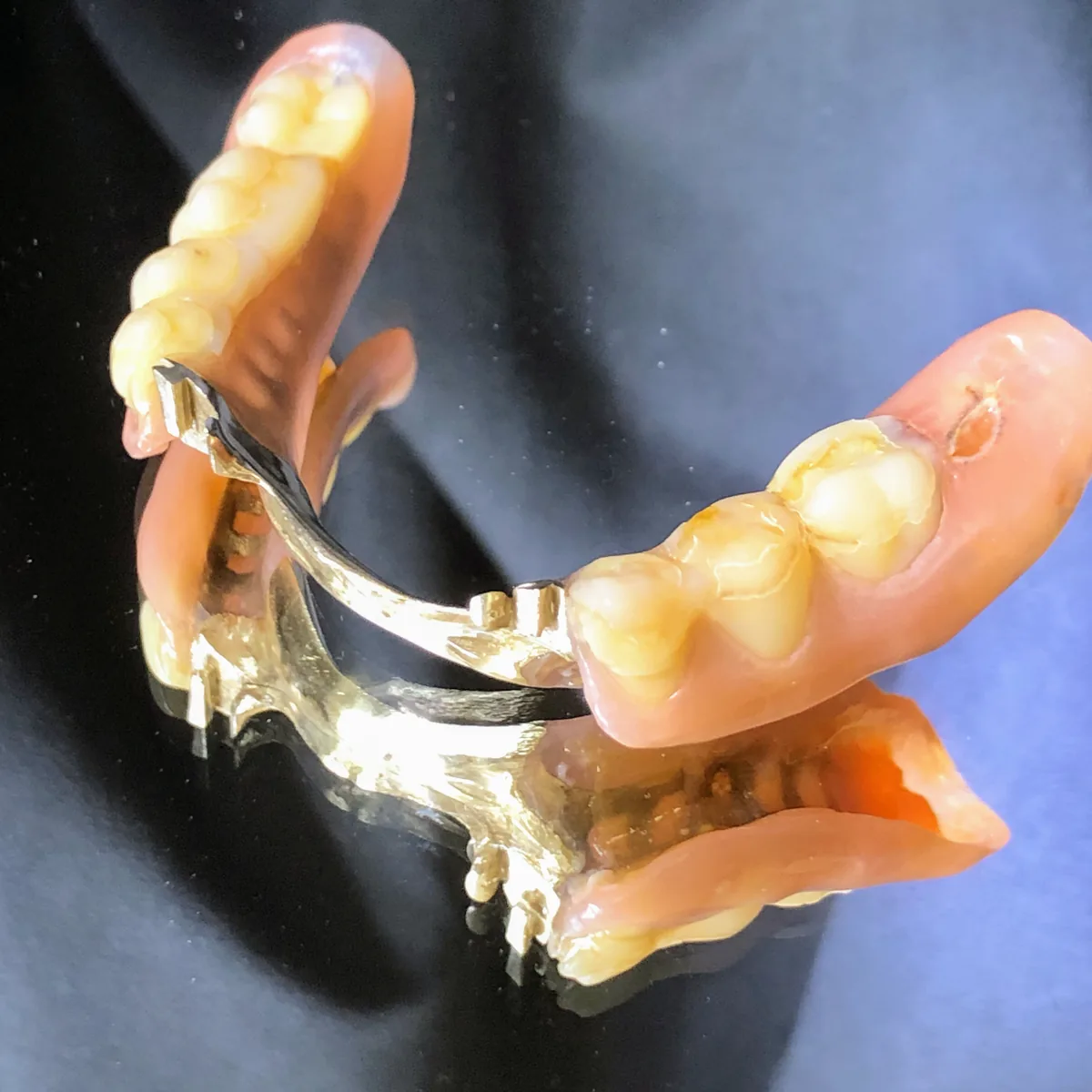
Dentures for gaps with teeth remaining in front and behind
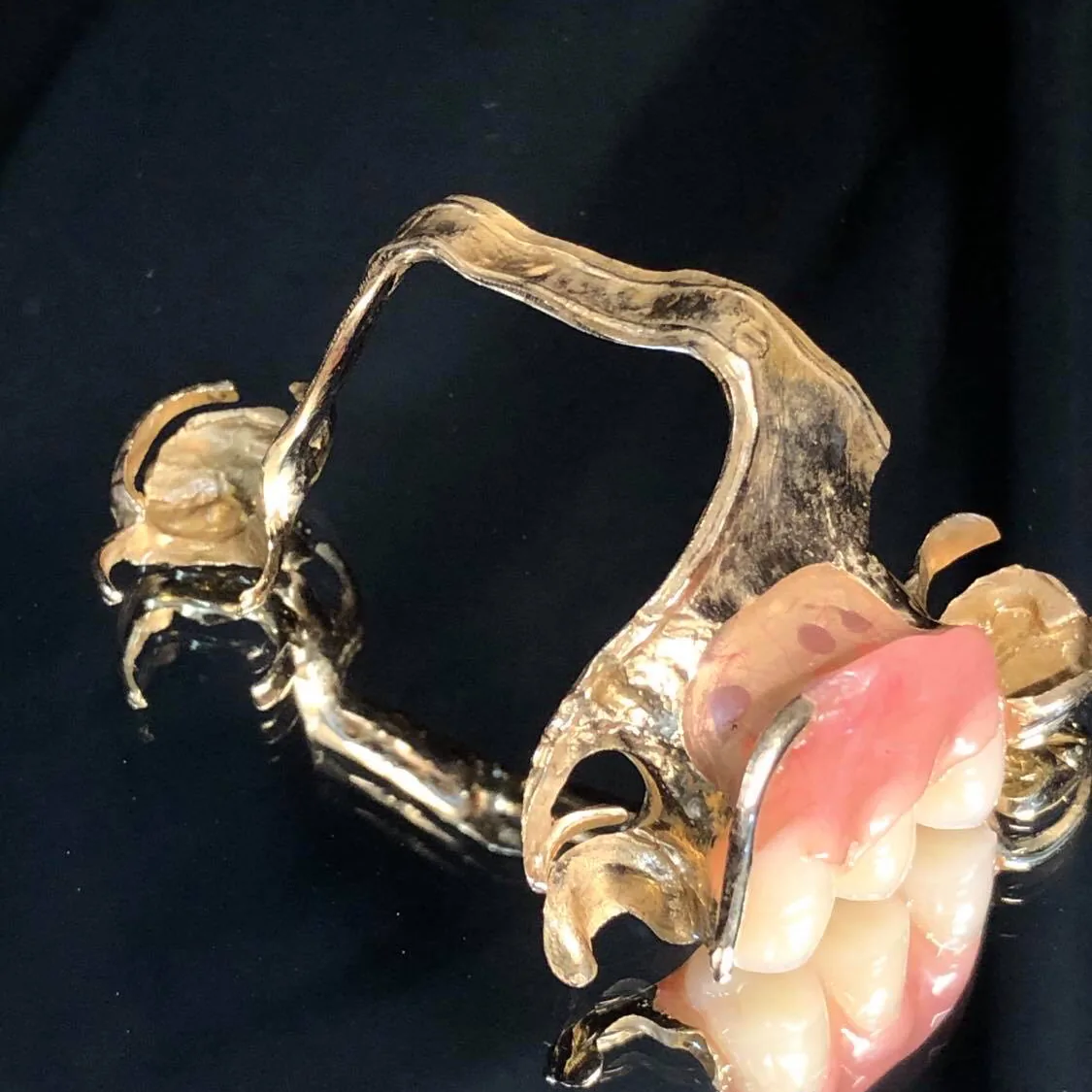
A partial denture that fills a gap with teeth remaining in front and behind sinks in the direction of the roots when you bite, in the same way as natural teeth.
In this case, we finish the surfaces of the attachments by milling so that force is also transmitted to the remaining teeth in the direction of their roots.
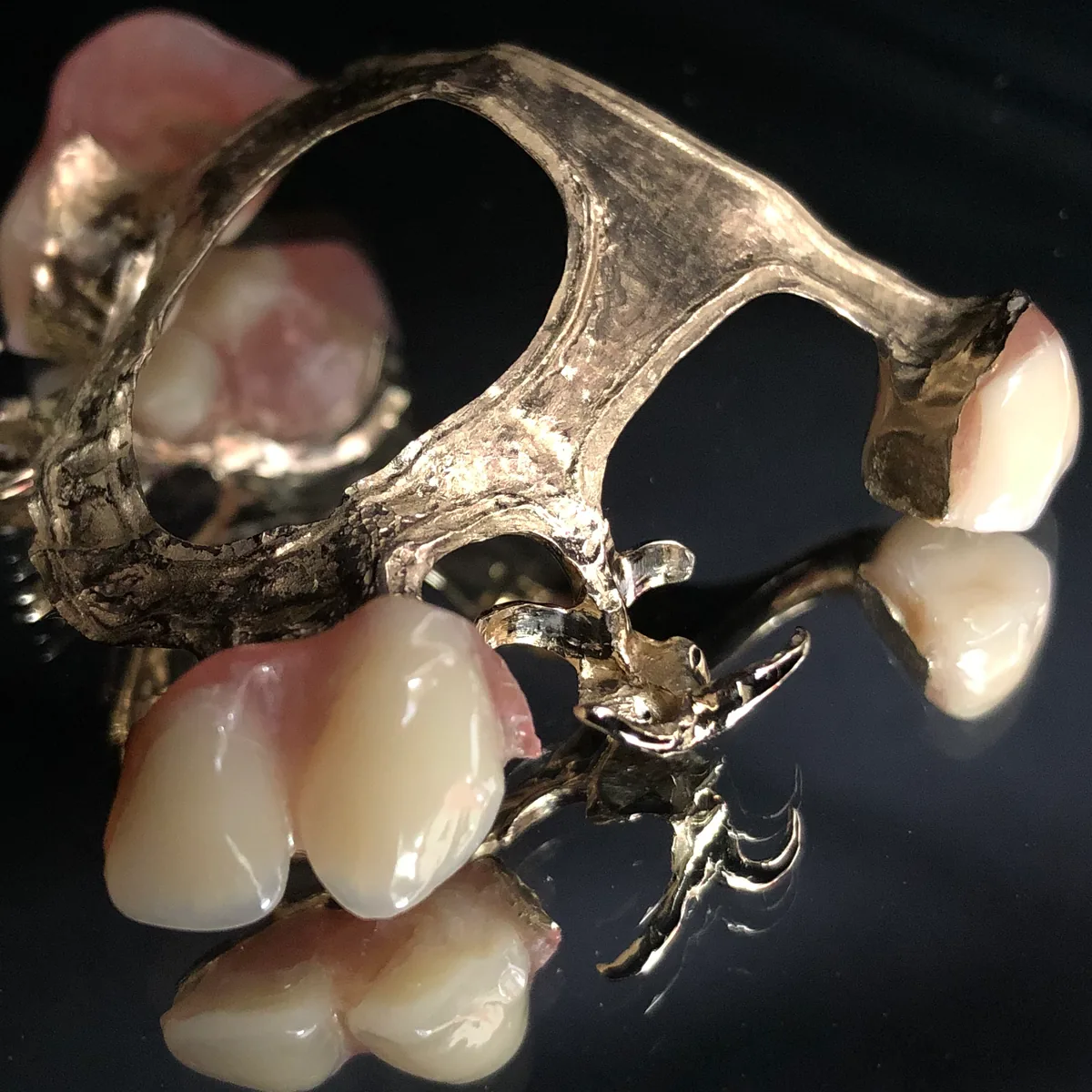
When the upper and lower dental arches are greatly offset
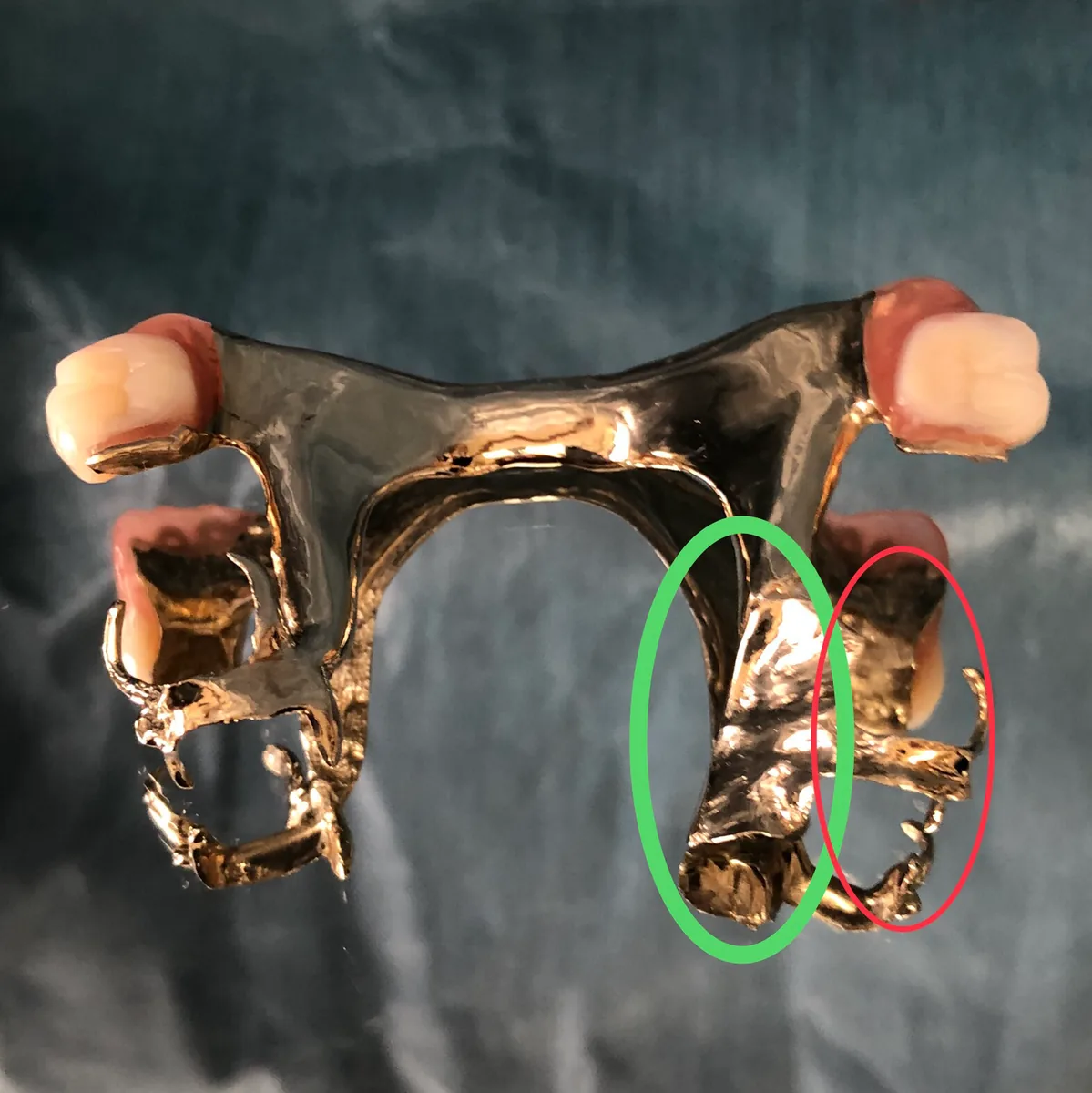
When the upper and lower dental arches are greatly offset sideways, it becomes difficult to obtain vertical support for the bite.
In such cases, there is a design in which the metal framework is extended towards the inside of the upper jaw (the palatal side) so that it acts as a platform for the bite, receiving the lower teeth.
In the photo, the red circle shows the area where the upper dental arch originally lies, and the green circle the area where the lower dental arch lies.
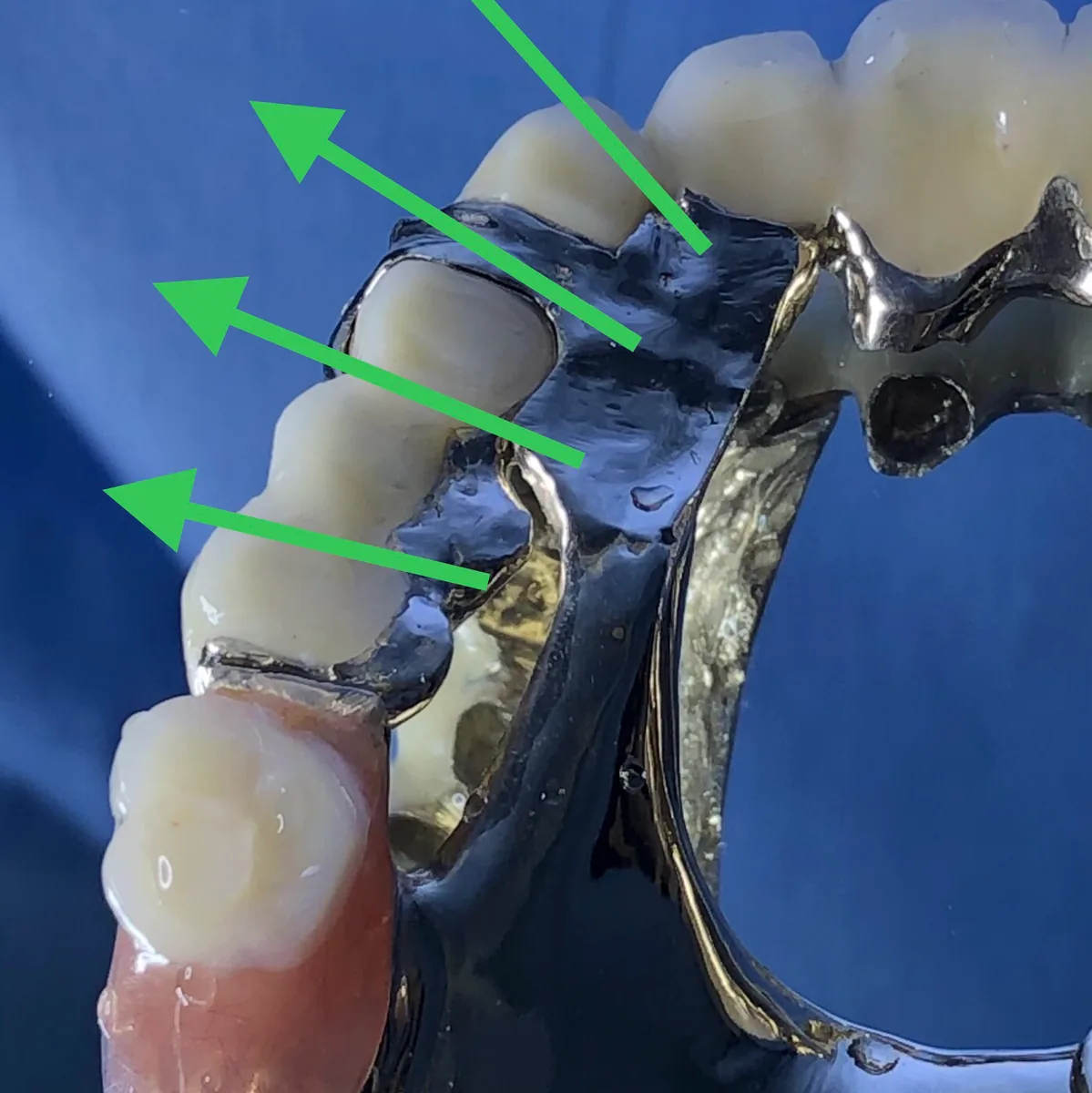
Preparing for future changes
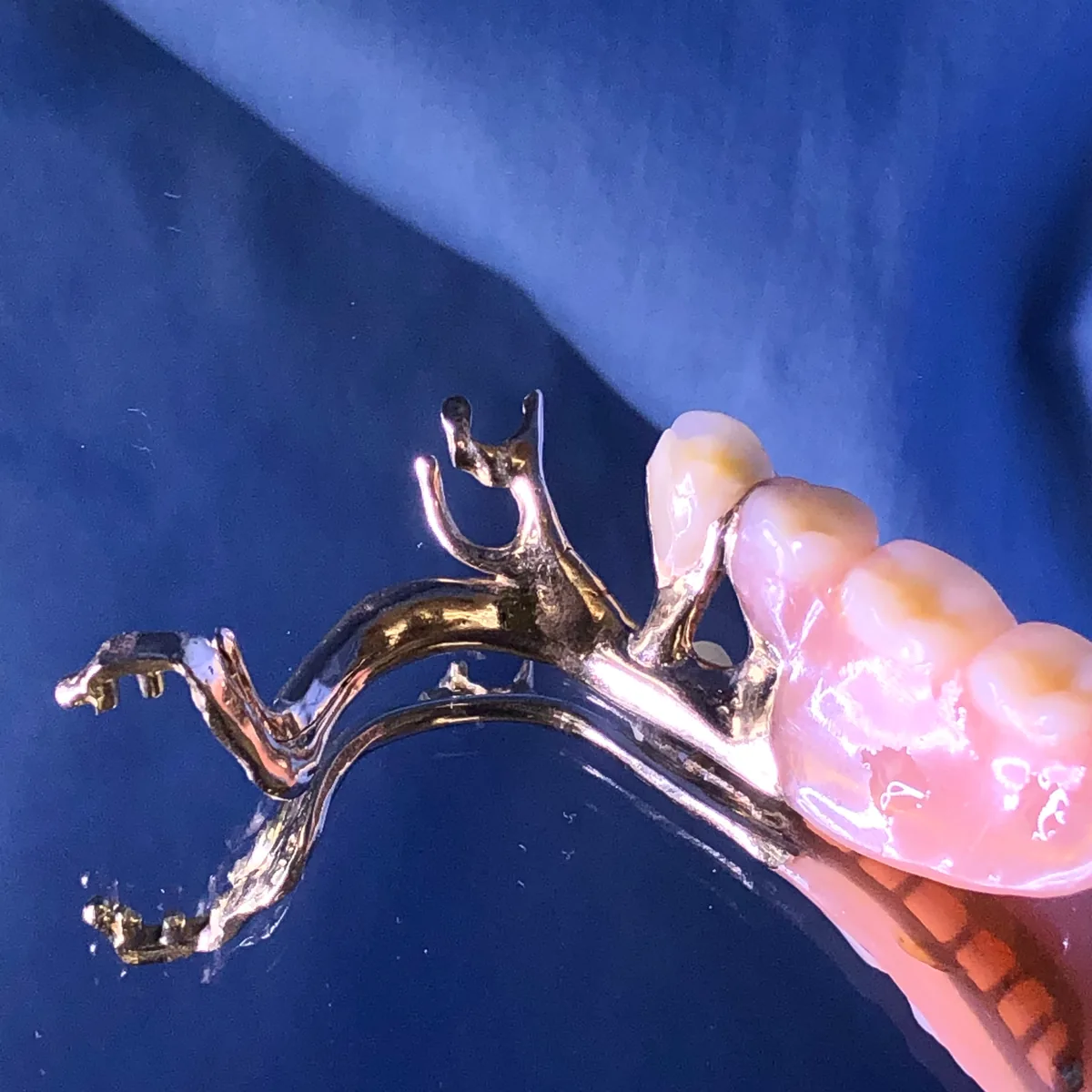
With age, there may later be teeth that can no longer be kept.
In such cases, we consider a repair that adds artificial teeth to the denture.
For this reason, we make dentures from materials and with a structure that allow later repair.
For repairs, we use laser welding in our clinic.
Treatment duration, number of visits, fees and risks → Fees
What denture design based on the finite element method can and cannot do
What denture design based on the finite element method can do
- Adjust the direction and magnitude of the forces on the supporting teeth, taking into account how the denture sinks when you bite and about what axis it rotates
- Aim to eliminate the force that lifts the supporting teeth (extrusive force), or to keep it as small as possible
- Apportion the difference in sinking between the teeth and the gums through the design of the framework and the attachments
- Separate rigid parts from moving parts within the framework, and change how it flexes through the shape of the cross-section
- Design with the same approach even when the metal used changes
What it cannot do, and how we compensate
| What it cannot do | How we compensate |
|---|---|
| Promising, through design alone, how the denture will fare in the future | Checking progress after fitting, and making adjustments and repairs ("For long-term use" on the dentures page) |
| Treating diseases of the supporting teeth themselves (such as tooth decay and periodontal disease) | Including treatment of the remaining teeth in the treatment plan (periodontal disease page) |
| Knowing the thickness and properties of each person's gums from calculation alone | Mucosal records |
| Determining the position of the bite and the angles of the artificial teeth | Cadiax, lateral cephalometric analysis, artificial tooth arrangement |
| Stopping changes in the mouth, such as losing teeth later | Making the denture from materials and with a structure that allow later repair (laser welding) |
It is generally said that because finite element analysis calculates with models in which the body's tissues are simplified to some degree, the results may differ from the actual forces in the body.
It has also been pointed out that properties of the gums such as their thickness and viscosity are hardly included in the analysis models.
Frequently asked questions
- What is an abutment tooth?
It is a tooth engaged by the part that holds a partial denture in place (the retentive component).
A partial denture is supported by these teeth and by the gums where teeth are missing.
At our clinic, we design with the direction and magnitude of the forces on the abutment teeth in mind.
- Does the design change depending on the type of metal?
The design approach is the same regardless of the type of metal used.
On that basis, we choose the material according to the shape and rigidity required.
- What happens if I lose a remaining tooth after the denture has been made?
Depending on the condition, we consider a repair that adds an artificial tooth to the denture.
At our clinic, we make dentures from materials and with a structure that allow later repair, and we use in-house laser welding for repairs.
Whether a repair is possible depends on the condition of the denture and your mouth at the time.
- How long can a denture with this design be used?
How long a denture can be used varies from person to person, and we cannot make any promises.
At our clinic, we record and check the progress of the dentures we make, and continue to adjust and repair them.
The director believes that whether a design is good or bad should be judged by looking at its long-term course.
Related technologies and treatments
- Attachments
- Parallel milling
- Mucosal records
- Austrian gnathology
- All the technologies we use
- Dentures (precision dentures): we carry the examination data into the shape of the denture
- Dentures (precision dentures): our approach to complete and partial dentures
Sources we referred to
For the general explanations (what the finite element method is, how forces generally act in partial dentures, and the meaning of the terms "retention" and "bracing"), we referred to the following published sources. What we describe about our own methods is based on the director's posts and explanations.
- Wakabayashi N. Advanced applications of finite element method in dental research: recent progress in non-linear analysis. Journal of the Japanese Society for Dental Materials and Devices. 2013;32(3):226-239 (in Japanese)
- Yamashita S. Rethink the mechanical principles associated with removable partial dentures. Annals of Japan Prosthodontic Society. 2020;12(1):16-22 (in Japanese)
- Zhu Y, et al. Biomechanical considerations in RPD design: application and perspective of finite element method in distal extension removable partial denture rehabilitation. Frontiers in Dental Medicine. 2025;6:1667504
Consultations and enquiries
Gibakai Medical Corporation
Yoshimi Dental Clinic
Square 2, Room 302 (third floor)
1-29-1 Tsukushino, Machida,
Tokyo 194-0001, Japan
TEL 042-795-1359 FAX 042-795-1398
Clinic days: Mon · Tue · Thu · Fri
10:00–13:00 / 14:30–18:00
A first visit begins with a first consultation (a private, non-insured service; 30 minutes to 1 hour) for examination and diagnosis. Questions about a diagnosis you received elsewhere are also covered within it.
In an emergency, such as being unable to chew or having severe symptoms, please call us on 042-795-1359 to discuss it.