What is laser welding?
Laser welding is a method of joining metals into one piece by concentrating the energy of a laser on a small area to melt the metal and letting it solidify.
In dentistry, it is used to join metal components in large bridges, dentures with metal frameworks and so on.
At our clinic, we join metal in argon gas by integrating a thin wire of high-purity platinum-gold alloy with the original metal being joined.
We use it to join metal components of dentures and other items, for repairs after they have come into use, and to modify the tips of instruments used in orthodontic treatment.
Welding is done with a high-power laser welder made by Heraeus of Germany, in our in-house dental laboratory.
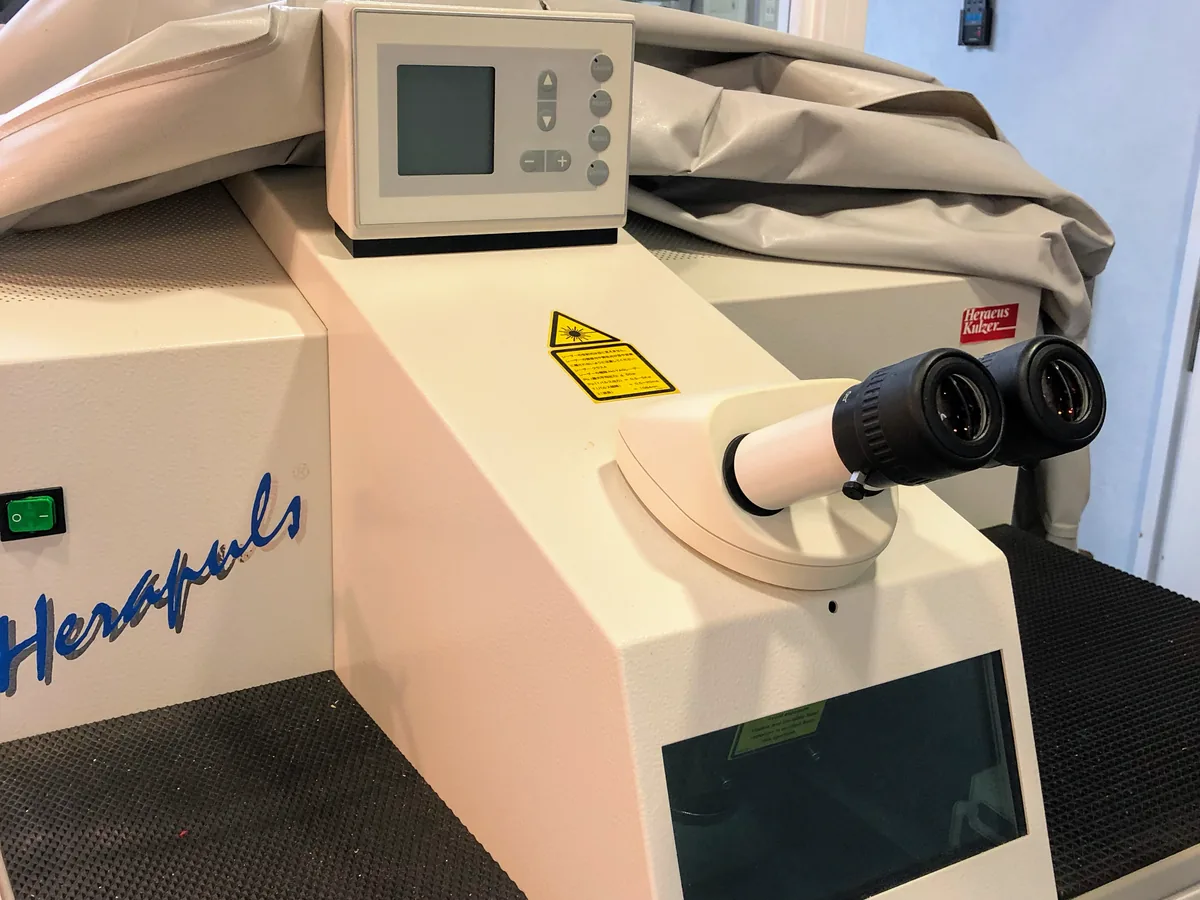
How laser welding works
We describe welding at our clinic in four stages.
- Filling with argon gas: the area to be joined on the original metal (the base metal) is filled with argon gas.
- Placing the platinum-gold wire: a thin, needle-like wire of high-purity platinum-gold alloy is placed against the area to be joined.
- Applying the laser: a high-power laser is applied to make the platinum-gold wire and the base metal into one.
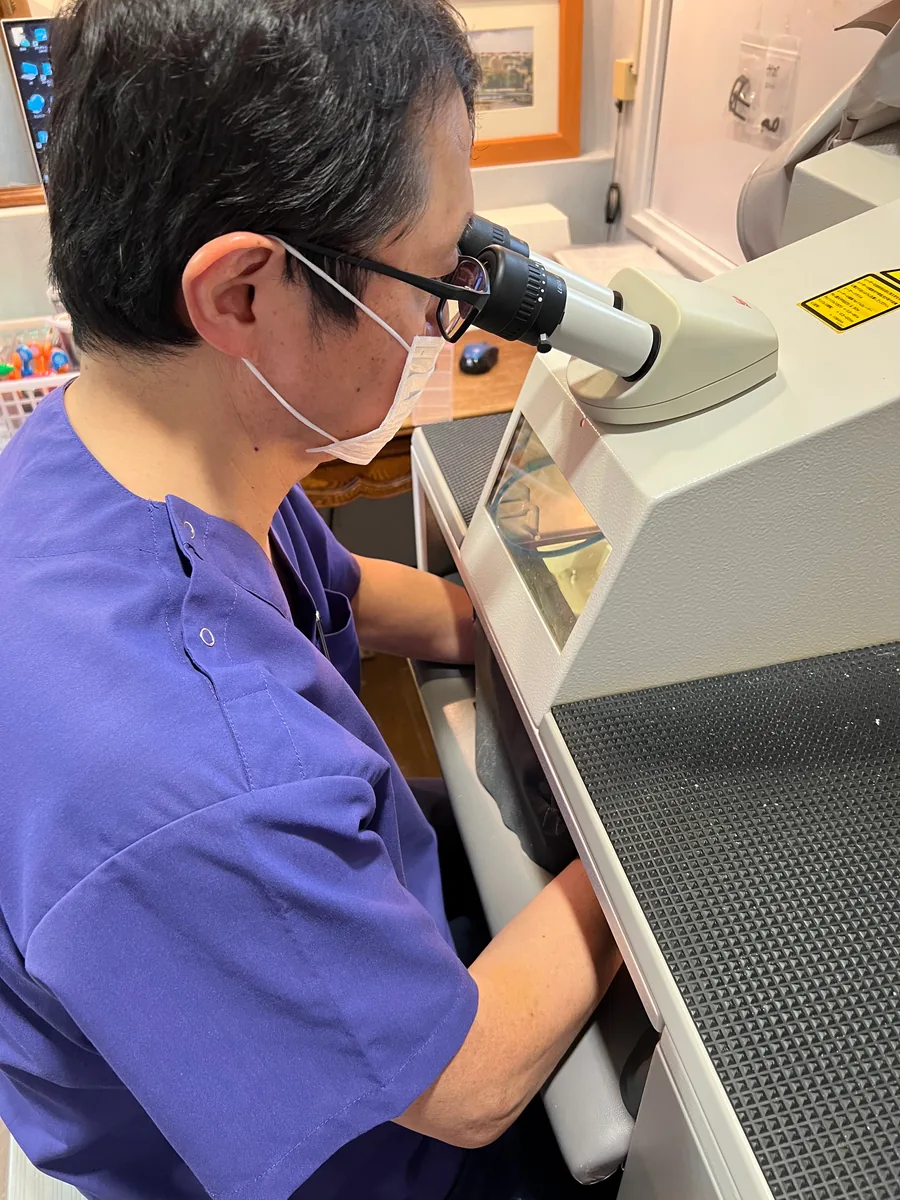
- Checking under magnification: the finished result is checked under a microscope.
As the photo shows, the welder has an eyepiece to look through while working.
Why we weld in argon gas
We weld in an environment filled with argon gas to limit the formation of an oxide film at the joint and to make it harder for foreign matter to get in.
In welding in general, the surrounding area is covered with gas so that the molten metal does not come into contact with oxygen and nitrogen in the air.
Argon is a gas that does not readily react chemically with molten metal (an inert gas), and it is one of the gases used for this purpose.
The base metal and the added metal
The original metal being joined is called the base metal.
At our clinic, we use high-purity platinum-gold alloy as the metal added when joining.
In a case where a framework cast in separate parts was joined, the same metal as the framework was used for joining.
The material itself is explained on the platinum-gold alloy page.
General characteristics
Laser welding in dentistry is generally said to have the following characteristics.
- Work can be done directly on the cast
- No solder (a different kind of metal used to join metals) is placed between the parts being joined
- Because the energy of the laser is concentrated on a small area, the surrounding area is less affected by heat
Why we use laser welding
Because we do not want oxide films or foreign matter in the joint
The director's view is that, when metals are joined, oxide films should not be allowed to form at the joint, and foreign matter should not be allowed to get in.
For this reason, we join metals with a high-power laser in an environment filled with argon gas.
To make separately made parts into one
Large metal frameworks are sometimes cast in several parts to correct for the errors that arise in casting (a method of converting a shape made in wax into metal).
It is laser welding that joins the separate parts into a single framework.
So that we can still work on it after it comes into use
The director's view is that a denture is not finished once it has been made, but is something to be used over a long period, with repeated fine adjustments.
Over the years, the condition of the mouth may change, for example when remaining teeth can no longer be saved.
We use laser welding so that, even then, repairs such as adding metal or adding artificial teeth can be carried out.
In practice at our clinic
In fabrication: joining parts cast separately into one
In one case, the metal framework of an upper prosthesis (which replaces lost teeth) was cast in three blocks.
In this case, the three were joined into one with a high-power laser in argon gas, using the same metal as the framework.
How casting works is explained on the casting page.
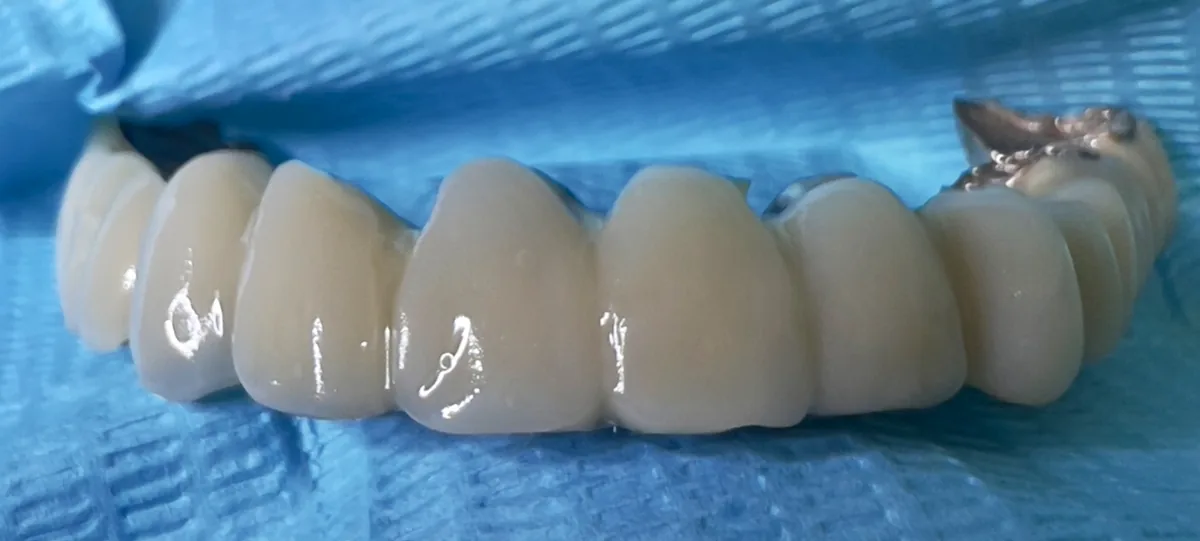
In repairs: adding metal and joining attachments
We carry out repairs in which platinum-gold alloy is added to the metal part of a denture that is already in use.
The surface where it was added looks rough.
We also carry out repairs in which a component that connects the denture to the supporting teeth (an attachment) is joined to the denture.
Photos: repairs
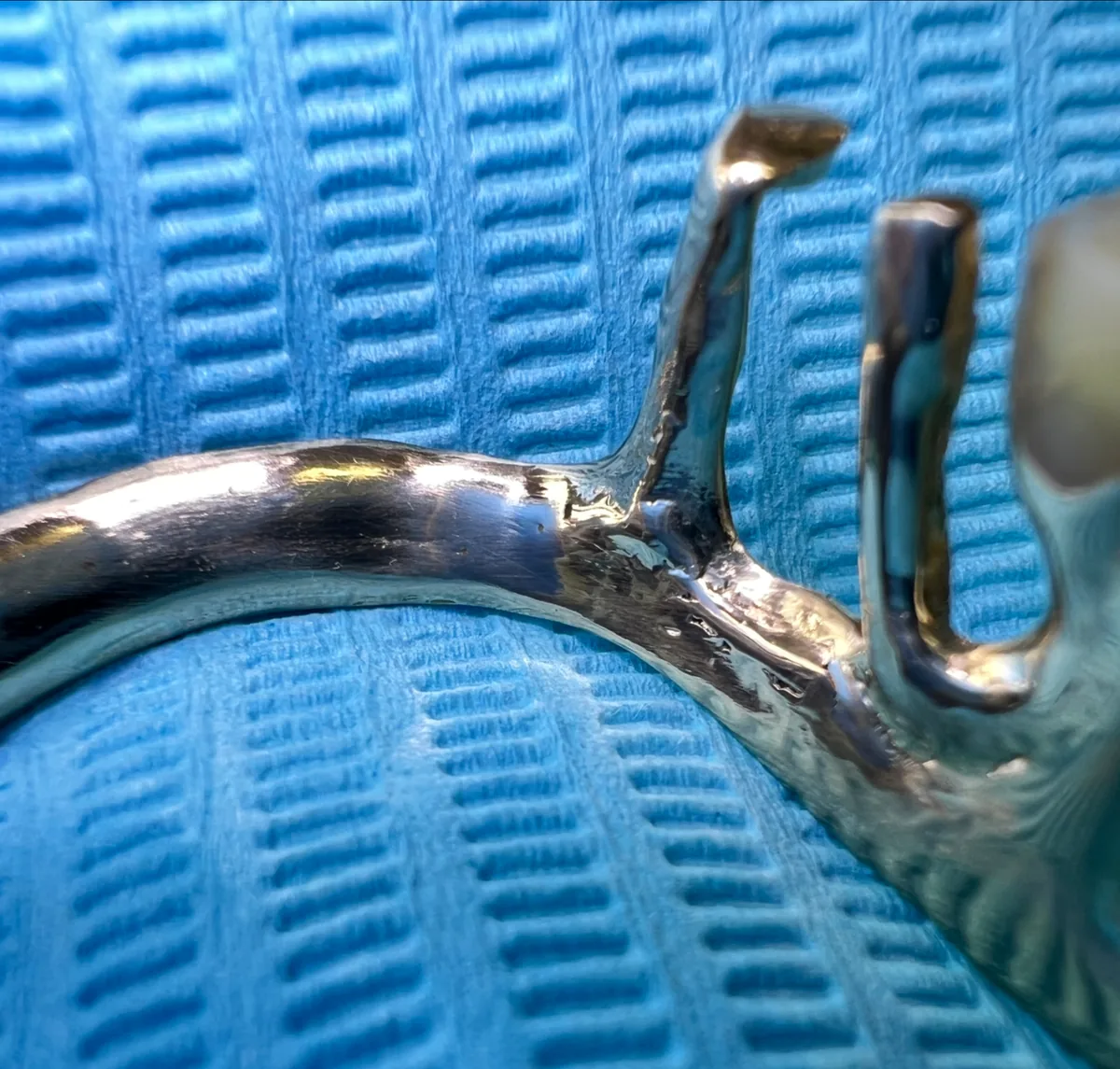
Adding artificial teeth later
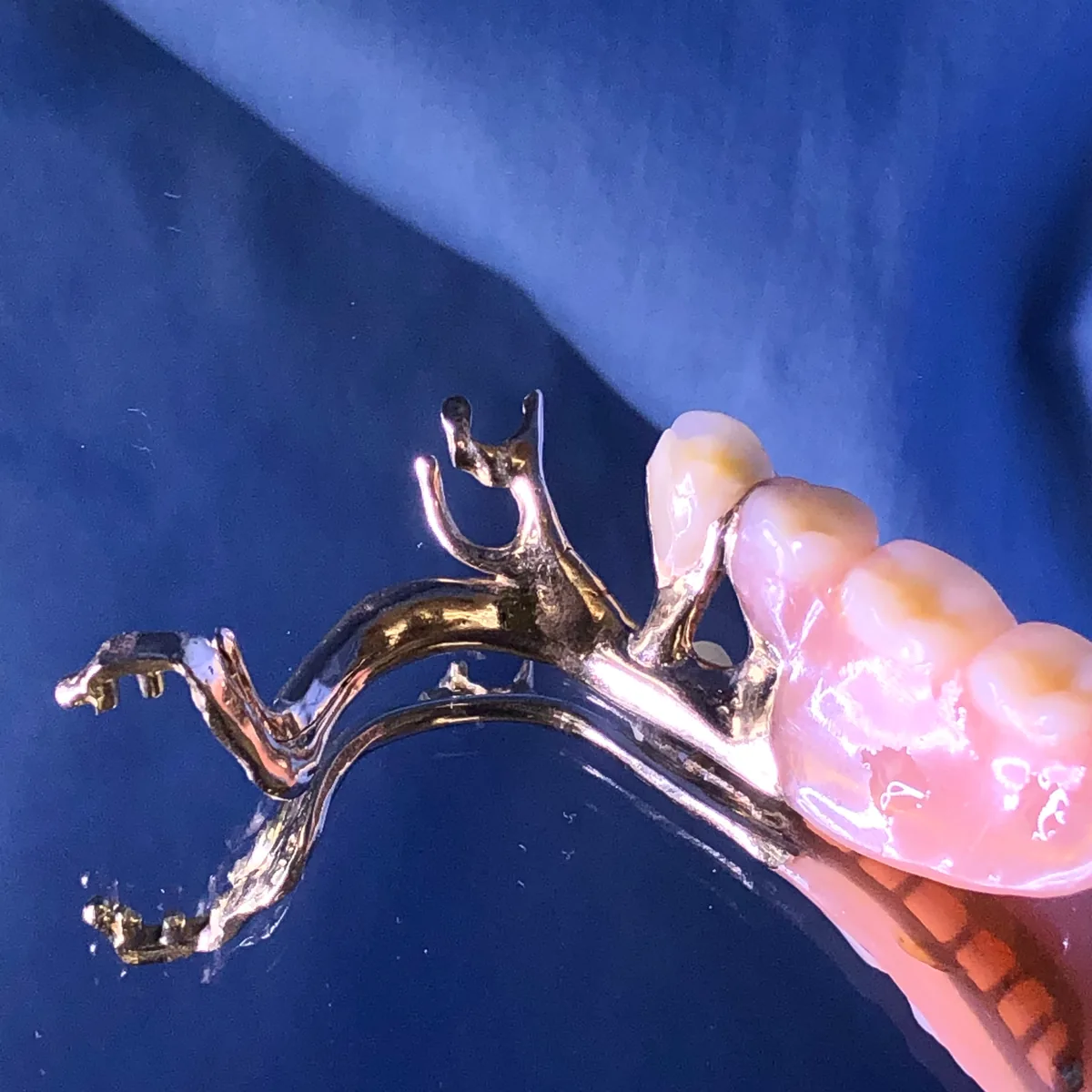
After a denture has been made, it may become impossible to save some of the remaining teeth.
In such cases, we consider a repair that adds artificial teeth to the denture.
At our clinic, we choose the material of the metal denture framework so that such repairs are also possible.
Making the denture easier to put in and take out
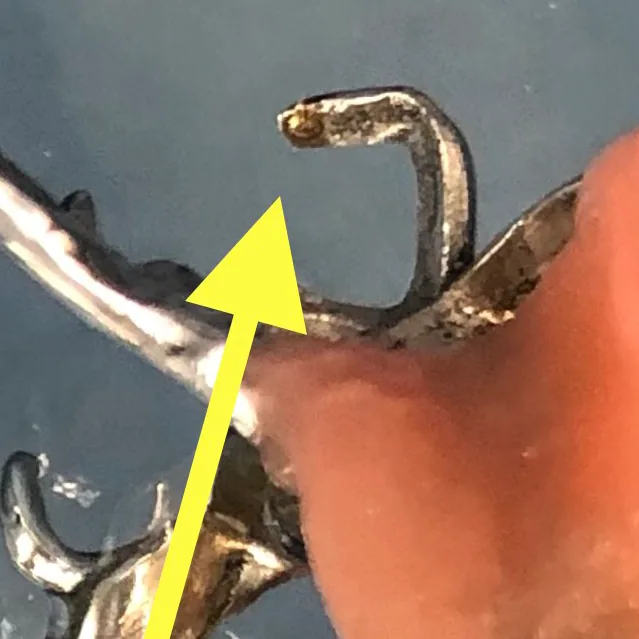
We sometimes weld platinum-gold alloy onto the tip of the part that holds the denture on the teeth (the retentive component) to make the denture easier to put in and take out.
The photo shows an example done on a provisional denture (at the tip of the yellow arrow).
Modifying the tips of instruments
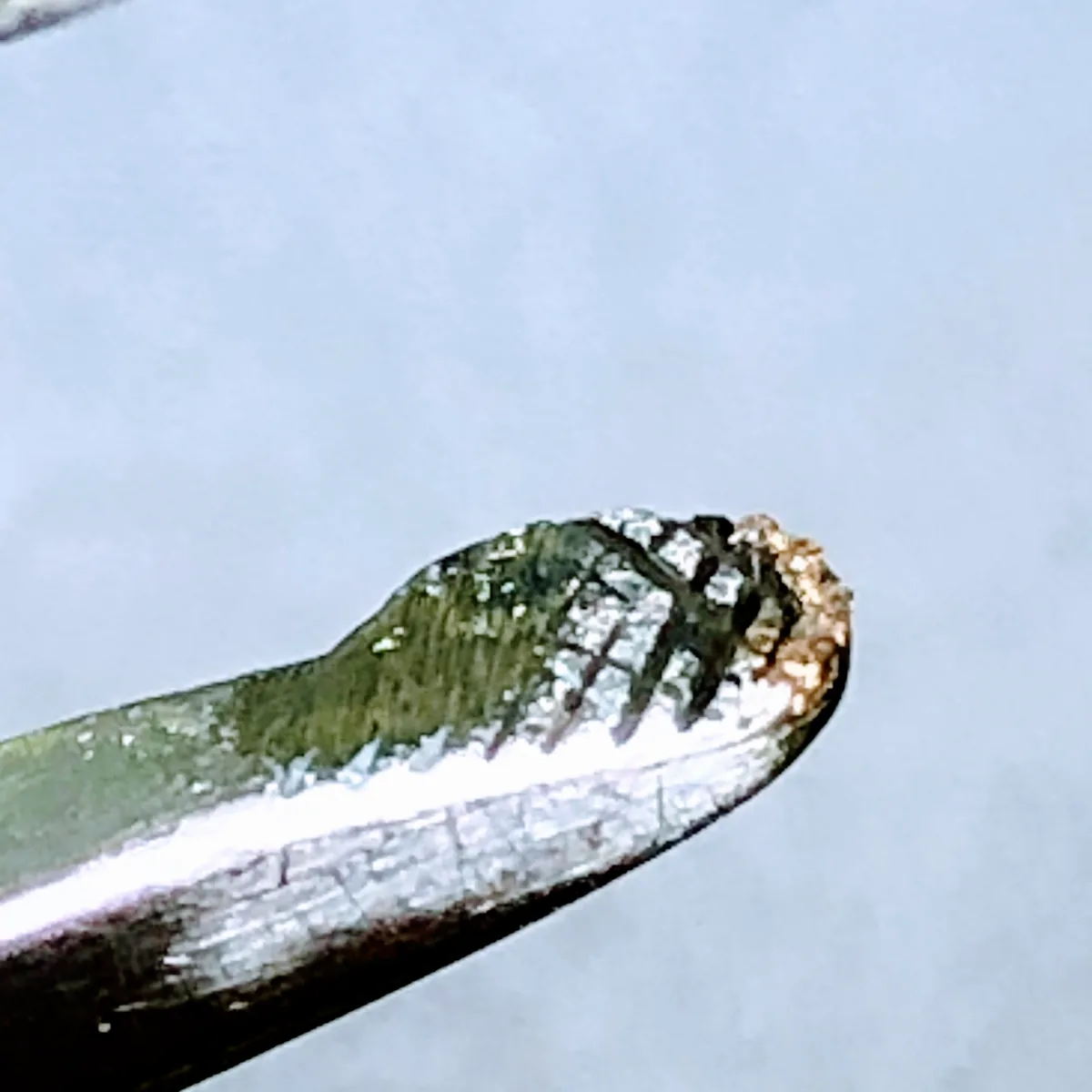
We also laser-weld platinum-gold alloy onto the tips of the pliers used in orthodontic treatment (instruments for gripping thin metal wire) to shape them.
This is explained in detail on the plier tip modification page.
Combining it with other technologies
- Casting: parts cast separately are joined into one by welding.
- Platinum-gold alloy: the metal added in welding. We choose it as a material that allows for repairs.
- Attachments: components that connect the denture to the supporting teeth are joined by welding.
- Stereo microscope for laboratory work: the finished result is checked under magnification.
What laser welding can and cannot do
What laser welding can do
- Joining metal parts cast separately into one
- Adding platinum-gold alloy to the metal part of a denture
- Joining attachments to a denture
- Repairs that add artificial teeth later (depending on the material and structure of the denture)
- Modifying the tips of retentive components and of instruments used in orthodontic treatment
What it cannot do, and how we compensate
| What it cannot do | How we compensate |
|---|---|
| Repairing every denture in the same way | We check the materials and structure used, and the condition of the denture and the mouth, and decide whether to repair or remake it |
| Eliminating the possibility of small voids or cracks forming at the joint (a point that is generally pointed out) | We work in argon gas and check the finished result under a microscope |
| Keeping a repaired denture from changing | We check progress and make adjustments as needed |
The main risks and side effects of dentures include discomfort until you get used to them, the need for adjustments, and remaking over time.
A repaired denture, too, may be affected by changes in general health and the oral environment, by deterioration over time, and so on.
Frequently asked questions
- If the metal part of a denture breaks, can it be repaired?
We carry out repairs such as joining metal parts or adding platinum-gold alloy in our in-house dental laboratory.
What kind of repair is possible is decided after checking the material and structure, and the condition of the denture and your mouth.
- Can teeth be added to a denture later?
When remaining teeth can no longer be saved, for example, we consider a repair that adds artificial teeth.
This is not possible with every denture; we check the denture, including its material and structure.
- Why do you weld in argon gas?
To limit the formation of an oxide film at the joint and to make it harder for foreign matter to get in.
- How do you check the finished weld?
We check the finished result under a microscope.
After a repair, too, we check the condition of the denture and your mouth and make adjustments as needed.
- Is it used for anything other than dentures?
We also use it to join the metal framework of an upper prosthesis and to modify the tips of the pliers used in orthodontic treatment.
Related technologies and treatments
- Plier tip modification: welding platinum-gold alloy onto the tips of orthodontic instruments
- Casting: converting the wax shape into metal
- Platinum-gold alloy: the metal added in welding
- Attachments: devices that connect the denture to the supporting teeth
- All the technologies we use
- Dentures (precision dentures)
- Temporomandibular disorders & orthodontic treatment that avoids extractions where possible
Treatment duration, number of visits, fees and risks → Fees
Sources we referred to
For the general explanations (how laser welding works, its characteristics and points to note, and why gas is used in welding), we referred to the following published sources. What we describe about our own methods is based on the director's explanations.
- Shimakura M, Takeuchi M. Change of hardness in fusion zone of dental metals in laser welding. Journal of Japanese Society for Laser Dentistry. 2010;21(3) (in Japanese)
- Welding Information Center (Japan Welding Engineering Society), "[Joining and welding technology Q&A: why is shielding gas necessary?]" (in Japanese)
Consultations and enquiries
Gibakai Medical Corporation
Yoshimi Dental Clinic
Square 2, Room 302 (third floor)
1-29-1 Tsukushino, Machida,
Tokyo 194-0001, Japan
TEL 042-795-1359 FAX 042-795-1398
Clinic days: Mon · Tue · Thu · Fri
10:00–13:00 / 14:30–18:00
A first visit begins with a first consultation (a private, non-insured service; 30 minutes to 1 hour) for examination and diagnosis. Questions about a diagnosis you received elsewhere are also covered within it.
In an emergency, such as being unable to chew or having severe symptoms, please call us on 042-795-1359 to discuss it.